From J. G. F. Riedel 30 June 1875
Gorantalo North of Selebes | (Celebes)
30th June 1875.
Sir!
I have fixed for a long time my attention on a peculiar fact, here daily to observed, a fact I suppose that would be of some interest to you.
The children of the primordial north selebesian tribes,1 are when coming, in the world rather of a white or blank colour (No 5 of M Broca’s types); but have on their back outward about the height of the plexus ischiadicus on both sides above the fessier, two round spots, as large as a dollar or larger of dark blue (noir bleuatre) colour (No 11 of M Broca’s types).2
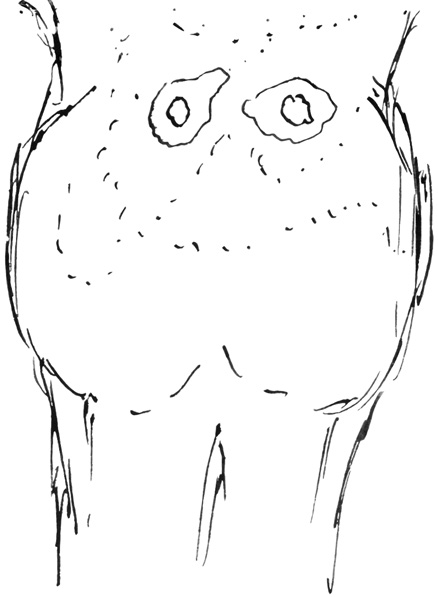
One or two years afterwards when the colour of the skin increased in darkness, the blue spots became larger & more irregular in circumference, a blue substance seems to flow under the epiderm & probably forms the pigment. Then the spots disappeared.— When the colour of the skin remained white or blank, the colour of many women, no change on the spots is to be observed.— I think these spots must have any casuality & be of some consequence. Is the subcutani formation of pigment depends from the more or less activity of the nerves in general & of the plexus ischiadicus in particular. Are these spots a hereditary portion, or a signification of diversity of races. Are these spots also observed amongst the mongoloide, the european children? etc.
I hope you will communicate me your opinion on this fact. If my description is incomplete I will give you, when desired more elucidations.
Do you think the circumcision according to the mohamedan rites have some more or less influence on the lenght of the praeputium.3 I think so. In our country the mohamedan boys goes always naked till their 6 or 10th year & I have observed many of them—not all—with a very short prepuce.—
I remain | Your most obedt Servant | Riedel
J. G. F. Riedel | Assistant Resident | Gorantalo | North-Celebes | Netherlands—India.
CD annotations
Please cite as “DCP-LETT-10036,” in Ɛpsilon: The Charles Darwin Collection accessed on