From Francis Galton 19 December 1875
42 Rutland Gate
Dec 19/75
My dear Darwin
The explanation of what you propose, does not seem to me in any way different on my theory, to what it wd. be on any theory of organic units.1 It would be this:—
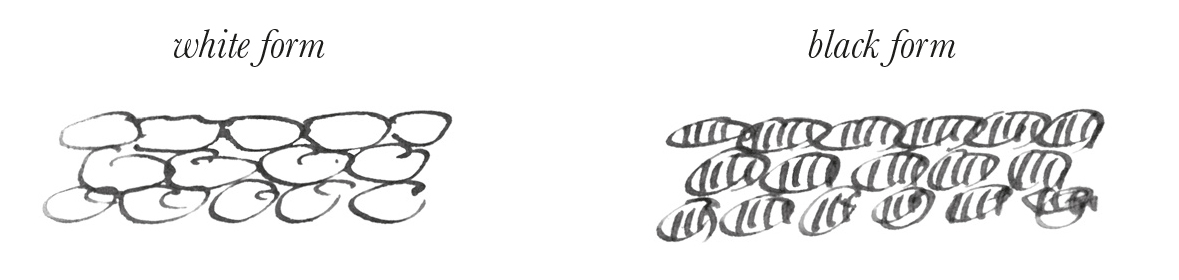
Let us deal with a single quality, for clearness of explanation, & suppose that in some particular plant or animal & in some particular structure, the hybrid between white & black forms was exactly intermediate, viz gray,—thenceforward for ever. Then a bit of the tinted structure under the microscope would have a form which might be drawn as in a diagram, as follows:—
Whereas in the hybrid, it would be either that some cells were white and others black, & nearly the same proportion of each, thus:—
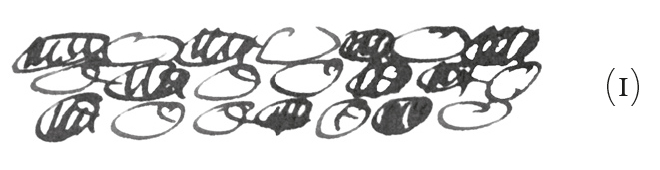 giving on the whole when less highly magnified, a uniform gray tint,—or else this:—
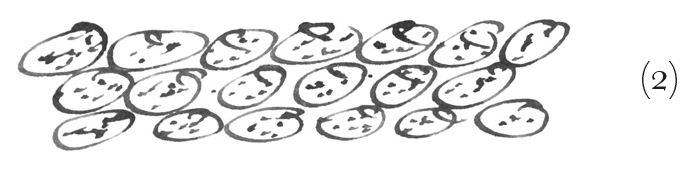 in which each cell had a uniform gray tint.
In (1) we see that each cell has been an organic unit (quoad2 colour) In other words, the structural unit is identical with the organic unit
In (2), the structural unit would not be an organic unit but it would be an organic molecule. It would have been due to the development, not of one gemmule but of a group of gemmules,3 in which the black & white species would, on statistical grounds, be equally numerous (as by the hypothesis, they were equipotent.)
The larger the number of gemmules in each organic molecule, the more uniform will the tint of grayish be in the different units of structure. It has been an old idea of mine, not yet discarded & not yet worked out, that the number of units in each molecule may admit of being discovered by noting the relative number of cases of each grade of deviation from the mean grayness. If there were 2 gemmules only, each of which might be either white or black, then in a large number of cases one quarter would always be quite white, one quarter quite black, & one half would be gray. If there were 3 molecules, we should have 4 grades of colour (1 quite white, 3 light gray, 3 dark gray, 1 quite black) & so on according to the successive lines of “Pascal’s triangle”.4 This way of looking at the matter would perhaps shew (a) whether the number in each given species of molecule was constant & (b), if so, what those numbers were.
Ever very faithfully yrs | Francis Galton
Please cite as “DCP-LETT-10309,” in Ɛpsilon: The Charles Darwin Collection accessed on