From Francis Darwin   [1 June 1876]1

Down, | Beckenham, Kent. | Railway Station | Orpington. S.E.R.

My dear Father

I have examined sections of Teazle in putrid meat infusion & in ammonia; and in both saw splendid protoplasmic movements, in about 8 glands altogether.2 The moving mass is always seated at the top of the gland, & when one can see accurately, exactly in the centre, where the radiating cells meet. I saw one most marvellous mass
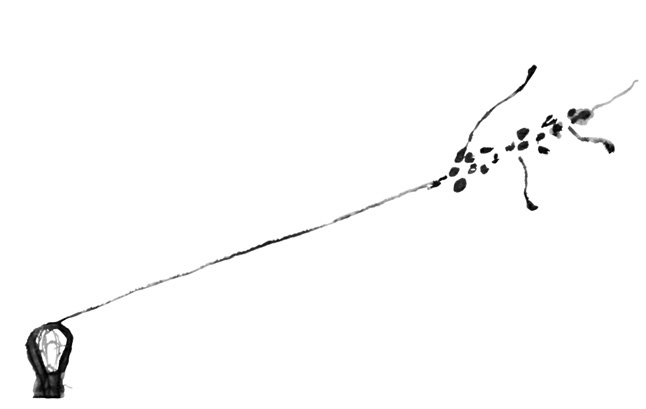
diagram

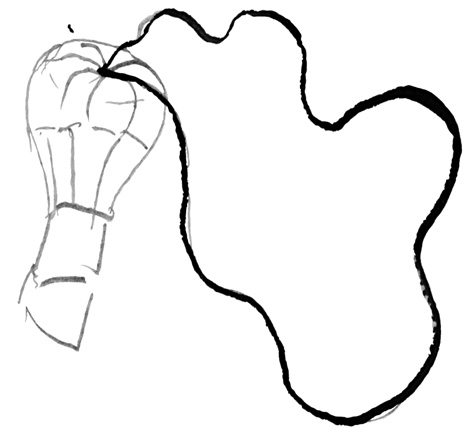
In another what looked like a great sheet, coming exactly from the centre.
diagram

But it may have been only a rope both ends beginning at the centre   There can be no doubt I hope now— it is most extraordinary & worth any amount of work   My strong lens is ordered by Balfour3 I hear— He says the physiolog dinner “was a great success”.4 I hope you are getting rested.

My best love to old mother | Yrs affec | FD

The date is established by the relationship between this letter and the letter to Francis Darwin, [2 June 1876].
Francis had discovered protoplasmic filaments protruding from the glandular hairs of the common or fuller’s teasel (Dipsacus sylvestris, now D. fullonum; see letter from Francis Darwin, [28 May 1876]). In his letter of 30 [May 1876], CD had suggested using a weak solution of carbonate of ammonia or a weak infusion of raw meat to bring out the filaments. Francis thought that the filaments might enable the plant to absorb nitrogenous matter dissolved in the water in the cups formed by some of the leaves (see F. Darwin 1877b).
The inaugural meeting of the Physiological Society was held at the Criterion Restaurant, Regent (now Piccadilly) Circus, London, on 26 May 1876 (Sharpey-Schafer 1927, p. 15). See also letter from Francis Darwin, 27 May 1876.

Please cite as “DCP-LETT-10515H,” in Ɛpsilon: The Charles Darwin Collection accessed on 5 June 2025, https://epsilon.ac.uk/view/dcp-data/letters/DCP-LETT-10515H