From W. T. Thiselton-Dyer [before 17 January 1877]1
message as I received it.
A few things occurred to me in reading the Introduction.2 No doubt they have all occurred to you and I merely offer them on the remote chance of their proving useful. The nos: refer to the paragraphs
II. The difference between ♀ & ♂ in some plants is really surprising. In Restiaceæ which are locally abundant in individuals, species, & genera in Australia and at the Cape of Good Hope the sexual differentiation has so far affected the whole plant that Dr Masters and Mr Bentham who have recently studied them—the former as regards Africa the latter as regards Australia—consider it practically impossible to match one ♂ & ♀ of at any rate many species amongst Herbarium specimens3
There is something curious about the “domestic economy” of Petasites vulgaris. I see you have Sir J. Smith’s English Flora and you will find the account of it in vol. iii pp. 426, 427. The species is if one may so put it both monœcious and diœcious. The two Linnean species Tussilago Petasites & Tussilago hybrida are regarded now as the predominantly male and female forms respectively4
By the way you have two Thirdly’s5
iv. There are many hermaphrodite plants which frequently suppress their petals. Ranunculus auricomus is one. This species is often sterile which I find Masters Journ. of Bot. 1867 p. 159, attributes to a tendency found in other Ranunculaceæ to become diœcious.6
vii. It hardly comes within your plan probably to mention the numerous cases in which flowers hang out ‘flags of distress’ without apparently paying any very heavy price for it.— In many Cruciferæ the external flowers of the corymbs are developed in a way comparable with that in Compositæ and Umbelliferæ. In Iberis there are certainly the proper proportion of stamens in the enlarged flowers though it is possible they may not be up to much.7
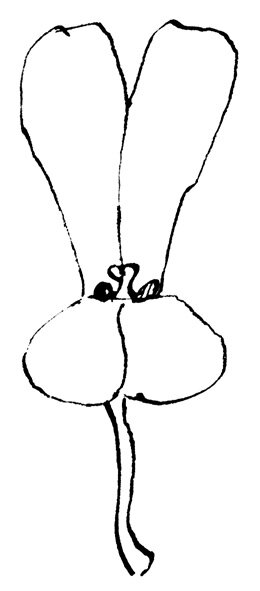
But the most singular arrangement I know is in Mussænda a genus of Rubiaceæ where one tooth of the calyx in a few flowers of an inflorescence is developed into a large leafy expansion8 Something (I am drawing from memory like this) I am not prepared to say without disturbing herbarium specimens what effect this may have had on the sexual organs
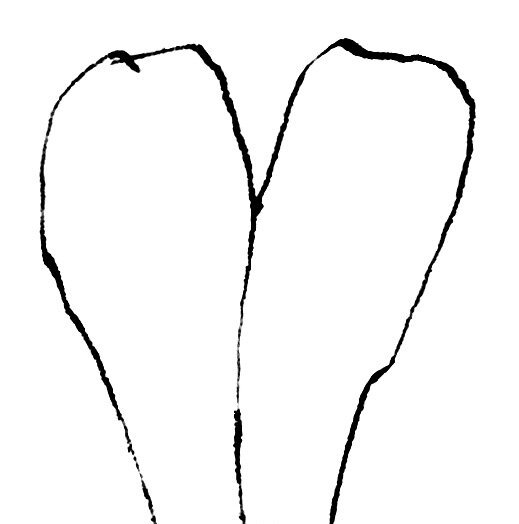
As you mention the singular arrangement in Muscari one calls also to mind cases like Salvia Horminum where the upper bracts are enlarged and brightly coloured and the flower suppressed. The same arrangement obtains also in Lavandula and other Labiates9
Believe me | Yours very truly | W. T. Thiselton Dyer
CD annotations
Please cite as “DCP-LETT-10757,” in Ɛpsilon: The Charles Darwin Collection accessed on