From C. E. Bessey 28 June 1877
Iowa Agricultural College. | Ames,
June 28th 1877
My dear Mr. Darwin.
Dr Gray forwarded to me your letter to him of date of June 4th—in which you so pleasantly refer to my notes on Lithospermum longiflorum, and promise me a copy of your new book.1
I shall be delighted to receive it, and shall be glad to follow up its hints.
I have been watching our little Oxalis violacea for some time and have partially put into shape my last year’s observations, in a paper read before the Iowa Academy of Sciences at its May meeting in 1877.2 You are, no doubt, familiar with the heterostylism so common in this genus.3 I carefully measured the lengths of Calyx, Corolla, pistils and the two rows of Stamens, and found a wonderful correspondence
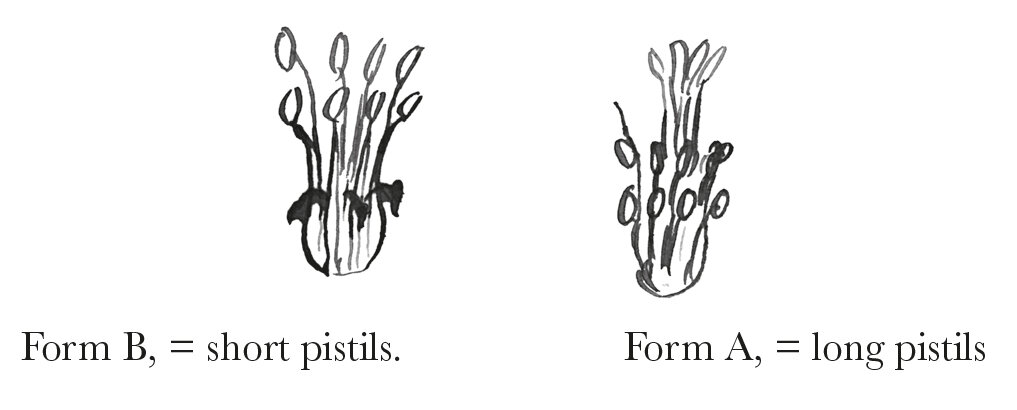
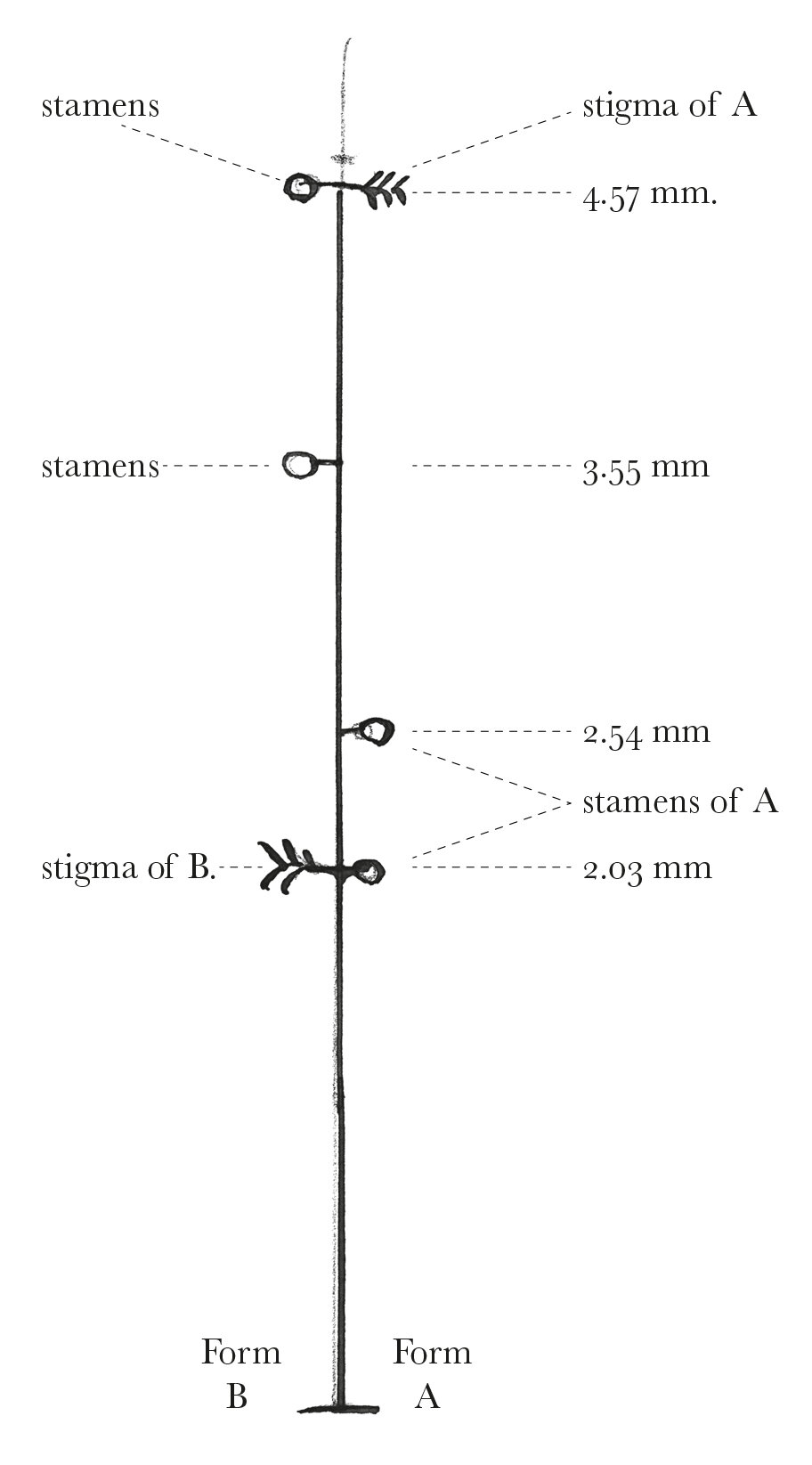
This diagram will show the relation of the parts in each form, and also their relation to each other. In my paper I say “The tendency must be towards dioe-ciousness, for, the long pistils of A and the long stamens of B are the ones (according to my view) which perpetuate their kind to the greatest extent.”
I further say that these and other observations “incline me to believe that this kind, of dimorphism is to be looked upon as but the early stage of a change which eventually will result in the complete separation of the sexes; that is, in complete dioe-ciousness.”
I will communicate to Dr. Gray (as I have promised to do) the results of further observations on this plant and Lithospermum, and he will no doubt show them to you if they appear worth your notice.4
Again thanking you for your pleasant words | I am | Very truly | Your obt servant | C. E. Bessey.
Please cite as “DCP-LETT-11021,” in Ɛpsilon: The Charles Darwin Collection accessed on