From W. G. Smith 27 July 1877
15, Mildmay Grove, N.
27 July 1877
My dear Sir
It was very kind of you to request your publisher to forward me a copy of your “Forms of Flowers” & I return you my best thanks for the book—1 It of course has an additional value in my eyes as coming from you for I have long been a careful & admiring student of your excellent works.—
During intervals of other work I have carefully looked over the Sea-Kale & Iris leaves— My son has also carefully looked over them & the conclusion arrived at is, that the decayed spots are not due to fungus-work2
Various fungi are common on the Cruciferæ but no fungus known to me leaves a scar in any way resembling the scars on your leaves— Some of these scars (where the epidermis has not yet decayed away) are thus in section
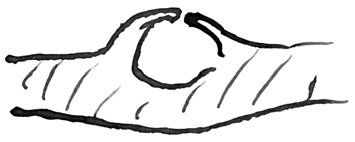
& I take the small orifice to be the hole from which some very small larva has emerged— Various eggs & other traces of small beetles, flies &c (?) were on the leaf— The fine mildew on some of the spots is an after-growth. I do not think the raised & brown border round the depressions tells against insect work for as far as my experience goes, this thickening is not uncommon after the bites & punctures of insects & the gnawings of larvæ— As a case in point I have just engraved a Cattleya leaf for G. Chron. punctured all over by some fly (to be described by Westwood) & every puncture is surrounded by a thickening of the cells thus in section.—3
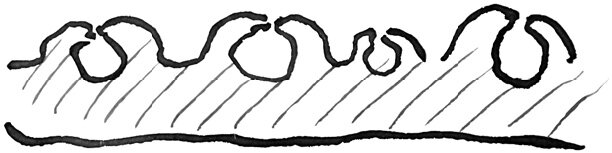
Above remarks also apply to Iris:— I can see neither spores or threads & nothing that at first sight reminds me of a fungus—or fungus-work I am inclined to consider the elongated spots to be due to the gnawings of some larvā & the smaller stains as caused by the puncture of some insect
The bloom on the 2 plants sent me appears to protect the leaves against the attacks of larvæ (& probably mites ⟨ ⟩)
Some botanists have thrown out a suggestion to the effect that hairs may possibly protect some plants from the attacks of fungus-spores, but I do not think hairy plants are so protected—there is such a great difference in size between hairs & spores or even fungus-threads—
Yours faithfully | W. G. Smith
Chas Darwin Esq | F.R.S.
Please cite as “DCP-LETT-11075,” in Ɛpsilon: The Charles Darwin Collection accessed on