From S. B. J. Skertchly 4 March 1878
Brandon | Suff.
Mar. 4. 1878.
My dear Sir.
I cannot readily express how grateful I am for your kindly expressions of interest in my work.1 Nothing could have encouraged and stimulated me more than your letter has done, and I shall treasure it as a sheet-anchor of comfort, when, as will happen now and then, I feel downhearted at harsh unsympathetic criticism.
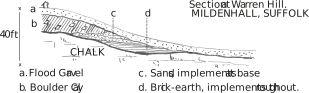
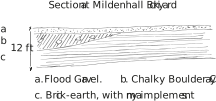
The Survey will publish the account of my researches into the age and divisions of the “palæolithic period”,2 and I now feel certain that all will come right, and that speedily, for I have been showing some fresh sections to a hostile colleague, who has completely given in, saying “The dullest beginner could not fail to be convinced”. The sections are as under:—
I am very sorry to hear you are in such feeble health, but trust ere this you are quite well again.
If quite convenient to you I should like “The Origin of Species”, because it initiated me not only into evolution, but into true methods of scientific thought.3
It may perhaps interest you to know that I have had many opportunities of examining the coral reefs of the African shore of the Red Sea, and found the conclusions you had expressed fully borne out by an examination of the entire coast from Suez to south of Bab-el-mandeb.4
Please do not trouble to answer this letter. I fear I have already given you too much worry, but am sure you will forgive me knowing how highly I value the slightest token of your approbation.
With all good wishes for your speedy restoration to health, | Believe me, My dear Sir | Yours ever faithfully | Sydney B. J. Skertchly.
Charles Darwin, Esqr. F.R.S.
Please cite as “DCP-LETT-11395,” in Ɛpsilon: The Charles Darwin Collection accessed on