From A. F. Gray 8 May [1878]1
Dear Sir,—
The following case will, I think, prove of interest to you, as it corroborates your belief that freshwater shells are sometimes transplanted by the agency of aquatic birds.2
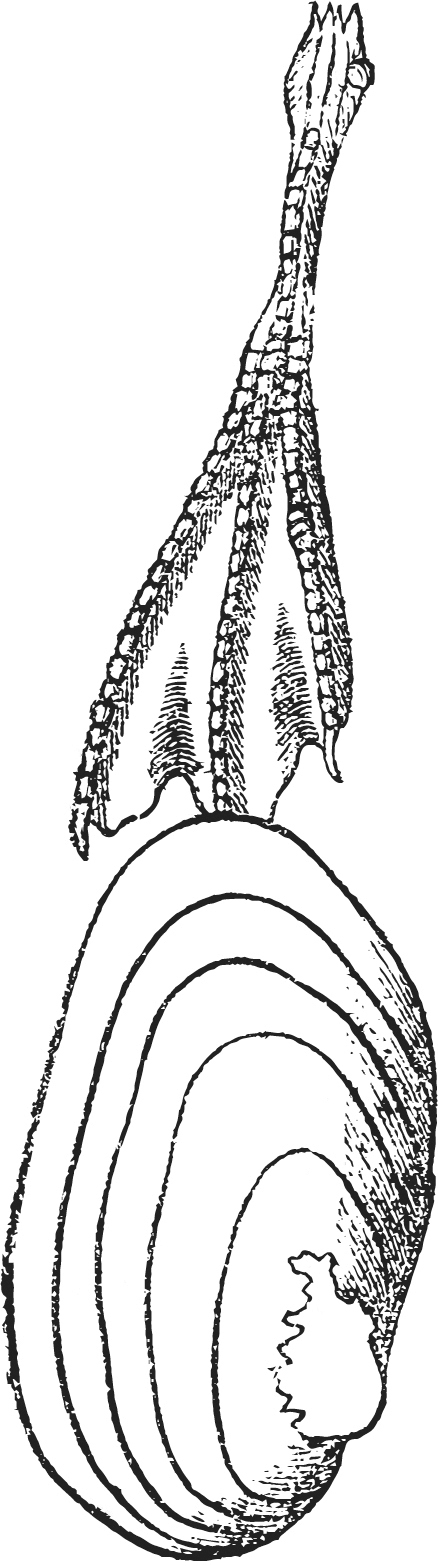
In the sketch I have endeavoured to give you a correct idea of the way in which the shell was attached to the duck’s foot.3
It was given to me by Mr. H. L. Newcomb, who shot the bird, which was a blue-winged teal (Querquedula discors), while flying, near the Artichoke river at West Newbury, Mass., September 6, 1877.4 The shell, the common mussel, or clam (Unio complanatus), is a very abundant species, being found in nearly all the rivers and ponds of the Atlantic slope.5 How long the shell had been attached is only a matter of conjecture, but it had abraded the skin of the bird’s toe, and left quite an impression. It was living when the bird was shot.
It would have undoubtedly been transplanted to some pond or river, perhaps miles from its original home, had the bird not been shot, and might then have propagated its kind.
Arthur H. Gray6
Danversport, Mass., May 8 | To C. Darwin, Esq.
Please cite as “DCP-LETT-11497,” in Ɛpsilon: The Charles Darwin Collection accessed on