To Francis Darwin 13 [September 1878]1
Down, | Beckenham, Kent. | Railway Station | Orpington. S.E.R.
13th
My dear F.
Glass Tubes come & I think will do very well.—2
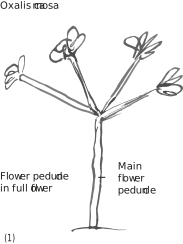
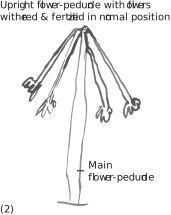
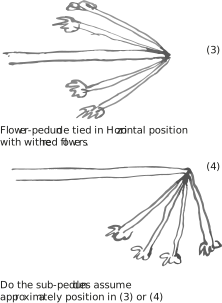
Will you ask at Kew to look at soon any plants of Oxalis carnosa, for chance of old flower-peduncles being still on. With upright main flower-peduncle (see fig. 2. in diagram), the sub-peduncles bearing young pods assume the position there shown,. (Afterwards they bend up to scatter seed).— Now if main flower peduncle were placed horizontally would sub-peduncles assume position of (3) or (4)? Perhaps there may be a naturally somewhat inclined old flower-peduncle, which would partially answer this question, which is important for me, as it would show whether movement of sub-peduncle is governed by geotropism or epinasty.— I stupidly did not ascertain this, though I made many tracings of movements of sub-peduncles.3
Also keep your eyes open for any plant not a climber in pot with tip of shoot bowed downwards or hooked, or even forming a rectangle.— I am much perplexed about this, & when you come back, I must get you to read up De Vries on Epinasty. With Smithia Pfundii, which always has end of shoot forming a rectangle, this position seems governed by geotropism, (& not as I had supposed by epinasty) & so I believe it is with Ampelopsis.— Some growing lilies, if my memory is right, grow with tips hooked.— I know Epipactis does so.— I want much to trace an Epinastic or Hyponastic movement—4
If you could find any one or two such plants at Kew, I could probably borrow them.
Have you any Tracing paper up stairs????— I am running rather short— I am working at Heliotropism, with subdued light, & at ApoGeotropism.5
Yours affect | C. Darwin
Manuscript Alterations and Comments
Please cite as “DCP-LETT-11692,” in Ɛpsilon: The Charles Darwin Collection accessed on