To Charles Lyell [3 January 1850]
Down Farnborough Kent
Thursday Evening
My dear Lyell
I have strongly recommended a map of Santorin & suggested, also, a map of Palma, which I think very desirable, though not, of course, necessary.— Your paper has interested me very much; justice was not done it in abbreviating any part of it in its reading at the Socy.—1 It will be a thorn in the side of E. de Bt.—2 At p. 20 do you not make a mistake? you say channel is as deep, within a “few inches”, diag as the crater: now by your own showing there is 213 or 18 fathoms or 108 ft. difference.—
195
—
18ramme
It may not be worth altering, but I think you overlook the cream of my case of tuff-strata at Galapagos, viz that the beds form narrow streams, hollow within from the setting of the outside crust, & therefore no one cd here suppose that we had once horizontal strata uplifted: inclination was measured from 25 o to 30o.—:3 You might explain this in bracket after words strata of tuff (known to have flowed as streams &c &).—4
I must trouble you with one other suggestion which from the discussion & from what I heard people say, appears to me very desirable, viz that at some such place as head of p. 3, you shd state in one or two sentences what is subject of dispute—viz whether the crateriform hollows have been produced by elevation, on the one hand or on the other by engulfment explosion, or other means—& not whether the surrounding strata have been a little more or less elevated.— And as a consequence of this difference of origin, whether the mountain was formed, like an ordinary volcano, or whether lava-streams were first poured out on a level or concave surface—or something to above effect.—5 Do think of this Suggestion.—
Your’s most sincerely | C. Darwin.
I cannot doubt that St. Jago, Mauritius & St. Helena are Craters of Denudation; but I can hardly stomach (though I do not doubt much denudation) Palma, without seeing my way how the Sea is to deepen the head of a long narrow Bay.—
P.S. I have opened my letter (& in doing so made a horrid mess) to say that I quite agree that this Diagram with
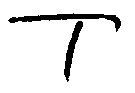 is unimportant,6 description being so clear.—
Forbes is going to read Edinburgh Royal Soc. some great Paper7 on Italian volcanos & very oddly the E.R.S. have referred it to me.—
Manuscript Alterations and Comments
Please cite as “DCP-LETT-1287,” in Ɛpsilon: The Charles Darwin Collection accessed on