From W. P. Marshall 26 December 1881
15, Augustus Road, | Birmingham.
26 Dec. 81.
Dear Sir,
In a dredging expedition last summer off Oban, by the Birmingham Natural History Society, we obtained several specimens of Virgularia mirabilis (with Funicularia and Pennatula);—and have been greatly interested with the account that you have given in the “Beagle” Voyage (1860 page 99) of the specimens of a Virgularia at Bahia Blanca found growing in muddy sand, and drawing themselves down into the mud when touched, leaving a few inches length projecting above the surface.1
Our Oban specimens,—which were all dredged in about 22 fathom water,—are 6 to 10 ins. length, and are all broken at both ends, most of them at the lower end being broken just below the termination of the polypi-bearing body. Their fracture at the lower end was accounted for by the steel cutting-edge of the dredge mouth;—but the fracture of the upper ends of such slender elastic stems appeared very unaccountable, until the above habit was known of drawing down into the ground, when the short exposed upper portion would become the part liable to be broken off.
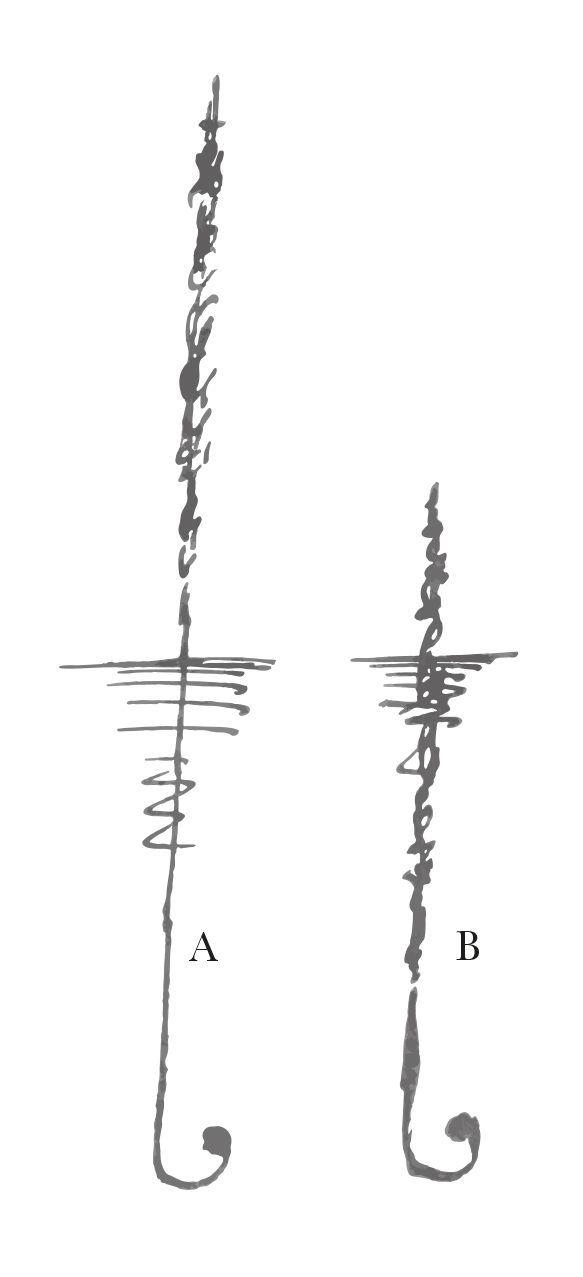
We shall be greatly obliged if you can kindly favour us with any further information upon this very interesting point;—and particularly as to what is definitely known of the form that the buried stalk assumes in its natural state, and how far the solid stem extends down the stalk below the ordinary surface level of the ground;—and whether the buried stalk may be considered to be possibly straight for the greater portion of its length whilst in the ground, and only appearing curved after being pulled out of its hole in the ground,—so that the process of drawing down into the ground (from A to B) might be effected by a simple vertical contraction of the straight fleshy stalk.
Also where a description can be seen of the Virgularia Patagonica that is referred to in the above, and what is its difference from V. mirabilis.
The figure of V. mirabilis in Dalyell’s “Rare & Remarkable Animals of Scotland”, (1848, Vol. 2) shows the lower portion straight for most of its length, and curved only at the extremity, as in the sketch A.2
I am Dear Sir | Yours very truly | William P. Marshall | Past President | Birmn. Nat. Hist. Society
Charles Darwin Esqre. | LLD., FRS.
Please cite as “DCP-LETT-13580,” in Ɛpsilon: The Charles Darwin Collection accessed on