From J. E. Gray [1846–54]1
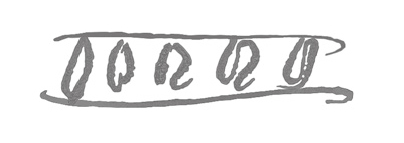
CD note:
I looked at series of Arcadæ, & a good series from teeth at umbo with ligament to mere row of crenations—4
But this case not good to quote.
The date range is conjectured from the possibility that CD was interested in the topic of umbonal teeth while working on barnacles (Cirripedia). CD began working on the comparative anatomy of barnacles in 1846 and on their systematics in 1848 (see Correspondence vol. 4, letter to J. E. Gray, 18 December 1847). The works on living and fossil Cirripedia were published between 1851 and 1854 (see Living Cirripedia (1851), Fossil Cirripedia (1851), Living Cirripedia (1854), and Fossil Cirripedia (1854)).
The configuration of umbonal teeth described by Gray is characteristic of the most primitive type of bivalve hinge, made up of many small similarly-shaped teeth; this configuration is described as a taxodont hinge. It keeps the valves aligned, but restricts the degree to which they can open. The umbo or beak is the raised portion of the dorsal margin of a bivalve shell.
Arcadae (a synonym of Arcidae, the family of ark clams) and Nuculidae (the family of nut clams) are characterised by taxodont hinges (see n. 2, above).
CD may have been interested in comparing the umbonal teeth of bivalves with the same feature in some barnacles that possess umbonal teeth on some of their valves. CD mentioned umbonal teeth as a diagnostic feature in stalked barnacles in, for example, Living Cirripedia (1851), p. 73.
Please cite as “DCP-LETT-13814,” in Ɛpsilon: The Charles Darwin Collection accessed on