To Charles Lyell 14 January [1855]
Down Farnborough Kent
Jan. 14th
My dear Lyell
We were yesterday & day before house-hunting, so I could not answer your letter. (I hope we have succeeded in a House, after infinite trouble, but am not sure, in York Place, Baker St).—
I do not doubt that I either read or heard from Sharpe about Grampians, otherwise from my own old suspicion, I feel sure I shd. not have inserted the passage in the Manual.1
The laminated rocks at Asension are described at p. 54…….—2
As far as my experience has gone I shd. speak only of clay-slate being associated with mica-slate, for when near the metamorphic schists, I have found stratification so gone, that I shd. not dare to speak of them as over lying them. With respect to the difficulty of beds of quartz & marble; this has for years startled me, & I have longed, (since I have felt its force) to have some opportunity of testing this point; for without you are sure that the beds of quartz dip, as well as strike, parallel to the foliation, the case is only just like true strata of sandstone, included in clay-slate & striking parallel to the cleavage of the clay-slate, but of course with different dip,—(excepting in those rare cases when cleavage & stratification are parallel). Having this difficulty before my eyes, I was much struck with Maccullocks statement (p. 166 of my S. America) about marble in the metamorphic series not forming true strata.3
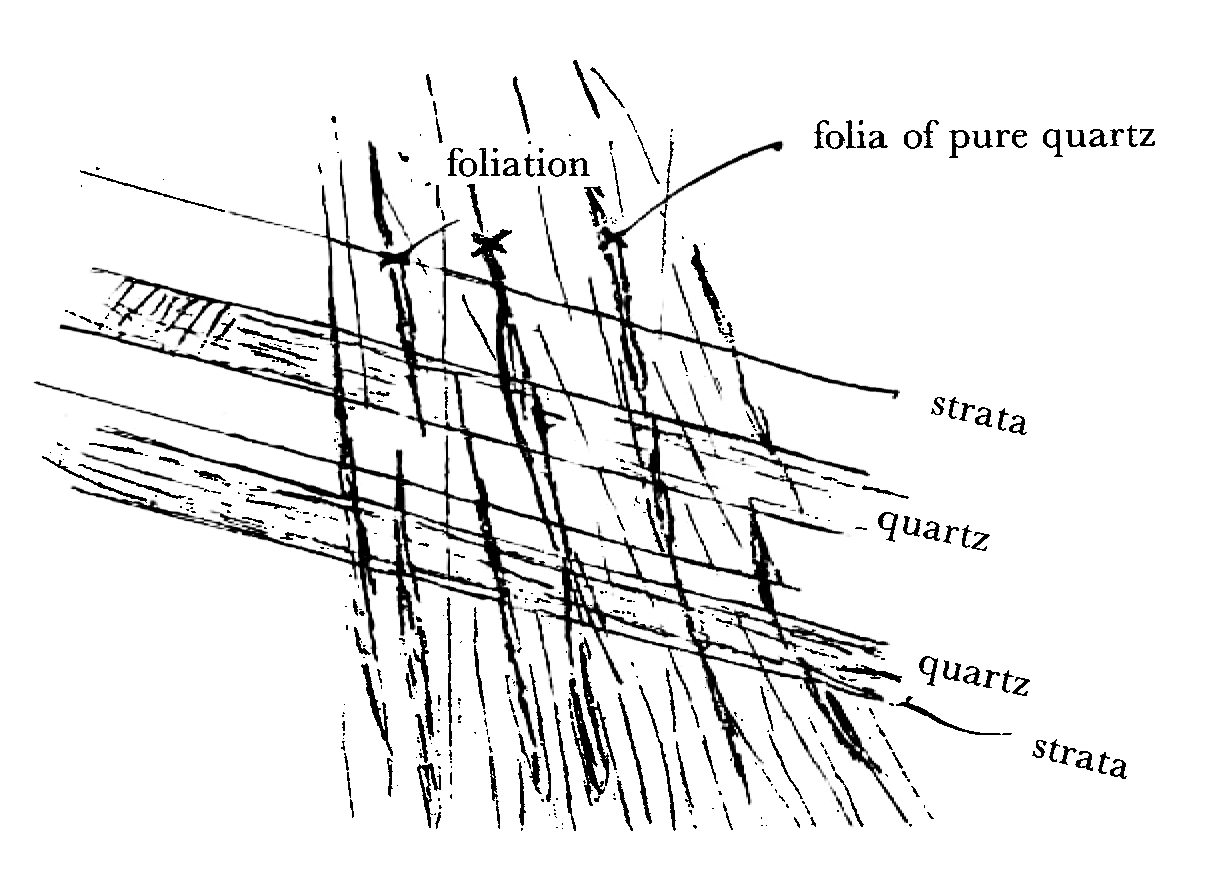
Your expectation of the metamorphic schists sending veins into neighbouring rocks is quite new to me; but I much doubt whether you have any right to assume fluidity from almost any amount of molecular change; I have seen in fine volcanic sandstone, clear evidence of all the calcareous matter travelling at least 4 feet in distance to concretions on either hand (p. 113 of S. America). I have not examined carefully (from not soon enough seeing all the difficulties) but I believe from what I have seen, that the folia in the metamorphic schists (I do not here refer to the so-called beds) are not of great length, but thin out, & are succeeded by others; & the notion that I have of the molecular movements is shown in the indistinct sketch herewith sent; the quartz of the strata might here move into the position of the folia, without much more movement of molecules than in the formation of concretions: I further suspect in such cases as this, where there is a great original abundance of quartz, that great branching, contemporaneous veins of segregation (as sometimes called) of quartz would be formed; I can only thus understand the relation which exists between the distorted foliation (not appearing due to injection) and the presence of such great veins.—
I believe some gneiss, as the gneiss-granite of Humboldt,4 has been as fluid as granite; but I do not, of course, believe that this is usually the case, from the frequent alternation of glossy clay & chlorite slates, which we cannot suppose to have been melted.
I am far from wishing to doubt that true sedimentary strata have been converted into metamorphic schists; all I can say is that in the 3 or 4 great regions, where I could ascertain the relations of the metamorphic schists to the neighbouring cleaved rocks, it was impossible (as it appeared to me) to admit that the foliation was due to aqueous deposition.— Now that you intend agitating the subject, it will soon be cleared up.
Most truly yours | C. Darwin
Manuscript Alterations and Comments
Please cite as “DCP-LETT-1630,” in Ɛpsilon: The Charles Darwin Collection accessed on