To Charles Lyell [21 January – 11 February 1855]
27 York Place, Baker St
Sunday
My dear Lyell
I have received your letter from Down, & I have been studying my S. American Book.
I ought to have stated more clearly, but undoubtedly in W. Tierra del Fuego, where Clay-slate passes by alternation into a grand district of Mica-schist, & in the Chonos islds. & La Plata, where glossy slates occur within the metamorphic schists, the foliation is parallel to the cleavage, ie parallel in strike & dip; but here comes, I am sorry & ashamed to confess a great hiatus in my reasoning, I have assumed that the cleavage in these neighbouring or intercalated beds was (as in more distant parts) distinct from stratification;1 if you choose to say that here the cleavage was or might be parallel to true bedding, I cannot gainsay it, but can only appeal to apparent similarity,—to the great areas of uniformity of strike & high angle,—all certainly unlike as far as my experience goes, to true stratification.— I have long known how easily I overlook flaws in my own reasoning, & this a flagrant case.—
I have been amused to find (for I had quite forgotten) how distinctly I give suspicion (p. 155) (top of page) the idea, before Sharpe, of cleavage, (not foliation) being due to the laminæ forming parts of great curves;2 I well remember the fine section at the end of a region where the cleavage (certainly cleavage) had been most uniform in strike & most variable in dip.—
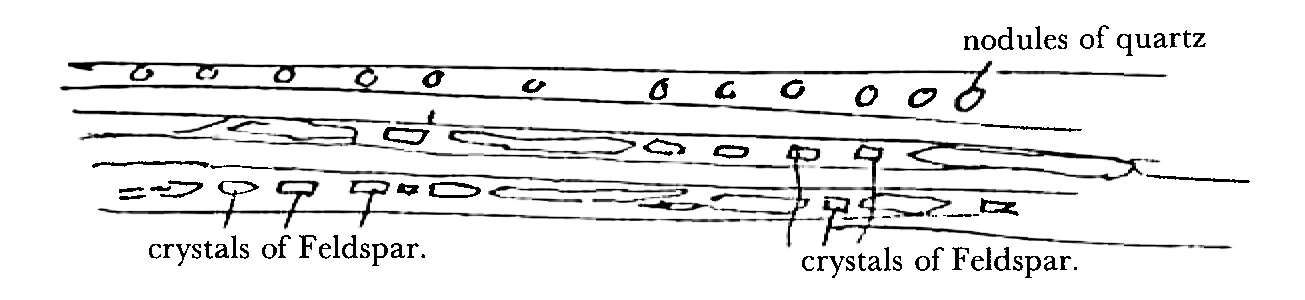
I made with really great care (& in M.S in detail)3 observations on a case which I believe is new, & bears on your view of metamorphosis (p. 149 at bottom)4 In a clay-slate porphyry regions, where certain thin sedimentary layers of tuff, had by self-attraction, shortened themselves into little curling pieces, & then again into crystals of feldspar of large size, & which consequently were all strictly parallel. The series was perfect & beautiful. Apparently also the rounded grains of quartz had in other parts aggregated themselves into crystalline nodules of quartz.
I have not been able to get Sorby5 yet, but shall not probably have anything to write on it.—
I am delighted you have taken up subject, even if I am utterly floored.
Your’s most truly | C. Darwin
P.S (Do read this P.S.) | I have a presentiment it will turn out that when clay-slate has been metamorphosed the foliation in the resultant schists has been due generally (if not as I think always) to the cleavage, & this to a certain degree will “save my bacon,” (please look at my saving clause p. 167.)6 but when other rocks, then that stratification has been the ruling agent,—the strike, but not the dip, being in such cases parallel to any adjoining clay-slate.— If this be so, preexisting planes of division, we must suppose, on my view of cause determine the lines of crystallization & segregation, & not planes of division produced for the first time, during the act of crystallisation, as in volcanic rocks. If this shd ever be proved, I shall not look back with utter shame at my work.—7
Manuscript Alterations and Comments
Please cite as “DCP-LETT-1633,” in Ɛpsilon: The Charles Darwin Collection accessed on