From R. E. Alison   [March – July 1835]1

The “pretil”2 or sea-wall of Valparaiso which runs frm Cruz de Reyes to the Arsenal was built about 1680 and was of very considerable elevation, but the sea during northers broke over it and washed the houses on the opposite side of the way at the foot of an old fort on the present site of the prison, up to the year 1817— An old Spaniard of the name of Jose Padin who at present is master mason to the builder of the Custom House, arrived in Valparaiso in 1785 on board a Spanish 64 and anchored within musket shot of the present high-water mark in 55 fathoms water.3 the spot which he pointed out now has about 6 fathoms at low water— About the same year, vizt 1785 another Spaniard arrived in a Merchant vessel which anchored off the arsenal in a line with a small ravine which runs through the centre of it. the anchor to the North was in 60 fathoms and the stern one was ashore in the ravine; the deepest part of the Bay close to the arsenal has now only 312 fathoms.—

A Mr John Martin4 a ship Carpenter of respectability in this place mentions that in 1819 he has walked at the foot of the sea wall on the beach, and has been frequently obliged to climb up to the street to avoid the sea. In 1820 large launches of 10 & 15 tons anchored in-shore of the wreck of the present site of the wreck of the Valdivia—5

R E Alison

[Enclosure]
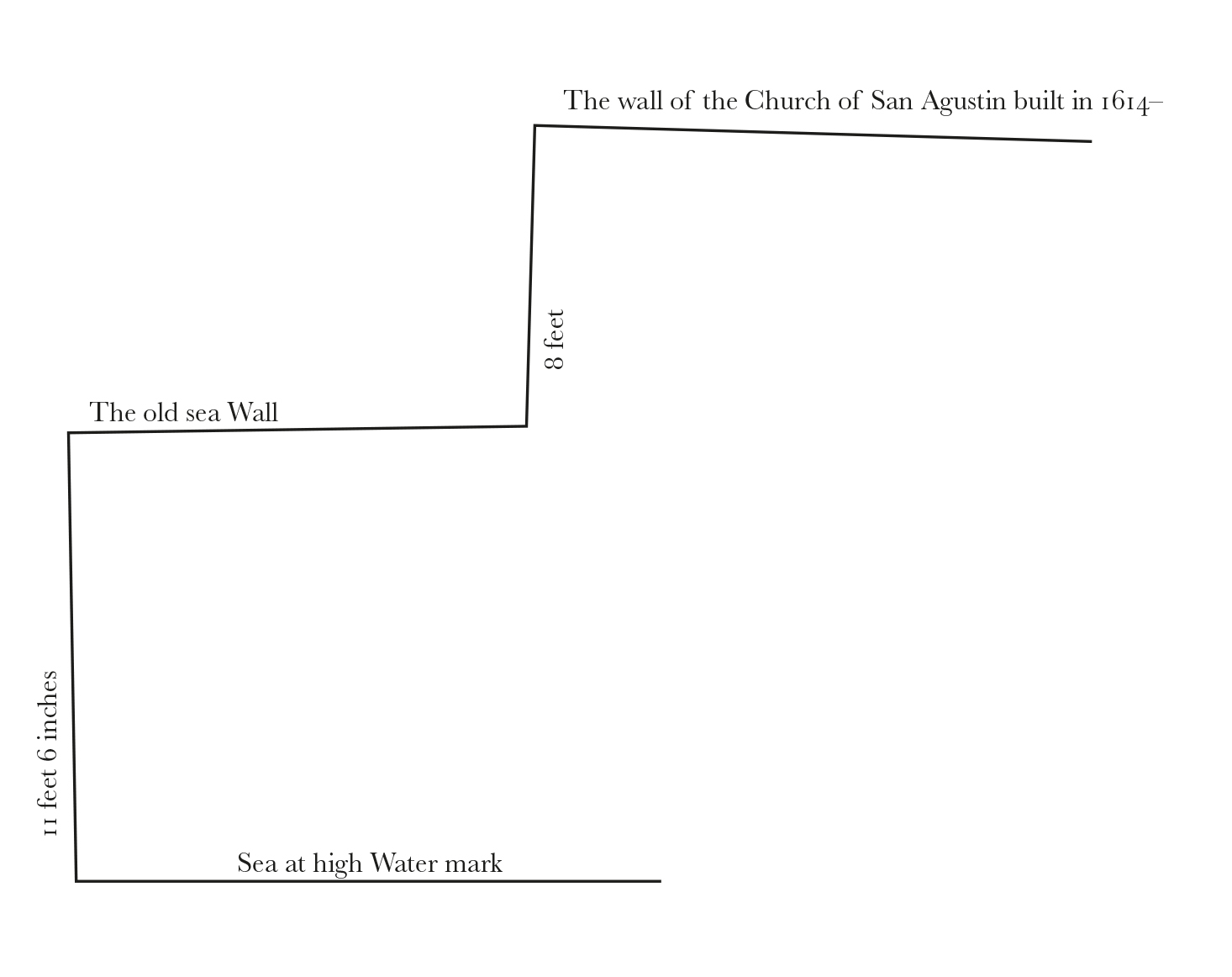
diagram

CD annotations

Enclosure:
By diagram] ‘What date?’ pencil
Verso] ‘The land certainly appears to have risen subsequently to the Earthquake 1822 shown by the wreck of a vessel’6 pencil
The date range is suggested by references to this memorandum in CD’s geological notes (see n. 6, below), and by the dates of his expeditions near Valparaiso. In 1835, CD was in the Valparaiso area between March and July. A summary of this letter was published in Correspondence vol. 1, with the date [June? 1834].
Pretil (Spanish): parapet.
A plan for the customs house in Valparaiso was drawn up by Juan Stevenson in 1828 (Memoria Chilena: Biblioteca Nacional de Chile, http://www.memoriachilena.gob.cl/602/w3-article-86762.html, accessed 11 May 2021). Jose Padin has not been further identified.
John Martin has not been further identified.
The frigate Valdivia was among a number wrecked in a storm between 9 and 11 June 1823 while at anchor off Valparaiso (Morning Chronicle, 18 October 1823, p. 4).
CD had been gathering information on the effects of the earthquake of 1822 since his earlier visit to Valparaiso and Santiago between July and November 1834 (Valparaiso notebook (English Heritage 88202335) and Santiago notebook (English Heritage 88202338)). CD and Alison discussed evidence for elevation of the land in Chile and the effects of the 1822 earthquake on a number of occasions in 1835 (see Correspondence vol. 1, letter from R. E. Alison, 25 June 1835, and Journal of researches, p. 374), and CD referred to the information contained in this memorandum in notes on the elevation of the land at Valparaiso made that year (DAR 36: 420–2 and 428). He cited it in support of the argument that the earthquake had raised the level of the land in his 1837 paper ‘Elevation on the coast of Chili’. See also South America, pp. 34–5.

Please cite as “DCP-LETT-247,” in Ɛpsilon: The Charles Darwin Collection accessed on 5 June 2025, https://epsilon.ac.uk/view/dcp-data/letters/DCP-LETT-247