From Frederick Smith 3 April 1860
British Museum
3rd. April 1860
My dear Sir
I have carefully examined your Hive-bees from Jamaica1 and can detect not the slighest difference between them & A mollifica dont accept this as my final determination because I intend to have another investigation— You mentioned when here last that y⟨ou⟩ had a piece of honey-comb—⟨or⟩ had seen one—in which a beautiful gradation of enlargement in the hexagonal cells was shown—i.e. between worker cells & drone cells— I said that I had seen the same in wasp combs— at that time I was not aware that I had preserved a piece— which I will show you in which by a repeated widening of the cells laterally
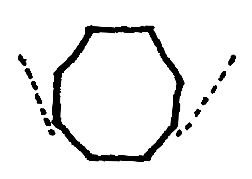 in about four rows they became large enough for the Queens or females Qy—are the small Queens—alias large workers—reared in these transition cells?—
I am bothering you with my queries &c— —but exc⟨use⟩ me I pray.— There was a very animated discussion here ⟨yes⟩terday speakers— Dr. Gray. Mr W⟨ollaston⟩ & Mr. P⟨as⟩coe2—or rather outpouring of opinion respecting the apterous or subapterous ⟨Bruchoi⟩ds— this brought to my mind that the same thing occurs in different genera of Insects—I dont think I have pointed it out & dont know whether you have noted it in any way— I will only mention one genus in which it occurs—Pompilus I believe every gradation of abbrevation may be found between the ample winged genus Macroceris & Brachypterus brevissimis—instances also occur in Coleoptera in which the same species is sometimes winged sometimes apterous or subapterous—Example—Calathus melanocephalus—
excuse my troubling you if all this is a twice told tale | and believe me | Yours very truly | Fredk Smith
Chas. Darwin Esqre
CD annotations
Please cite as “DCP-LETT-2744,” in Ɛpsilon: The Charles Darwin Collection accessed on