Dear Sir
I suppose you are at home again, & I sincerely hope that you are nearly well again.— I write chiefly to say that since writing to you I have been lucky enough to receive H. viridis.2 You propose to look at Bee again & very glad I shall be to hear result.— But I am convinced this flower will remain an everlasting puzzle to me.—3 I shall, also, be eminently grateful for observations on E. palustris.—4
You mention Spiranthes: it is no use watching this, for I watched it last autumn at Eastbourne till I was sick:5 it is, I have no doubt visited by moths.— Have you any entomologist near you? if you could persuade him to collect moths at night when near where the Spiranthes grows, he might find pollinia attached to proboscis & this would be a real treasure to me.— By the way, I have just thought that I shd be very glad if you would repeat one little experiment on Spiranthes & let me quote you as witness, if you succeed.
First open flower just to see position of parts—
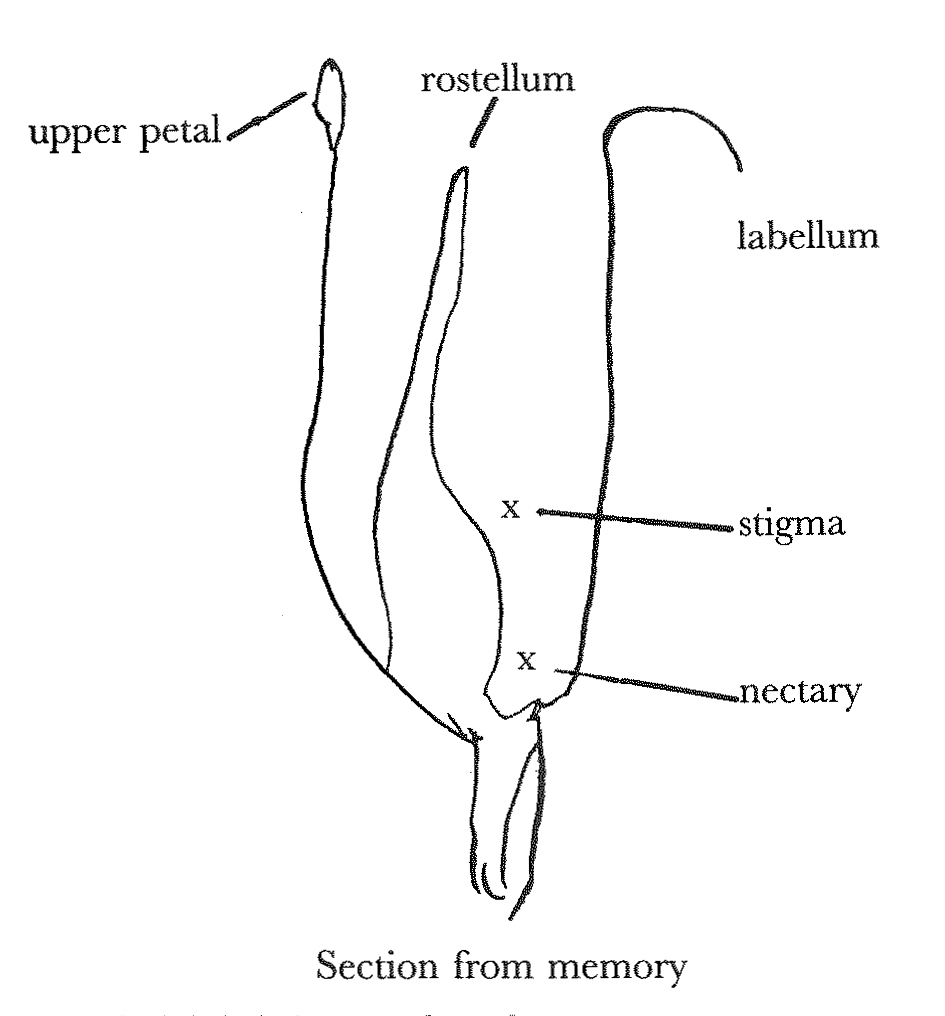
Take thin, straight flexible bristle or culm of grass—push it into nectary, to do which, on account of oblique projecting stigma, it must be pushed down near labellum.— Do this often & nothing will happen.— Then before withdrawing the culm of grass, bow it by pushing down, so that convex surface touches the exact (but hidden) median line of rostellum & you will generally find that the pollinia (by most curious contrivance) stick to the culm. I was led to try this by reflecting that in act of withdrawal moths bow their probosces.—
Lastly insert culm with the pollen-masses adherent, into the nectary of the same or another flower & you will find pollen-grains adherent on projecting stigma.— The point on which I want a wit-ness is the necessity of the bristle or culm being bowed so as to strike middle line of rostellum before it is withdrawn, in order that pollinia may be removed.— You must be careful not to try flowers from which pollen-masses have been withdrawn by insects: it is best to choose the upper flowers which have been open only one or two days.— Will you keep this note & try this little experiment?—6 I shall publish on British Orchids this late autumn.—7
My dear Sir | Yours sincerely | C. Darwin
Manuscript Alterations and Comments
Please cite as “DCP-LETT-3187,” in Ɛpsilon: The Charles Darwin Collection accessed on