To J. D. Hooker 4 October [1861]
Down Bromley Kent
Oct 4th.
My dear Hooker
Will you have kindness to read enclosed & look at diagram.— Six words will answer my question.— It is not an important point; but there is to me an irresistible charm in trying to make out homologies.— You know the membranous cup or clinandrum, in many orchids, behind the stigma & rostellum: it is formed of membrane which unites the filament of the normal dorsal anther, with the edges of the pistil. The Clinandrum is largely developed in Malaxis, & is of considerable importance in retaining the Pollinia which, as soon as flower opens, are quite loose.—
The appearance & similarity of tissues &c at once give suspicion that these lateral membranes of the clinandrum are the two other & rudimentary anthers, which in Orchis & Cephalanthera &c &c exist as mere papillæ. Here developed & utilised.—
Now for my question; exactly in middle of filament of normal anther, & exactly in middle of the lateral membranes of clinandrum, & running up to same height, are quite similar bundle of spiral vessels; ending upwards almost suddenly.— Now is not this structure good argument that I interpret the homologies of sides of Clinandrum rightly?1
Yours affect. | C. Darwin
I find that the great Bauer does not draw very correctly!! and good Heavens what a jumble he makes on functions.2
[Enclosure]
True Dorsal anther in bud with pollinia seen within cells.
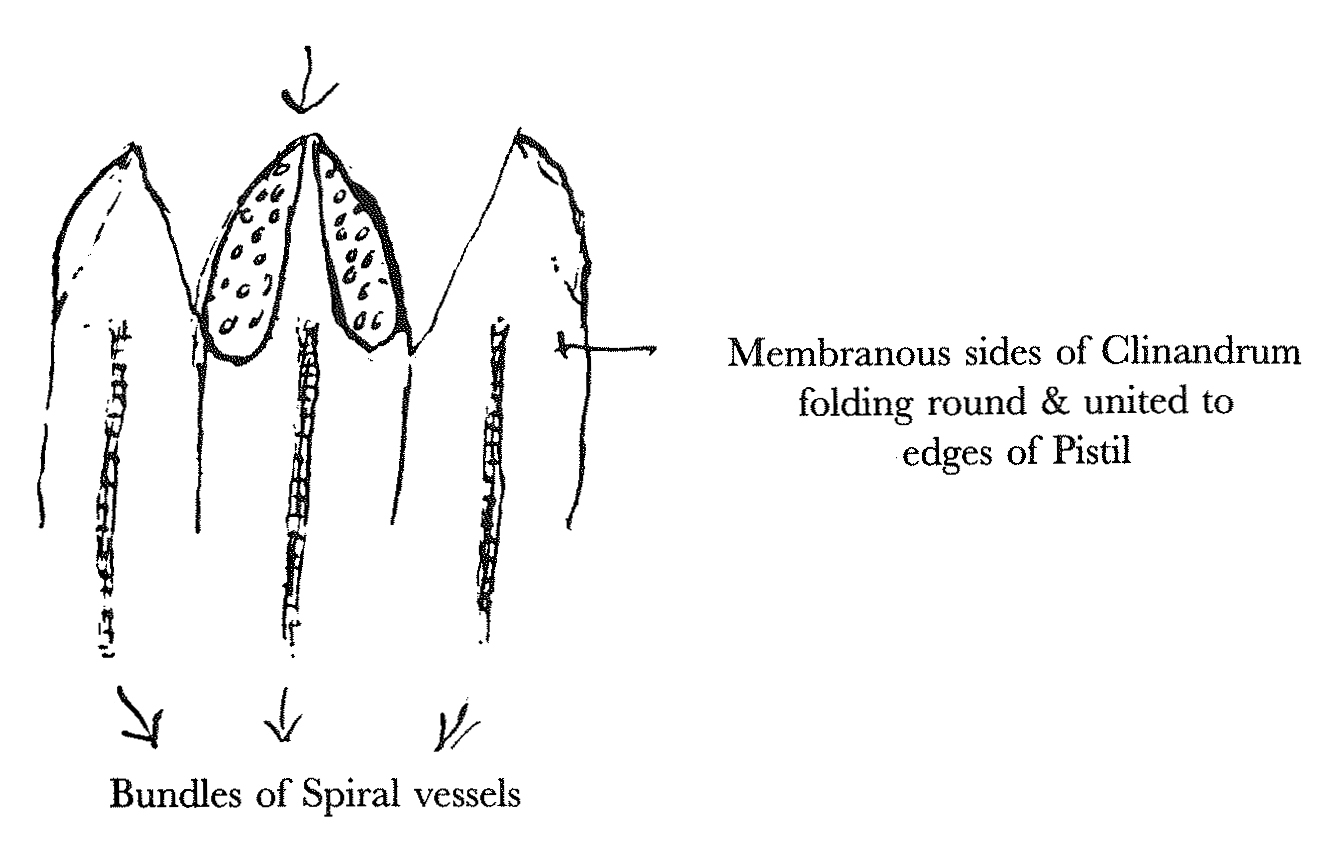
(Back of Clinandrum of Malaxis, laid out flat.)
Manuscript Alterations and Comments
Please cite as “DCP-LETT-3276,” in Ɛpsilon: The Charles Darwin Collection accessed on