From Edward Newman 6 April 1862
York Grove | Peckham
6 April 1862
My dear Sir
You expressed an interest in the existence of dimorphism among insects;1 I have several illustrations of this, and should you intend being in London on the evenings of either the Linnean or Entomological meetings I shall have great pleasure in taking them for exhibition and will read a few very brief notes thereon with the view of eliciting observations of more value from yourself.2
Should this plan be inconvenient to you, I will leave the specimens with Mr Kippist or elsewhere for your examination.3
I may just observe that in the families of ants which belong to the old genera Formica and Atta, the two forms are equally abundant a fact that has obtained the notice of all entomologists. What may be called a “guess solution” of this phenomenon has been attempted by an untenable hypothesis namely that the larger workers are undeveloped females, the smaller undeveloped males but this is opposed to fact, both sets or forms of workers are aculeates and aculeates are invariably female: in Atta Mr Smith tells me the sting is always present,4 in Formica the poison is present but not the sting; the skin or flesh of the object attacked is perforated by the mandibles and the poison injected into the wound no male insect possesses poison: the poison is called formic acid
Believe me dear Sir | [illeg] faithfully yours | Edward Newman
Charles Darwin Esq
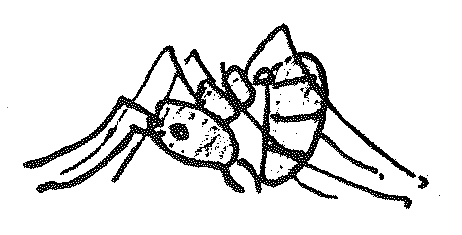 Position of the common wood ant when it attacks on object
Please cite as “DCP-LETT-3497,” in Ɛpsilon: The Charles Darwin Collection accessed on