From William Erasmus Darwin [late February–May 1865]1
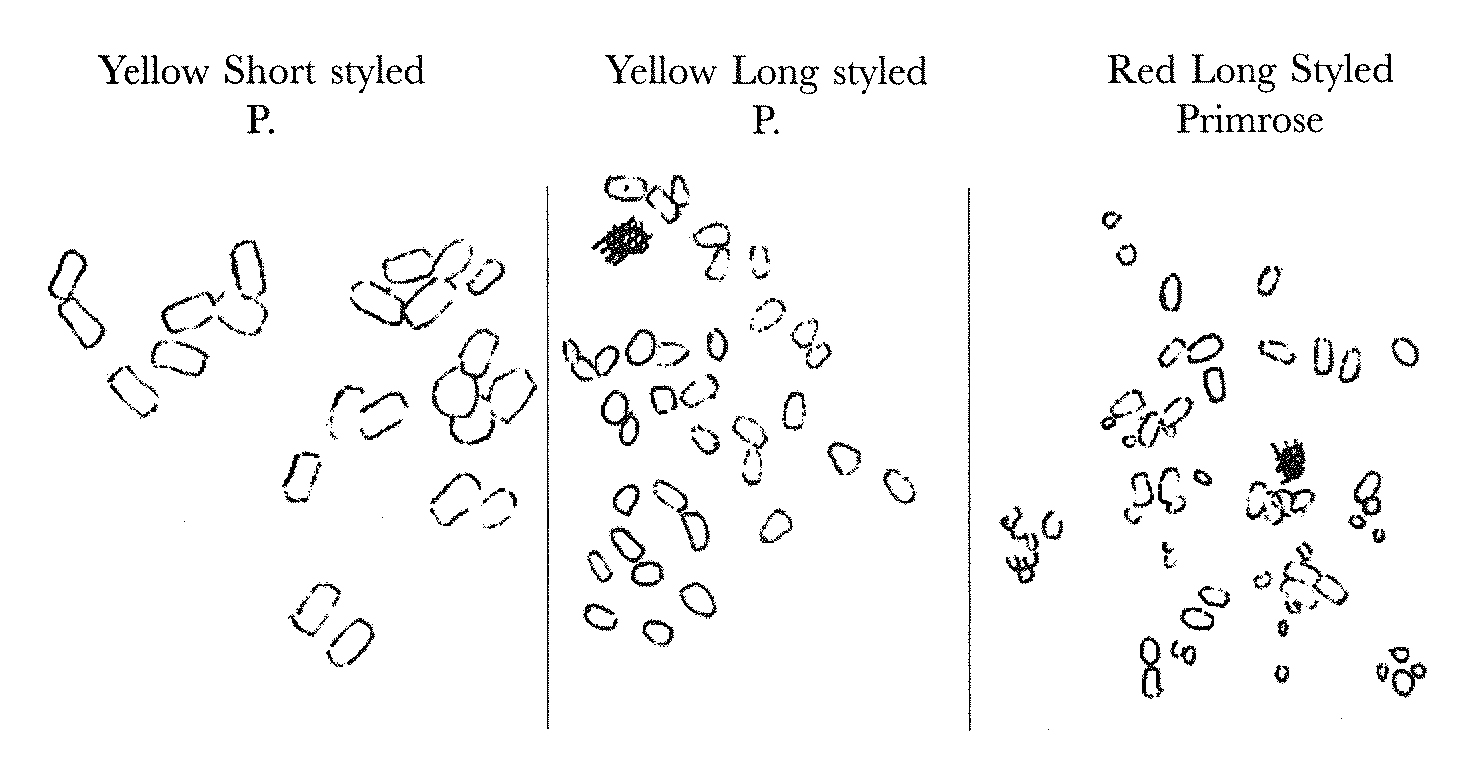
Primrose Magnified 350—
CD annotations
Left column: Yellow Short styled P.] ‘Common Primrose | 1865’ added below, pencil
Middle column: Yellow Long styled P.] ‘Long styled’ underl pencil; ‘Common Primrose’ added below, pencil
Right column: Red Long Styled] ‘Red’ double underl pencil; ‘Plants which I have crossed this year’3 added below, pencil
Bottom of page] ‘for Oxlips’4 added red crayon
Verso: ‘Size of Pollen in long-styled Red Primrose’ pencil; ‘Use’5 added & circled pencil
The date is conjectured from the flowering season of the common primrose (Primula vulgaris) and from CD’s annotations. See also nn. 3 and 5, below.
This sketch of the pollen-grains of Primula vulgaris under magnification forms part of a series of diagrams of the pollen of Primulaceae made by William in the spring of 1864 and 1865 (see DAR 108: 83–89a and Correspondence vol. 12, letters and memoranda from W. E. Darwin, [15 March 1864], 22 March [1864], [30 April 1864], and [after 19 May 1864]). CD believed that differences in pollen size and in the size of some flower structures were an indication of heterostyly (see Forms of flowers, pp. 3, 244).
In 1865 and 1866, CD made a series of experimental crosses with red (purple) long-styled primroses (Primula vulgaris var. rubra) raised from seed sent by John Scott in 1863 (see Correspondence vol. 11, letter from John Scott, [26 July – 2 August 1863], Correspondence vol. 12, letter from John Scott, 16 May [1864], and CD’s notes in DAR 108 and DAR 110). See also this volume, letter to B. D. Walsh, 19 December [1865], and letter to J. D. Hooker, 22 December [1865]. CD published his results in ‘Illegitimate offspring of dimorphic and trimorphic plants’, pp. 420–3, Variation 2: 109 n., and Forms of flowers, pp. 224–8.
CD may have intended to use the data on primrose pollen in his ongoing investigation into the differences between Primula vulgaris and P. veris, and their relationship to the common oxlip (now P. veris x vulgaris) and the Bardfield oxlip (P. elatior). He published his results in ‘Specific difference in Primula’, and Forms of flowers, pp. 55–75.
In ‘Illegitimate offspring of dimorphic and trimorphic plants’, p. 421, CD described the pollen of the red (purple) long-styled primrose as ‘of the small size proper to the long-styled form’ but ‘mingled with many minute and shrivelled grains’. See also note in DAR 108: 93, in which CD wrote that William made this observation after the pollen from the red long-styled primrose was sent to him.
Please cite as “DCP-LETT-4729,” in Ɛpsilon: The Charles Darwin Collection accessed on