From Edward Forbes   [after 14 February 1845]1

Thursday

Dear Darwin—

Any letters directed to the Survey—at 6 Craigs Court Charing X—will always find me—2

Gryphaea orientalis3 is from the Southern India* beds & is Cretaceous— Probably upper GreenSand.

* Verdachellum4 not Pondicherry in this case.

I shall look out for the Copiapo Avicula which had escaped me.5

D’Orbigny & Von Buch no doubt mean the same thing.6 Exogyra or Gryphæa couloni is a characteristic Neocomian fossil. Von Buch’s conclusion of the beds forming a passage from the oolites to the Chalk is exactly what I believe to be true. Von Buch wrote before the “Neocomian” was investigated.7

The relative positions would be as follows:
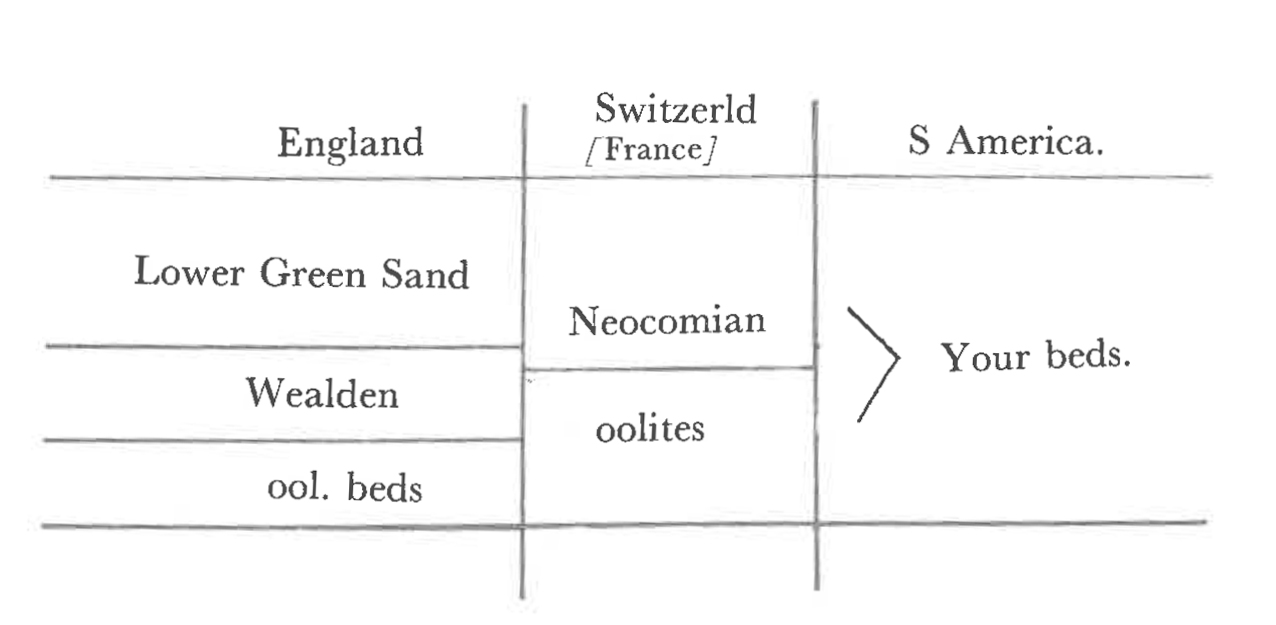
diagram

D’Orbigny probably looks on the Amer beds to be purely “Neocomian” since he holds the doctrine of definite divisions or formations everywhere.

Ever, most sincerely | Edward Forbes

Date based on Alcide d’Orbigny’s naming of CD’s South American shells (see letter from A. C. V. D. d’Orbigny, 14 February 1845).
Forbes had begun work at the Geological Survey on 1 November 1844 (Wilson and Geikie 1861, p. 378).
Forbes regarded one of CD’s Gryphæa specimens as identical to Gryphæa orientalis (South America, p. 212).
Viruddhachalam or Vriddhachalam, south-west of Pondicherry.
See South America, p. 223, where Avicula was listed as a new species by Orbigny. CD stated that George Brettingham Sowerby considered it to have been A. echinata and noted that the specimen had been lost.
According to Orbigny, CD’s Gryphæa was similar to G. couloni (a synonym of Aetostreon latissimum) from the Neocomian formations of France and Neuchâtel. Christian Leopold von Buch, who had also examined a Gryphæa (Exogyra) from a South American deposit, declared it to be identical to specimens of G. couloni from Southern France and the Jura (Buch 1836, p. 471). The passage is scored in CD’s copy in the Darwin Library–CUL. CD recorded their views and Forbes’s clarification in South America, pp. 181, 193.
The geographical extent and chronological position of the Neocomian beds were hotly debated throughout the 1840s, following their identification by Jules Thermann in 1835 (EB).

Please cite as “DCP-LETT-809,” in Ɛpsilon: The Charles Darwin Collection accessed on 5 June 2025, https://epsilon.ac.uk/view/dcp-data/letters/DCP-LETT-809