From R. H. Blair 9 November 1872
St. Martin’s Rectory | Worcester
Nov 9. ’72
My dear Sir,
I have to thank y⟨o⟩u very much for the hands⟨o⟩me work you have sent me. As ⟨I⟩ feel somewhat ashamed to have done so little to help your enquiries to a solution I should like to explain to you how it happened—whilst thanking you for courteously mentioning me notwithstanding my shortcomings.1
When you asked me questions respecting the expression of the Blind, I replied that my ignorance of facial anatomy placed almost insuperable difficulties in my way. You then recommended me to read Sir Charles Bell’s work, which I accordingly did with great pleasure & interest.2 After th⟨at⟩ I prepared for you a careful account of various peculiarities of the Born-Blind, so far as expression is concerned. The most startling conclusion I came to, of all the rest was that Born-Blind have no command over the muscle corrugator-supercilii.3 I tested it in various ways. But alas! one evening in Evening-Chapel, I observed two youths, both born Blind, one about 14 the other over 20, decidedly frowning at the same moment, and I put my paper in the fire as worthless. I am sorry for it, for it contained a good deal that was true & perhaps curious.
I am convinc⟨e⟩d now that the Born Blind, at least those that we have, cannot command that muscle. They use it however (that is one or two of them—two at least) involuntarily, and just when in deep thought. But whilst able to smile, or to look serious at the word of command, they can no more frown at command than I could move my ears.4 (I think I have seen one man or boy move his ears voluntarily)
We have now several good cases for experimenting, and if it will interest you, I shall be glad when there is a little more chemical activity in the light to have photograms5 taken of all the expressions I can get at.
One Born Blind, aged about 20, with an enor⟨m⟩ous head & thick hair, turns ashy pale when in a scrape, & moves the skin of the forehead up & down quickly in thick wrinkles.
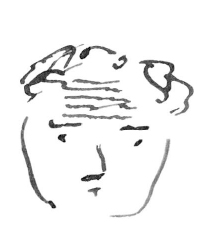
He cannot & does not frown so far as I can make out. But in all cases the expression of the mouth is perfect and often very lively.
If you still care for it I will feel much pleasure in dotting down observations. I did not expect your work out so soon, & was procrastinating through press of other work. I am studying yr valuable & masterly work carefully.
yrs faithfully | R. H. Blair
C. Darwin Esqre F.R.S. &c.
CD annotations
Please cite as “DCP-LETT-8615,” in Ɛpsilon: The Charles Darwin Collection accessed on