From James Paget 17 January 1873
1, Harewood Place, | Hanover Square. | W.
Jany. 17. 1873.
My dear Darwin
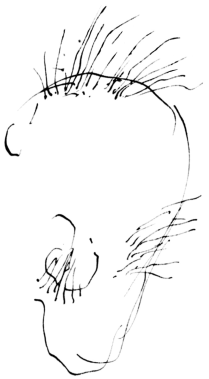
It is so great a pleasure to collect facts for you that you must excuse my sometimes sending what may be very useless— The enclosed is a rough sketch of an ear I saw two days ago— The gentleman is a Northern German, and, judging from his features, a Jew—(name Strauss) 51 years old— He has abundant very black scalp-hair,—about an average quantity of dark short hair on his arms and (he told me) on his trunk & lower limbs— His peculiarity was in the tufts of hair on his ears. He had about the average quantity at the very orifice of the meatus: and three remarkable tufts or clusters at the places indicated in the sketch,—tufts of black, stiffish hairs from an inch to an inch in length— I have never seen this arrangement before, and think I can be sure that it is very rare— The gentleman was not aware of any similar growth of hair in other members of his family; but I could not cross-examine him for he seemed to discern that my questions tended monkey-wards1
There was no growth of hair on the other surface of the ear— The upper and the posterior tufts grew below & within the border of the helix: the middle and anterior tuft from the outer border of the curved between the tragus & antitragus— The general form of the ear was not remarkable: but it had no small lobe descending from the upper border of the helix.
Always sincerely your’s | James Paget.
Charles Darwin Esq
[Enclosure]
CD annotations
Please cite as “DCP-LETT-8739,” in Ɛpsilon: The Charles Darwin Collection accessed on