From E. C. Rye 29 August 1873
Parkfield | Putney | S.W
29 Aug. 1873
Dear Sir
In my periodical examination of foreign literature for the purposes of the Zoological Record, I have observed some remarks by H. v. Kiesenwetter, in Berliner Entomologische Zeitschrift, XVI (1872), p. 370, that may possibly be of incidental interest to you—& which at all events will give me no trouble to communicate—1
He is revising the European ⟨spe⟩cies of Malthodes, a genus of small and very feebly constructed beetles allied to Telephorus,2 whose integuments are so weak as to barely deserve to be called coriace⟨ous—⟩ but in which the males have a very marked & highly developed apparatus at the apex of the abdomen, evidently of primary use for generative purposes (though not being actually the intromittent organ or a modification of it), as prehensile instruments: thus (e.g.)
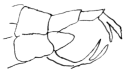
(viewed laterally)— This structure varies in each species—& is of great use in determining species3
Now, in one of the spec⟨ies,⟩ M. brevicollis (atomus of Thomson),4 he rightly observes that the female is to be taken by hundreds or even thousands—but that during 20 years (in which he has studied the genus more or less) he has only met with 3 males: and he observes that there are other European species, as yet only known as females.5 He proceeds to insinuate the occurrence of Parthenogenesis here,—observing that one species at least has been described in which the female has only ⟨r⟩udimentary elytra & wings—though the male is normal in those respects—& from this he seems to think a tendency to imperfect development, or arrested larval form is suggested.
Now, as the males are abundantly distinguishable apart from the anal characters (antennæ generally twice as long as in female) they cannot have been passed over—and, with so highly developed a structure for perpetuation of the species, it seems odd that the usually stronger sex should so disappear. And why especially does M. brevicollis be subject to this absence of males? Other common species are as abundant in one sex as the other.
It is the extraordinary adaptation of male organs, implying a survival of ⟨the⟩ fittest, that, coming with the abse⟨n⟩ce of the fittest now it has survived, indu⟨ces⟩ me to send this note.
Yours truly | E. C. Ry⟨e.⟩
Please cite as “DCP-LETT-9032,” in Ɛpsilon: The Charles Darwin Collection accessed on