From T. M. Reade 7 May 1874
Heath House | Blundellsands | Nr. Liverpool
May 7th 1874
My dear Sir
Being engaged in investigating the Drift Phenomena of the N.W. of England certain apparently inconsistent facts have fixed themselves upon my notice but which may possibly be explained could I obtain a trustworthy comparative list of the molluscous fauna of Tierra del Fuego & of the South American shores up the coast of Patagonia to say La plata.1 Could you kindly inform me if such information is in existence.
I send you the 1st part of a paper of mine on the drift of the N.W. of England2 from which you will see that though the assemblage of shells of our Low Level Boulder Clays show a more Northern facies than those now living on our shores they do not indicate a very low temperature of the then seas— On the other hand judging from the striated boulders it is quite clear to me from long observation that intense glacial conditions prevailed— I can only refer this apparent anomaly to some such conditions as prevail now at Tierra del Fuego— A low summer temperature caused by prevailing winds & peculiar hygrometric conditions of the air favourable to precipitation of snow with a quickly evaporating sea surface might perhaps account for the phenomena as we find it here—
I trust I am not asking too much but knowing the great interest you formerly took in the subject & the extent of your own observations in S. America I have ventured to trespas on your kindness & valuable time and should feel indebted for any help however slight you may feel inclined to give me—
I am dear Sir | Yours faithfully | T. Mellard Reade
Chas Darwin Esq FRS—
P.S. Did you ever know a case of forest trees being partially buried while growing, with material thrown up around the Stem or trunk & then throwing out second roots near the new surface— Such a case occurred at a Quarry I know of
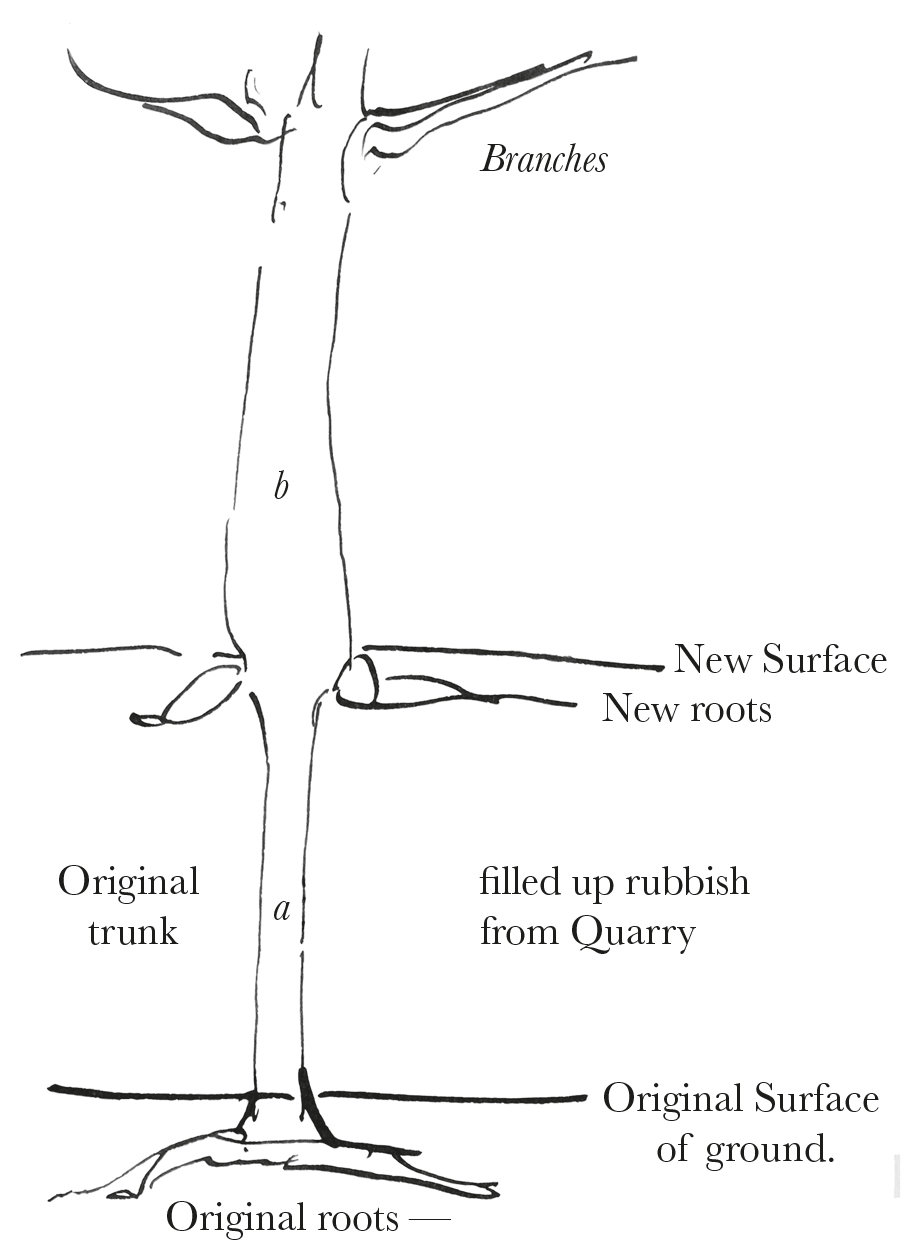
The trunk at a apparently ceased to thicken but at b grew thicker— It appears to me a curious instance of adaptability to new conditions— If it is worth your notice I shall be glad to get you further information if possible—
Please cite as “DCP-LETT-9443,” in Ɛpsilon: The Charles Darwin Collection accessed on