From J. T. Moggridge 11 June 1874
26 Eastbourne Terr. | Paddington | W.
11 June 1874
My dear Sir
When I was at Montpellier in the early part of last month M. Ch. Martins gave me some stones taken from the fruit of a tree which appears to be half almond & half peach, the flesh being yellow & eaten by children, clinging to the stone.1
He asked me to transmit these to you, thinking that they might interest you, & the more so as the characters of the tree come true from seed—
M. Martins told me that he had just brought to a close the first course of lectures ever given at Montpellier in which the Darwinian hypothesis was admitted— The early portion of these lectures, treating of the lower animals, was delivered by M. Sicard, M. Martins taking the vertebrata—2
When I asked the latter how he had dealt with man, he made a comical grimace & said “quant à ça il m’a fallu des menagements”—3
I learned enough of the local politics of Montpr. to shew me that the expression of liberal opinions, whether secular or religious, would be apt to secure the active condemnation of the rigid protestants & catholics alike, the two bodies being ready to combine to hunt & annoy a “libre penseur”.—4
Something of the kind was done in the case of my friend M. Duval-Jouve, whose honorary inspectorship of the Academy was taken away from him soon after the accession of the clerico-conservative government.5
M. Duval-Jouve, who is well known for his papers on grasses, sedges & other Monocotyledons, of the histology & development of which he has made himself master,6 is one of those who take pleasure in expressing the admiration they feel for your works, & for you as known through them, & I doubt whether you have anywhere a more devoted & yet judicious & discriminating follower than M. Duval-Jouve.
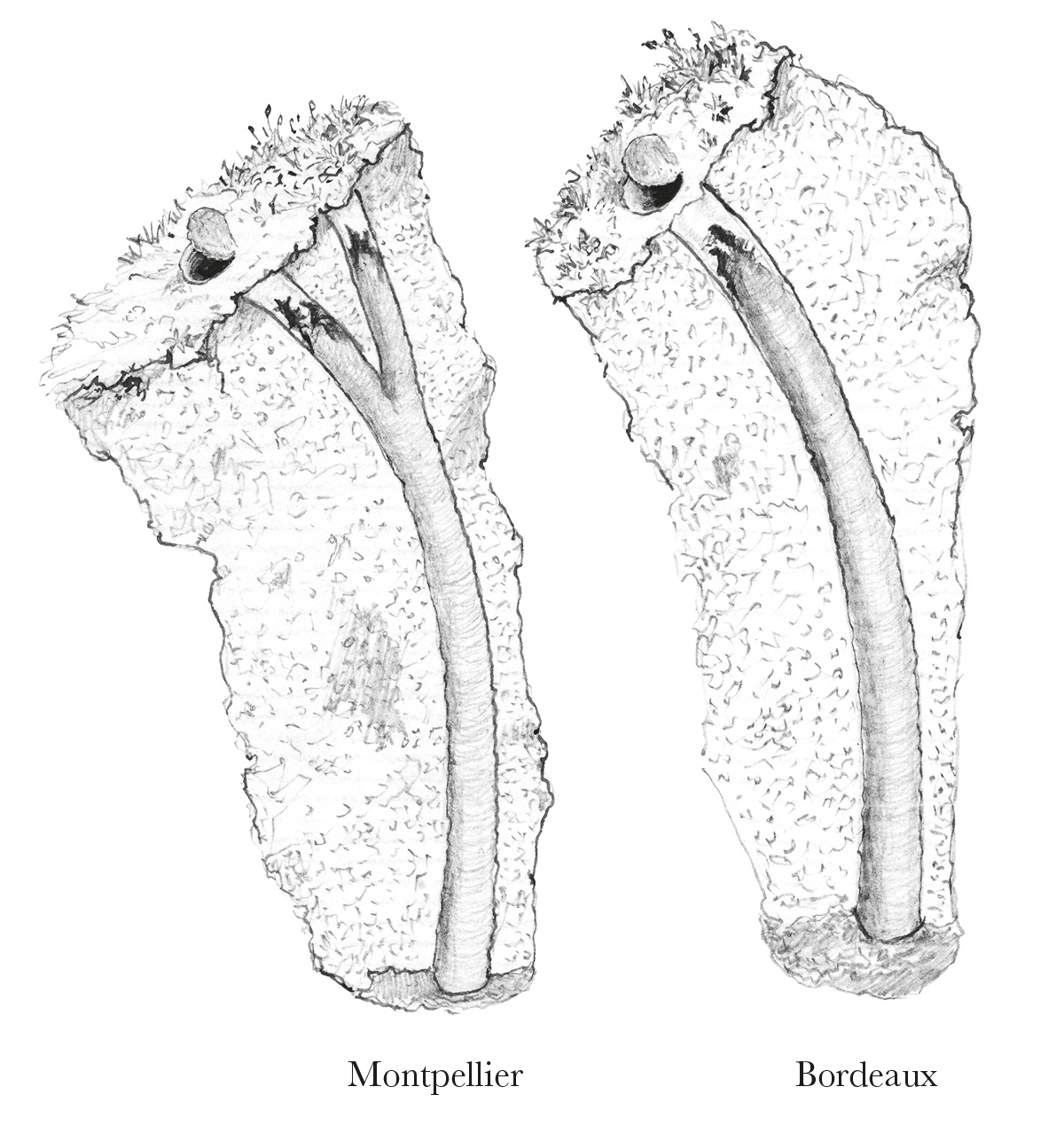
I was fortunate in spider hunting when on my journey homeward, discovering one new trap-door nest at Montpellier & another at Bordeaux.7
Both of these new nests have thin wafer-like doors, & correspond in form with those I have already figured as belonging to Nemesia Meridionalis & Eleanora, only that they have no lower door! (see sketch)—
It is curious to note that while in England & Northern France we have the very simplest form of trap-door-nest, that at Bordeaux is simpler than the nests of Montpellier & the Riviera; while the Montpellier nest, though advanced one stage further by its branched tube, comes next in order.—
It would almost seem as if there were some relation between climate & complexity of structure (for even Montpellier has a colder & longer winter than the Riviera) & that the less intelligent workmen had to put up with the worser climates.—
These new nests have also the additional interest of affording examples of what we may conceive to have been the early stages by which the more complex ones were evolved.—
Be that as it may, we have now 6 distinct forms of trap-door nest instead of the single form (that of N. Ca-ementaria) supposed to be the only one existing in Europe up to the end of 1872!.8
However, while all these nests are more or less cleverly adapted for concealment, I have lately heard of a trap-door-spider closely allied to the Nemesias, which, though apparently in no way better able to protect herself than her relations, makes a nest the bright, white-silk, open, funnel-shaped tube of which appears to court attention, projecting as it does some inches above the ground & supported but not concealed by the sparse stems of grasses & other plants.9
How then does this spider secure herself against the attacks of the enemies so much dreaded by the European trap-door-spiders.?
Mr. Wallace, to whom I mentioned this curious nest, suggests that the spider may be nocturnal in its habits & that the night-flying insects which form its prey may be attracted by the white, corolla-like funnel of the tube!10
I am busily employed in gathering together my notes with a view to publishing a supplement to Ants & Spiders, hoping to get this completed before October, when I propose to return to Mentone.—11
We remain in London until the 22nd., & then go down to Richmond for the summer, when my address will be 2 Foxton Villas, Richmond, Surrey—
Believe me | Yrs very sincerely | J. Traherne Moggridge.
[Enclosure]
Please cite as “DCP-LETT-9488,” in Ɛpsilon: The Charles Darwin Collection accessed on