From T. C. Copland 23 June 1874
Office of Public Works, | Customs House, Dublin,
23 June 1874
Sir
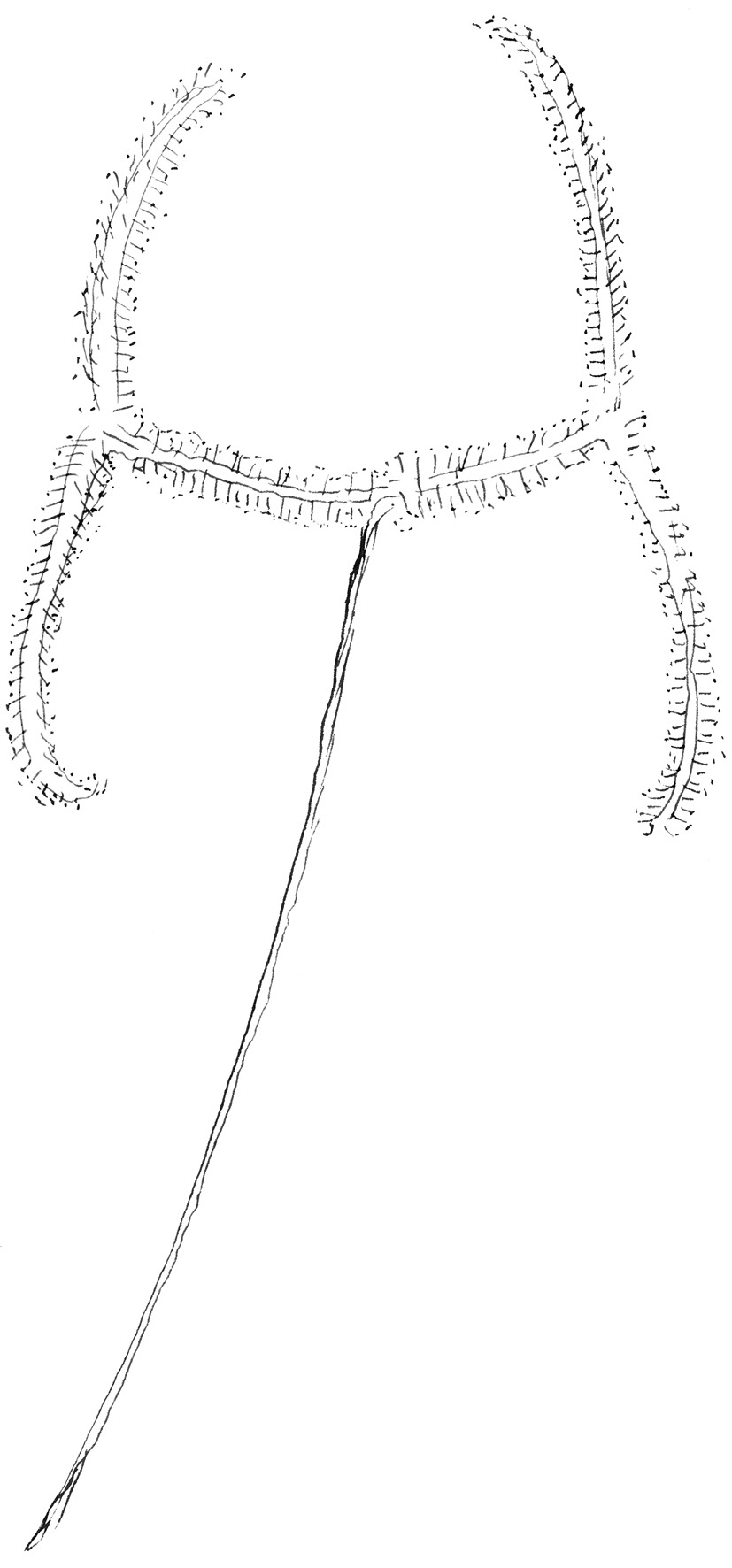
Observing in a paragraph in the Echo last week that you are publishing a work on the habits of Drosera rotundifolia, it may interest you to receive my own notes on those of another species—Drosera dichotoma.1 It is a tender or half hardy plant, but I cannot give you its habitat. A plant I had for some years threw out fresh leaves on a foot stalk about 7 or 8 inches high every year armed with points tipped with glutinous matter just as our own has; and I have invariably found that a fly caught on the points of any of these was drawn into the channel in the centre of the leaf & sucked dry in a very short time. The leaves were with me deciduous & generally were filled with victims before they shewed any signs of decline, when they gradually dried up.
The rough sketch on the other side is from memory but is pretty near the natural size & appearance.— I unfortunately lost the plant by keeping it in sphagnum (Irish) as an experiment—
I am | Sir | Your obedt servt | Thos. C. Copland
C. Darwin Esq
CD annotations
Please cite as “DCP-LETT-9509,” in Ɛpsilon: The Charles Darwin Collection accessed on