From A. W. Bennett 12 March 1875
6 Park Village East, | Regent’s Park, | London N.W.
March 12th. 1875.
My dear Sir
In a paper which I read before the Belfast meeting of the Brit. Ass. on the form of pollen-grains; I alluded to the difference between the size of the grains in the two forms of the dimorphic Primulas, & described those of the long-styled form as being always smaller than those of the short-styled form.1 This was in accordance with observations made the previous spring on the primrose, cowslip & polyanthus. I was aware that you had also noticed this difference, but, before reading the paper, had not turned to your observations. On doing so subsequently, I was surprised to find that your statement in the Journal Lin. Soc. vol X, p. 393 is exactly the reverse!2 Suspecting naturally that I had made some mistake, I have been repeating the observations (but in the case of the primrose only), & with the same result as before. This I find to be nearly uniformly the relative size (drawn under the camera ×250)
 long-styled
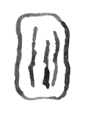 short-styled
Can you tell me whether you think there is any possibility of an error having crept into your description, or whether there is really this remarkable variation in different localities?
I see that Sir John Lubbock, in his little book on Wild Flowers & Insects (p.35) confirms my statement; but I suspect his information is drawn from my Belfast paper.3 He suggests however what seems to me a probable explanation, that the long-styled form requires longer pollen-tubes, which are provided in the large grains of the short-styled form.
Apologizing for troubling you, believe me | very truly yr. | Alfred W. Bennett
C. Darwin Esq. F.R.S.
Please cite as “DCP-LETT-9884,” in Ɛpsilon: The Charles Darwin Collection accessed on