TALBOT8204
[fragment]
Dr Hincks
Millburn tower Edinburgh1
Jany 27 – 62
Dr Sir
I have read with interest your remarks on the word kudur. I have a memorandum that kati assi means “I took in my hands” i.e. I took persons captive. If this is correct, Kudur assi may mean I took my helmet (or my crown whichever is correct): not, “I laid it aside”.
I am aware of the passage to which you refer in pl.18 l.67, but if you will look at line 56 in the same page, you will see by the sign
 prefixed, that the zabil-kuduri were men. They were the magistrates whom the king placed over the conquered cities of the land of Siruvi – I consider that their name denotes their dress which consisted of a flowing robe
 , and a mitra or lofty cap Kudur. In line 62 same page,
 of course means soldiers, but they were those of the enemy. Ikduru signifies “they took to flight”. Their place of refuge is then described. In line 63 the King’s soldiers follow them, and storm their stronghold. I do not agree with you that ana is required and not as, in the passage kudur as reshdu-ya assi. For we read in Nakshi Rustaur l.18 Maginat as reshdu-sun nasu.
It was not Ménant’s discovery that the character for King may have been originally the hieroglyphic for a wasp or bee. It was published by Oppert some years ago; at least I have known it for that length of time & always attributed the remark to Oppert.
I am rather disposed to agree with O. that
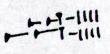 has the value sakh – At least it appears that
 Kpu-sakh-kha means beloved.
There is not the least reason for supposing that Rawlinson took the idea from Oppert of the origin of polyphone sign s from an admixture of the writing and vocabulary of the Assyrians with Accadian, Scythic & other neighbouring nations. Norris & Rawlinson had studied the Scythic or Median writing and noticed that the Syllabic sounds sometimes represented real words in those other languages. I return Opperts letter to you and your answer. He is a man of talent and sagacity, but rare impartialité is hardly the quality I should have attributed to him. No doubt he has marked with the letter O a large number of signs first published by yourself and Rawlinson; – M. Ménant is his “noms propres Assyriens” p.59 gives 2 forms of the name Sardanapalus. I wish to ask if you ever met with either of them, and can refer me to the passage where it occurs To me it appears that these names may have had their origin [incomplete, ends here]
Please cite as “TALBOT8204,” in Ɛpsilon: accessed on