TALBOT8242
Michael’s Grove
7th November 1860
My dear Sir,
I have
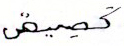 [tonïtru?] from Golius 1 as the etymology of
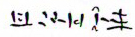 . Castell 2 gives
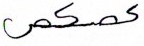
You would gratify me by describing your N. 169. I mean length and breadth, and number of lines. I have another 169a photograph, which is really K 210, and I cannot find nutarda[?] upon it. If you look carefully at the tablet you call "160 otherwise 136b" you will see that it really is 169, but the bottom is shaved off, leaving 160 only. The proof is double, – "K 169" is photographed (not written) at the top of the slab upside down. Again, there is the reverse of the plate slab with 169 clearly written; also 136 a, and both are lithographed on Sheet 25 vol. II Obv. & Rev.
I find
 in Esar; v. 20, in Neb. Y [illegible] 83, E.I.H. v. 18, and turmina turda in 29H v. 43. I shall be soon at the word kumína[?] which Opp. 3 makes "Martre") and shall be glad to know about the existence of
 in that combination You are aware that in all the Michaux stones [seen?] having
 . not
 .
 reads
 . in 1 Mich ii.5 and
 . in both the others.
Can you explain tiri in satirimu N[illegible] i. 22, 31 and tirisassi E.I.H. iv. 5. which must be tiri of marble
 but which I have erroneously rendered "beryl" from
 somewhere. I must beg pardon for this scrawl, but my hand is shaking and the printer is waiting
I am yours faithfully
Edwin Norris
H. Fox Talbot Esq
&c &c
 may be sounded durmina which would account for
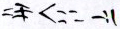 . of E I H v.43.
Please cite as “TALBOT8242,” in Ɛpsilon: accessed on