TALBOT8296
Dr Hincks
Millburn1 Feb. 10th – 62
Dr Sir
If you compare BM plate 27 line 95 with plate 16 line 85 it results that
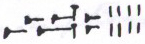 shakh is equivalent to
 sha
 akh although the first of those signs has been blundered by the lithographer. The sign in question has also the value sha, in weshabiba, I filled full from
 BM 1st series pl 64 l.61.
With respect to the meaning of kuduri the following passage deserves consideration, In B.M. pl.20 line 15, the Kings of Nahiri peacefully bring tribute, and Ashurakhbal thereupon appoints persons
 called yatil-kaduri over the lands of the Nahiri. These were evidently his lieutenants or prefects. Kuduri cannot mean soldiers, for he was at peace with the Nahiri, & had sent no soldiers thither.
Rawlinson never published his translation &c. of the N. Rustam insn, but the copies were distributed among the members of the Asiatic Society.
Oppert has transcribed erroneously the 18th line of the N. Rustam – The word maginal is quite plain: the cuneiform is
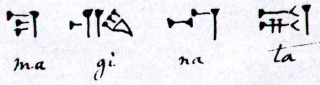
It undoubtedly means helmets; –
I set very little value on Opperts Hebrew transcriptions, & as the Assyrian language differs much from Hebrew, I think the notion an unfortunate one, of so transcribing the cuneiform texts. A passage or two might have been so given, as a specimen, but the rest shd have been transcribed into Roman characters.
The Persian text has takapara when the Assn has helmet-wearers This word I consider to belong to the great Indogermanic root tegere Germ. dechen, (I see you are of the same opinion).
Previous to your translation of 1854 in Septr 1853 I printed (for the Liverpool meeting of the British Assocn) a short translation for the Khorsabad sculptures, of the 8 gates of Sargons palace dedicated to the 8 gods, and of some other things.
Yours very truly
H. F. Talbot
Please cite as “TALBOT8296,” in Ɛpsilon: accessed on