TALBOT8316
Dr Hincks
Millburn1 Feb. 17 – 62
Dr Sir
Oppert admits no homophones as you remark, but in my opinion he is quite wrong, for there are many, as
 and
 for instance.
He says that the name of the god
 is to be read, sometimes Nisroch, sometimes Salman. As the true name has long been a matter of doubt, I requested him to furnish me with proof of these two assertions. He replies that one of the values of
 is nis & one of the values of
 is ruk, to which I can only reply that I have not yet met with either value. As to Salman, he refers me to BM pl. 23 l.135 as proof positive for he reads
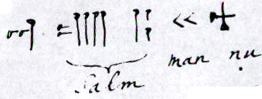
On the contrary I think the 2 last signs are a title of the god and no part of his name, & I am inclined to translate it
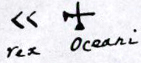 . what is your opinion?
Rawlinson has remarked that the name
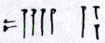 seems to imply domus aquæ – And, as there are various indications that he was the Assyrian Neptune, I think this remark is not without plausibility.
Ménant has an alleged discovery “that polyphones are never simply syllables”, but I think it cannot be supported. Is not [sign] as, a simple syllable? Yet it has other values as adau, and ru. By the way I do not know how the latter is proved, can you inform me?
The sign
 has the values sib and lib but is not strictly a polyphone, for the Assyrns seem to have used those 2 roots quite [ill. del.] indifferently, wch the hebrew distinguishes as בל and בצ – This arose I think partly from their cognate meaning – “heart, love desire, wish &c” – and partly from the tendency in Assyrn to substitute < for S, first observed by Rawlinson in what he called the Liphal conjugation (altakau for astakan &c. &c)
I have referred to the passages in the N. Rustam wch you enquire about; – In line 24, the reading is
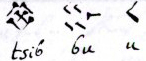
and
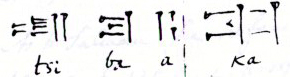
And in line 27
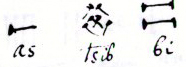
I remain Dr Sir Yours vy truly
H. F. Talbot
Please cite as “TALBOT8316,” in Ɛpsilon: accessed on