Faraday to the the Holyhead Road Committee 7 May 1822
Royal Institution, May 7th 1822
The following remarks are intended to accompany the evidence I have been called upon to give before the Committee on Holyhead Roads1. The nature of an examination will not always admit of the information required being put into the best form; and as some rather refined sources of probable injury have been stated, and other sources insisted on, which have not been generally noticed, it will be of advantage to have the whole placed in one connected view.
With regard to the composition of sea water, the following numbers are very nearly correct, and accord with the best analysis. Its specific gravity varies a little in different parts of the ocean, from the vicinity of mouths of rivers, ice, evaporation, and other causes, but may be estimated as a mean at 1027, pure water being 1000. When of a specific gravity of 1027.2, being such as I used in my experiments, one cubic foot of it weighs 1026.265 ounces avoirdupois; and contains,
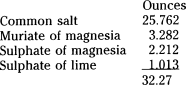
besides small quantities of some other salts, which however are in proportions too minute to be of any consequence.
When any of these salts in their pure and separate state are dissolved in water, and left in contact with iron, or are boiled with wrought iron in a close vessel analogous to a steam-engine boiler, corrosion of the iron takes place, and an oxide of that metal is formed. The effect even takes place at common temperatures, and is much increased by the free access of air. In consequence of this power of corrosion, which belongs also to the solutions when mixed, as they are in sea water, all iron boilers in which sea water is used will be subjected to a much more destructive process than when fresh water is used in them, notwithstanding any degree of care that may be given to them; and if care is not given, then other serious causes of injury arise, which greatly add to the bad effects necessarily attendant on the use of sea water.
With regard to the prevention of the corrosive and injurious effects of sea water in such circumstances, I am not aware of any means that can be offered for the purpose which will embrace the whole; but from experiments made in the laboratory, a part of the evil appears to be more manageable, and capable of a remedy: and though perhaps the engineer may not find the means so available, or the advantages so important, as to make it worth while applying this remedy in the large way, yet it is important that his attention should be directed to it, that a true estimate may be formed of the circumstances connected with it.
Of the salts contained in sea water, the muriate of magnesia is that which acts most powerfully on the iron of the boiler. I boiled clean metallic iron in solutions of muriate of soda or common salt, muriate of lime, muriate of magnesia, and sulphate of magnesia, for about an hour; the corrosion of the metal in all the solutions had taken place, and oxide of iron had been deposited; but the portion deposited in the muriate of magnesia was by far the greatest; and further, when the solution was filtered, it was found to hold a portion of iron even in solution, an effect which was not produced by any of the other salts.
Hence it is evident that the muriate of magnesia is a much more injurious salt than any of the others existing in sea water. At the same time I am not able to say what portion of the whole injury arising to a boiler by the use of sea water in it is due to this salt. It will be seen from the table of salts given, that its quantity is only about one eighth part of that of the common salt; so that though its powers are great, they will in part be restrained by the smallness of its proportion. One thing, however, is worthy of attention; namely, that the corrosive effect due to this salt may be prevented, whereas the others, as far as I know, are intractable in this respect. The muriate of magnesia is a salt composed of muriatic acid and magnesia; and it owes much of its corrosive power over the iron to the weakness of the affinity existing between its elements. This, however, enables other bodies to decompose it, producing substances that, comparatively, are inert on the iron. If for instance, lime, or potash, or soda, be added to muriate of magnesia, a muriate of lime, or of potash, or of soda, is formed, all of which are found by experiment to have less action on the metal than the magnesian salt, and magnesia is deposited. Hence, as regards the muriate of magnesia, the excess of corrosive power due to it above the other salts may be destroyed; but it is for the practical engineer to state from experience, either already in his possession, or to be had by observation, whether it may be done advantageously. The points for consideration, I presume, are, What quantity of corrosive power compared with the whole quantity due to the sea water would be destroyed? Would any injury arise from the deposition of the magnesia that would more than counterbalance the advantage? Can the corrective agent be introduced with facility into the water? Would any inconvenience or injury, at present unknown or unforeseen, arise from the use of it?
I have ventured to put more stress on the effect of the muriate of magnesia when in solution, and on the means of correcting it, than it may perhaps seem to deserve; but I thought it my duty, when called upon for information, to give all I could; and I think the attention will not be misapplied that may be given to determine the quantity of effect due to this salt, and the possibility of correcting it.
The quantity of muriate of magnesia in a cubic foot of sea water being 3.28 oz.; the following are the equivalent quantities of the other substances concerned. It would require 1.64 oz. of dry quick lime, or 2.78 oz. of pure potash, or 4.1 oz. of dry pearlash to decompose it; with the two first substances 1.14 oz. of magnesia would be deposited, and with the third 2.43 oz. of carbonate of magnesia.
When copper is substituted for iron in the above experiments the injurious effects are very much diminished; and it would probably be found, ultimately, that copper boilers were the most economical, and certainly the least troublesome. It must however be constantly remembered, that all mixture of copper and iron, by which I mean the use of copper and iron in contact with each other, or indeed of any two different metals, as of iron and brass, or even copper and brass, should be avoided as much as possible in those parts to which the salt water has access. When two dissimilar metals are in contact with each other, and also with sea water, a voltaic effect is produced, which occasions rapid corrosion of the most oxidable metal at the points of contact, as well as a lesser effect over its whole mass; and the action will be stronger from the circumstance of the temperature being high. Hence in the pumps or tubes connected with them and with the boiler, and in every part where the salt water passes, such combinations of dissimilar metals should as much as possible be avoided.
When a boiler charged with sea water is heated, and steam sent off from it, the following effects take place within:- the water becomes more and more concentrated, acting as the same time more powerfully on the iron. When the concentration arrives at a certain point, the sulphate of lime begins to deposit, and form crusts on the bottom and sides of the vessel. Continuing the evaporation, the water becomes so much diminished in quantity as to be unable to hold even the common salt in solution, and it begins to deposit. During the whole of this evaporation the temperature of the fluid has been rising, and it requires more heat to make it boil than it did before. Ultimately, if the operation be continued, the salts become dry in the boiler, the temperature rises, and when it attains from 270° to 300°, the muriate of magnesia is decomposed, its earth or magnesia left free, and its muriatic acid sent off in the state of gas.
Hence, it is evident, that boilers using sea water are liable to certain kinds of injury, through ignorance or carelessness, which by a knowledge of the circumstances, and attention, may be prevented. If the evaporation is carried on so far as to cause the deposition of sulphate of lime, it will tend to form crusts on the sides and bottom of the boiler; and though the addition of a fresh portion of sea water will at first dissolve this, yet when the evaporation is continued it will add to the quantity of sulphate which is thrown down by the concentration. The same is the case with common salt; upon the evaporation of a certain portion of steam from the water the salt would be deposited, and would tend, with the sulphate of lime, to form crusts at the bottom of the boiler.
One bad effect produced by this state of things is the burning of the bottom of the boiler and the flues. The heat in traversing the bottom of the boiler to reach the water, has also to pass through the crust of deposited matter, and this being of bad conducting powers obstructs its passage, and causes its accumulation in the metal itself, which of course suffers from combustion more rapidly in proportion to the elevation of temperature: at the same time, the flame and smoke, not being able to give off their heat to the already heated metal, pass on into the flues at a temperature far above what they ought to do, and burn them.
Another evil is, that less steam is raised; for the crust acting as a barrier between the fire and the water, prevents the latter from receiving that accession of heat which it ought to do; and the quantity of steam produced is proportionably less. Hence there is a waste of fuel in getting steam, or else there is a want of steam, and at the same time there is a burning of the boilers.
A third source of injury suggests itself, which, though I am not aware it has been observed in practice, well deserves pointing out, that if any effect should arise from it, it may be distinguished and guarded against. I refer to the decomposition of the muriate of magnesia by a heat approaching 300°F. This effect can never take place whilst the salts remain in solution, and it is the most soluble of any of the salts in sea water. But whenever any portion of the common salt is rendered dry, and caked, it is then possible that muriate of magnesia should be decomposed, and its muriatic acid liberated in a free state. Thus, if from the concentration of the sea water a crust of common salt and sulphate of lime had formed on the bottom of the boiler, it would act as before mentioned, by preventing the transmission of the heat through it, which would consequently accumulate on the lower side, and any portion of muriate of magnesia contained in the crust would then be decomposed; its free acid partly acting on and combining with the iron at the bottom, and partly passing into the water, and from thence wherever the water or steam passed. Again; I believe there are instances known where the water has been suffered to sink below the level of the upper surface of the flue, or furnace, which sometimes passes through the boiler; in such case, any portion of muriate of magnesia left on the top of this flue would be heated, and if sufficiently so, would be decomposed as before.
From the possibility, therefore, that this highly injurious effect may take place, I think it very desirable, where engineers have cause to suspect carelessness in the attendance of boilers using sea water, that they should look for the effects that are to be expected. These, beside great internal corrosion of the bottom, may even extend to the steam passages, inasmuch as the acid liberated is volatile; and if the water in the boiler is found to hold iron, not in a state of suspension only, but in actual solution, it would be well to compare its quantity with that which sea water by mere boiling may be made to take up.
The evident remedy for the injuries that may arise from the concentration of the sea water below the point at which it deposits salt, and the only one that suggests itself to me, is the removal of the water in the boiler before it acquires this undue degree of concentration. In doing this, there can be no difficulty; and I should conceive it may be done in such a way as to occasion very little loss of heat by the water thrown out. The practicability, however, of such a plan, may be better judged of after a consideration of the various points of deposition and temperature, and the quantities of water that may be abstracted as steam before their occurrence. Sea water in a close vessel, but at common atmospheric pressure, boils at 214°F. very nearly. Suppose 1,000 parts of such sea water, and the evaporation continued until the sulphate of lime began to deposit: this took place in my experiments, when 701 parts of steam had been driven off, and when consequently 299 parts of salt and water remained. The temperature of the water in ebullition was then 217°F. As the evaporation went on, more and more sulphate of lime was deposited, and the thermometer rose until the temperature was 228°F. when common salt began to deposit, and when 898.3 parts of steam had been abstracted. Still continuing the ebullition, salt and sulphate of lime were deposited in considerable quantities, and the temperature still rose, because of the concentration of the muriate of magnesia in the solution. The muriate of magnesia was not however deposited until the whole was dry, being retained in solution till the last.
Hence it follows, that taking 1000 parts by weight of sea water, 701 parts may be converted into steam before any deposit at all takes place in it; and that 898.3 parts of steam may be obtained before any common salt will be deposited. It also follows, that sea water, boiling at common pressure at less than 217°F. is not depositing any thing; and that boiling at temperatures below 228°F. it is not depositing common salt.
It is now easy to ascertain the propriety of changing the water in a boiler. If the water left in at the end of the voyage is less than three tenths of the whole quantity introduced, it will deposit sulphate of lime; and if it is less than one tenth, it will deposit common salt; and the more the diminution below these quantities, the greater the depositions. It is also evident, that with a small boiler intended to supply the same quantity of steam as a larger one, the necessity of changing the water will be greater and more frequent.
I am not aware of all the circumstances that influence the quantity of water necessary to be added to that with which the engine is first set to work; but I should presume both they and the quantity are variable. At sea, where every portion of water introduced into the boiler from the sea is a means of introducing a fresh portion of salt, I should think it would always be an object to supply the boiler as much as possible from the condensed water of the steam that has passed through the engine; and the more perfectly this is done the less the necessity for any precautions respecting the deposition of salt in the boiler. As, however, the evidence proves, that even in short voyages, lasting but a few hours, the water in the boiler has been so concentrated as to deposit abundance of salt, it is evident that there is a necessity for changing it, by allowing the escape of the concentrated water, and introducing fresh portions.
The means of doing this are in the hands of every engineer, and I should think might be so applied as to occasion very little loss of heat. The indications, when it may be necessary, may be founded on the temperature at which the water is boiling, and on its specific gravity. With regard to the latter, I think the best instrument the man could have would be the hydrometer, with one, or at most two marks upon it, the one to indicate the density of the water when it begins to deposit common salt, and the other, the density perhaps when it begins to deposit sulphate of lime. Regard must of course be had to the temperature, but that is a point easily arranged.
The indications by temperature would be obtained by inserting a thermometer into the boiler; certain precautions, however, would be required in its application. In the first place, it is essential that the thermometer dip into the water, for the atmosphere of steam which is above the surface of boiling sea water, or of, I believe, all saline solutions, is not, at any pressure, at the same temperature as the water itself, but always lower, and the more so as the water is more concentrated. In the second place, the temperature both of the water and steam will vary with variations of the pressure in the boiler; but this, when ascertained by the steam gauge, easily gives the correction, which, added to the temperatures I have given, will give the temperatures for the various points, in the circumstances of the altered pressure.
When the consumption of water by a steam engine, or rather, I would say, its waste, for I mean the portion that is lost by the steam-vent, and in other ways, is known, it is easy to ascertain whether it would be advantageous to go to sea at first with fresh water in the boiler. If this precaution sufficiently balances the concentration caused by the loss of steam, it is effectual; if not, it only lessens or retards it. The propriety of selecting such waters as contain no earthy matter, as carbonate or sulphate of lime, or any substance which may deposit in and clog the boiler, is evident from the effects produced in many of the steam-engine boilers in Cornwall.
Proust has lately demonstrated the existence of mercury in sea water2. The quantity of this substance contained in it is probably far too small to cause any injury to steam engines at sea. At the same time, it is matter of interesting, and perhaps useful inquiry, to ascertain whether it may not have an effect. The high temperature of parts of the engine would favour its action, and perhaps make the existence of that substance sensible in those situations where till now it has escaped observation.
Coals.- The proper selection and state of the coals used on board steam vessels, especially when one very great object is to secure a regular and short passage, whatever the state of the weather may be, is very important. I am not, however, sufficiently acquainted with the varieties of coal raised in this country to state the particular qualities which distinguish them, or to point out the best for this particular purpose. As however it is not practicable to have access to any coal at pleasure, all that can be done is to ascertain the qualities of those within reach, and choose the best.
All coal containing pyrites should be rejected, or at least the purest kind selected. Mention has been made before the Committee of the spontaneous inflammation of coal on board a steam vessel. This is an effect which, I believe, not unfrequently takes place at the pit mouth, and when produced, it is due to the pyrites or sulphuret of iron the coal contains. When large masses of coal containing this substance are exposed to air and moisture, those agents sometimes act on the pyrites, causing the oxydation of the iron in them, and liberating sulphur and combustible aërial products; and the heat produced by this action in the mass, sometimes rises so high as to fire the sulphur and sulphuretted gases, and these inflame the coal, so that the combustion of the mass is produced without the approximation of any ignited body.
The coals in steam vessels are generally, I believe, put into boxes at the sides of the place where the engine stands, and I do not think that with moderate caution they can fire there; i.e. provided the communication between them and the furnaces be prevented; for their masses are comparatively so small, and they remain for so very short a time together undisturbed, that it is not probable the mere action of air and moisture on the pyrites should inflame them. It is true, the elevation of temperature in the place in which they are stowed, caused by the vicinity of the furnaces, will be favourable to such an effect; but I do not think its influence would be dangerous, except with very bad coals indeed. It would however be easy at all times to know the state of the coals, by having one, two or three iron pipes going across the boxes in which they are put; any tendency in the coals to heat would heat pipes also, and might be detected by a thermometer being placed in them.
The pyrites contained in coal have probably a more injurious effect in steam vessels, by the action they give rise to on the bottom of the boiler, and on the iron of the furnace and flues. Whatever part the sulphur or sulphureous vapours come in contact with, it attacks, and causes its destruction; hence a rapid and premature decay. They tend also to increase the quantity of slag in the furnace, and thus embarrass the grate; and this latter effect is increased by the mixture of dirt with the coals. I am not sufficiently acquainted with large furnace fires to know the most advantageous mode of managing them, but there are evidently some curious and apparently conflicting circumstances, which require attention. Were coal a pure combustible matter, there would be no difficulty in saying, that, generally, the whole should be burnt, and made to produce the highest heat possible; but being a mixture of pure combustible matter with earthy substances, oxide of iron, and generally pyrites, in greater or smaller quantity, it becomes a point for consideration whether it shall be made to produce the highest possible heat in the furnace, or a moderated one. With the highest heat the residue forms a glassy slag, which rests on the grate, and chokes the apertures; with a moderated heat the slag is not formed, but the ashes that fall through the grate contain much combustible matter. In practice, I believe, it is found advantageous to preserve a stratum of clinkers, or broken slag, on the bars of the grate, which preserves them cool, and diminishes, to a certain extent, their combustion and decay; and I have seen furnaces in which, by this means, large and powerful fires had been going on for years over very thin bars, without injuring them. Where however the coals are liable to vary in quality, the practice must vary also. But this much is certain, that the clinkers or slag will be in proportion to the earthy and ferruginous matter in the coal, and to the heat to which it is exposed; and also that the presence of pyrites considerably facilitates and hastens the formation of slag; so that it will be produced at a lower temperature than if no pyrites were in the coal: and consequently, it results, that whenever the best and most certain effect is required in a steam vessel, coals should not be used indiscriminately, but a selection made from among such as can be obtained, those being preferred which contain the least pyrites and earthy matter.
M. Faraday.
Bibliography
PROUST, Joseph Louis (1821): “Sur l'existence vraisemblable du Mercure dans les eaux de l'Océan”, Mem. Mus. Hist. Nat. Paris, 7: 479-81.
Please cite as “Faraday0171,” in Ɛpsilon: The Michael Faraday Collection accessed on