Christian Friedrich Schoenbein to Faraday 26 December 1836
Dear Sir
Some weeks ago I had an opportunity to send you a paper "On a peculiar action of Iron upon some salts"1, which, I hope, will by this time have reached you. Having since observed some new facts, regarding the transference of the active and inactive state of Iron from wire to wire, facts which I think to be of some importance to electro-[chemical science], I take the liberty to communicate them to you by writing.
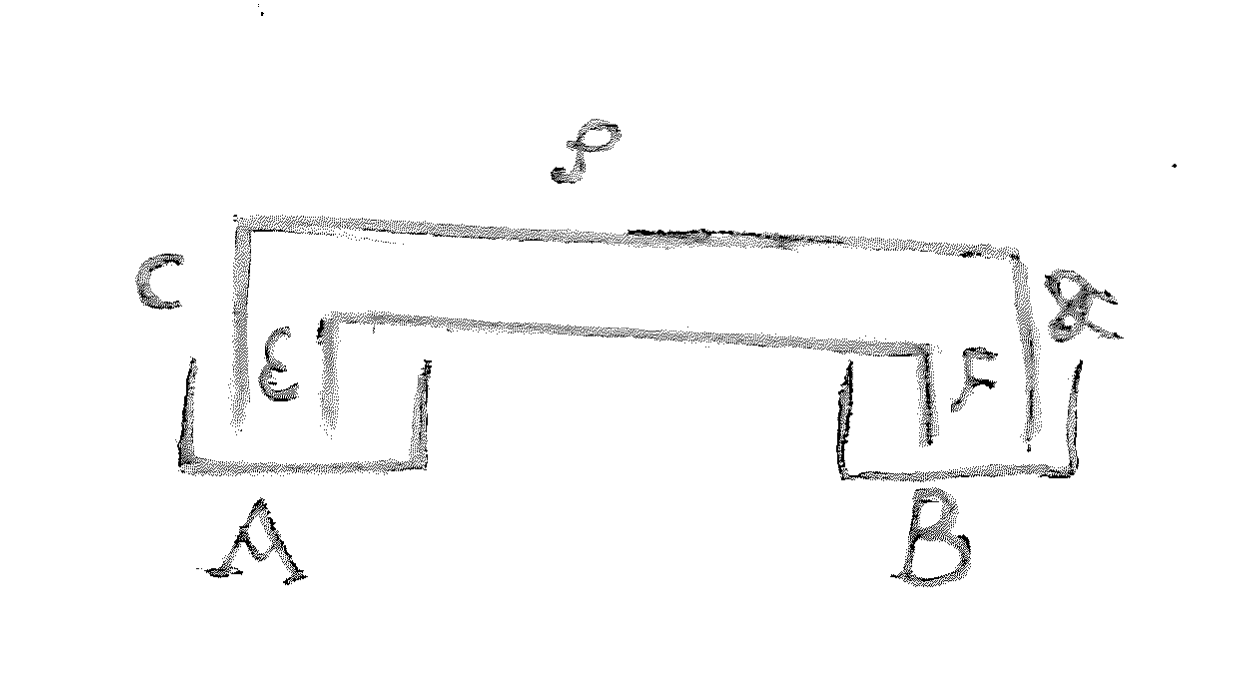
First fact.
A and B represent vessels containing nitric acid sp. gr. 1.35 and CPD a platina wire connecting them. If the oxidized end E of an iron wire EF be put into A, and F afterwards into B, F turns active, though a current passes from F through the acid into D. (Usual condition for calling forth the peculiar state)
Second fact.
If CPD be a wire of a metal, which is acted upon by the acid in A & B, for instance silver, copper, iron, brass &c., the end F of the iron wire will turn inactive on its being plunged into B, after the immersion of the oxidized end E in A. (The same takes place, if the middle part of the connecting wire P consists of Platina; and the ends C and D of Silver, Copper &c.)
Third fact.
If CPD be an iron wire, its end D inactive, C active, and the end E (not oxidized) first plunged into A and F afterwards into B, F turns inactive, that is to say assumes the state of D. (The inactive iron end D may be replaced by platina and the active one C by any metal, which is acted upon by the acid in A, without causing a change of result by so doing)
Fourth fact.
If every thing be precisely so, as in the foregoing case, but E oxidized and first put into A, F turns likewise inactive on its being afterwards immersed into B.
Fifth fact.
If CPD be again an iron wire the end D inactive (made so not by heating but by immersing it into strong nitric acid) and the end F put into B and E afterwards into A, not only E but also D turns active, whatever the number of wires may be similar to CPD, all their inactive ends in B turn active under the circumstances mentioned; though these wires do not touch each other at any point.
Sixth fact.
If the four electrodes of two piles (each consisting of about half a dozen of pairs of Zinc and Copper) be introduced into two vessels containing common nitric acid in such a manner, that the positive electrode of one pile and the negative one of the other dip into the same vessel and the oxidized end of an iron wire be plunged into any of the vessels and its ordinary end afterwards into the other one, the latter turns inactive, just in the same way, as if the two vessels were connected by a copper- wire. But to obtain this result it is required to bend up the second, that is to say the ordinary end, thus

pre‑vious to immersion.
Now why does F in the first case not become inactive by the current produced by its being plunged into B? It seems to be an indispensable condition for calling forth the inactive state in iron, that in the moment of its being immersed into the acid a current of a certain energy is passing through it. The current produced by the part of the metal immersed is of sufficient strength, when both ends of the iron wire plunge into the acid contained in only one (small) vessel; but when this same current has to pass through the acid of two vessels and besides to enter and issue into and from the connecting platina wire, its strength is diminished below the degree necessary for producing the effect in question. But if this way of accounting for the fact be correct, it is to [be] asked, how it comes, that with a connecting wire, whose ends are attacked by the acid of the vessels different results are obtained. It is obvious, that in the second case, two currents moving in opposite directions and originating in C and D are established, as soon as the iron wire EF has connected the vessels A and B. Besides these currents a third one is produced by the immersion of F in B. But this current having to make the same way, which the current in the first case must pass, why is its effect different from what that of the latter is? Now it seems to me, that if two currents of opposite direction circulate through our circuit of the second [case, they remo]ve in some way or other the obstacles, which the third current (in itself of weak power) would have to overcome, if it was moving alone through the circuit; or in other terms if two opposite currents cross the nitric acid, its conducting power for a third current is encreased. In the third case, there are likewise two opposite currents established, as soon as F dips into B; one produced by C the other by E; and there is again a current excited by F, which must be considered as the cause of the peculiar state of this end. It is only to be wondered at, why D when having been made inactive by immersion in strong nitric acid or by the help of platina, is not rendered active by the current produced by F; for from the same reasons, why F turns inactive, D should be thrown into action. But from many facts it appears, that a much stronger current is required to change the inactive state into the active one, than that current is, by which an ordinary wire can be rendered inactive. The fourth fact will be accountable, if we consider, that in this case, there comes a current from C to F, which added to that produced by F itself, becomes strong enough, as to call forth the inactive state in F, though it is still too weak, to render D active and probably only so on account of the absence of two other opposite currents. As to the fifth case, E turns active, because in the moment of its immersing there are no two opposite currents put into circulation; the current produced by E is therefore too weak, to excite in E the peculiar state and there are besides the two currents of C and F, which would more than neutralize the current of E. Now the current originated by F being continuous and besides powerful compared to that excited by an iron wire's turning inactive, would for itself throw D into action, but its energy is still encreased by the two opposite currents produced at C and E. About the sixth fact, I say nothing, as its connexion with the foregoing ones is sufficiently clear. I allow the inference, I have drawn from the facts stated, is rather hazardous and in apparent contradiction to the generally established principle, that two equal but opposite currents annihilate each other and that the circuit, through which such currents move is exactly in the same state, as if no currents were passing through it. But I think that without adopting my view of the subject the facts spoken of remain quite unaccountable. Whatever cause however, they depend upon, to my opinion they deserve to be closely searched into, as their minute investigation will no doubt, lead to some interesting result.
The last number of the "Bibliotheque universelle" contained a paper of mine "on the bearing of iron to oxigen["]2, which happens to be full of most unhappy misprints. They will, no doubt, be corrected in the forthcoming number3. I am very anxious to know your opinion about the contents of the said paper.
Begging your pardon for having repeatedly intruded upon you a badly written letter, I take the liberty of calling myself
Your's | very truly | Dr. Schoenbein
Bale Dec. 26th 1836.
Address: Doctor Faraday | Professor of Chemistry | at the Royal Institution | London
Bibliography
SCHOENBEIN, Christian Friedrich (1836b): “Sur la manière dont le fer se comporte a l'égard de l'oxigène”, Bibl. Univ., 5: 397-402.
SCHOENBEIN, Christian Friedrich (1837c): “Experimental Researches on a peculiar Action of Iron upon Solutions of some Metallic salts”, Phil. Mag., 10: 267-76.
Please cite as “Faraday0959,” in Ɛpsilon: The Michael Faraday Collection accessed on