Faraday to William Whewell 25 October 1837
R Institution | 25 Oct 1837
My dear Sir
I owe you many thanks for your kind letter1. Tomorrow I go to Brighton to write my paper2 in peace & quietness & shall not be able therefore to see you on the 1st of next month. I have thought over my matter a hundred times and am pretty sure; nevertheless the writing of it may suggest some views which if they occur I would like to catch before I come to you finally for words[.]
The words inductricity, inducteity3 cathodic & anodic I think are good - but as I shall have occasion to treat of the first principles of Electrical action I will just write my paper & then if the thing still seems to me clear submit the whole view to you at once.
You remember perhaps that I said I thought induction was not directly an action at a distance but an action of contiguous particles - that I think I shall establish4. Again I mentioned that I thought I had proofs that different insulating substances were not alike in their power of allowing or sustaining inductive action through them, of this I am not as yet quite so sure but am almost satisfied[.] Now what am I to call this capacity for induction if it stands my final test.
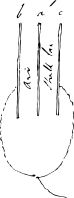
Put the point thus (which is almost the form of my experi‑ment) let a be an insulated electrified metallic plate & b & c uninsulated metallic plates with air between a & b, but shell lac between a & c: if the whole of the inductive force is called 27, then 10 shall be exerted between a & b whilst 17 is exerted between a & c though the intervals are in both cases the same 5[.] In my notes I say the Electric capacity of Air being 1, that of shell lac is 1.7 and so on; but I am not quite satisfied with the term electric capacity since I view the effect as one depending on the more or less ready polarity or other condition assumed by the particles between the inducing surfaces. Remember I am only giving you a case which I am still testing by experiment but I believe the difference exists. To make an unexceptionable experiment I have found very difficult[.]
Now do not laugh at me if I ask you not to speak of these things as yet to others. I may be delayed in my final proofs longer than I think, & then should wish to trust as little of my views to the honesty of the world as possible. If they are correct they must be of the utmost importance to every part of the theory of Electricity and have an influence on every form of its powers & effects: & it is but natural that I should like to review such matters as conduction, discharge, excitation, action of points &c &c &c &c &c in the hopes of arriving at some contingent & collateral discovery; - perhaps crystallization; - before others have pos‑session of the key. I do not mean to delay the matter but merely wish to render myself sure of the principle before I send it forth[.]
Ever My dear Sir | Your Obliged Servant | M. Faraday
Revd W. Whewell | &c &c &c
Address: Revd W. Whewell | &c &c &c | Trinity College | Cambridge
Bibliography
FARADAY, Michael (1838a): “Experimental Researches in Electricity. - Eleventh Series. On Induction”, Phil. Trans., 128: 1-40.
Please cite as “Faraday1045,” in Ɛpsilon: The Michael Faraday Collection accessed on