Faraday to William Whewell 10 August 1846
Tunbridge Wells | 10 Aug 1846
My dear Sir
I received your letter1 here this morning where I am resting a very stupid & giddy head. The head so continually gets out of order that I often make up my mind that I shall never do any thing more. I have not much to say to you further about light & magnetism & yet it so happens that what I have to say will meet in some degree part of your letter. My course of study, apparatus, and means do not enable me to supply the careful measures which as you say are so much to be desired but I have fallen upon a method of facilitating their estimation and of very greatly increasing the rotation. The peculiar character of the rotation & its dependance upon the lines of magnetic force led me to conclude that by silvering the polished ends of the diamagnetic employed I should be able to reflect the polarized ray to & fro several times within its substance & so accumulate rotation upon it for as the rotation is the same way as respects the line of magnetic force whichever way the ray was moving in the media so the amount of rotation due to one transit across the glass would be doubled by a second transit & tenfold for ten transits2[.] This proved to be the fact & you will understand the how by allowing the diagram to represent a parallellopiped [sic] of glass and the two surfaces a & b the silvered ends. A ray polarized by a
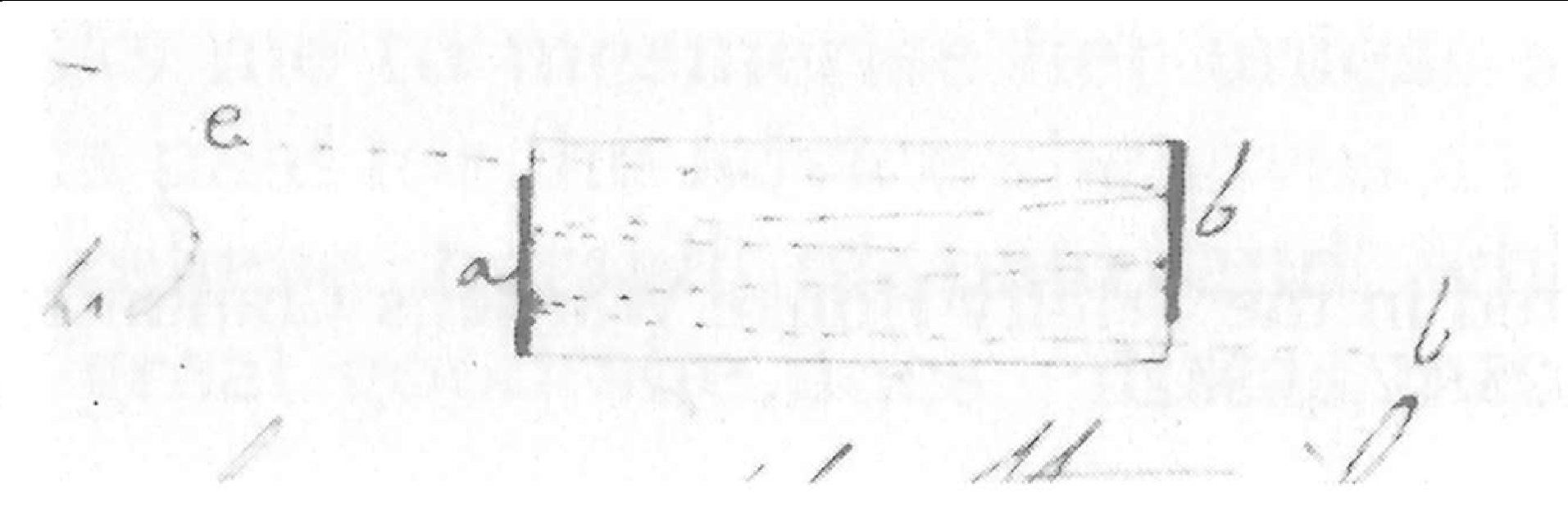
Nicholl eye piece passing from l may go diagonally across the glass & out at e - or by moving the glass a little it may be made to make two or four (as in the figure) or more reflexions within & then go out to e, and this gives rise to a series of images of the luminous object, the first of which is seen directly & the rest after reflexions. I have even traced these images up to the tenth which corresponds to nineteen transits of the ray across the diamagnetic. Placing this piece of glass over the magnet and arranging the apparatus so as to observe the rotation for the images in succession, I obtained for the first or direct image a rotation of 12˚, for the second image a rotation of 36˚ & for the third image a rotation of 60˚. Each of these images is of course much weaker than the last but it is easy with a strong light to observe the 4th, 5th, 6th, & 7th, which give very high results in numbers. I am just now writing a paper on this matter for the next Phil. Mag.3 and would rather you should not speak of it except confidentially until that appears.
I am very glad to hear you are preparing a new edition of your great work4. I do not remember a single thing that I could point out to you[.] I anticipate great pleasure and instruction from it.
Ever My dear Sir | Most Truly Yours | M. Faraday
Rev. Dr. Whewell | &c &c &c
Bibliography
FARADAY, Michael (1846f): “On the Magnetic Affection of Light, and on the Distinction between the Ferromagnetic and Diamagnetic Conditions of Matter”, Phil. Mag., 29: 153-6, 249-58.
Please cite as “Faraday1898,” in Ɛpsilon: The Michael Faraday Collection accessed on