Faraday to George Biddell Airy 17 April 1848
Royal Institution | 17 April 1848
My dear Airy
Your letters are always real letters & therefore it is a pleasure both to receive & answer them1[.] The time has often come into my thoughts & I will tell you briefly on what experiments I rest for my present opinion. Having such a magnet as the one you saw here and placing a copper wire helix either with or without an iron core between the poles having its wires connected with a galvanometer, we observe that when the magnet is made active a current is formed by induction in the helix & rendered sensible by the galvanometer. I find this current to have a sensible duration to be strongest at the first moment - & to weaken gradually until insensible. I can make it sensible for a second or even more & though it lasts longest when an iron core is in the helix it has duration for a time when the iron is away & the copper helix alone is concerned there being little difference in the two cases as to time.
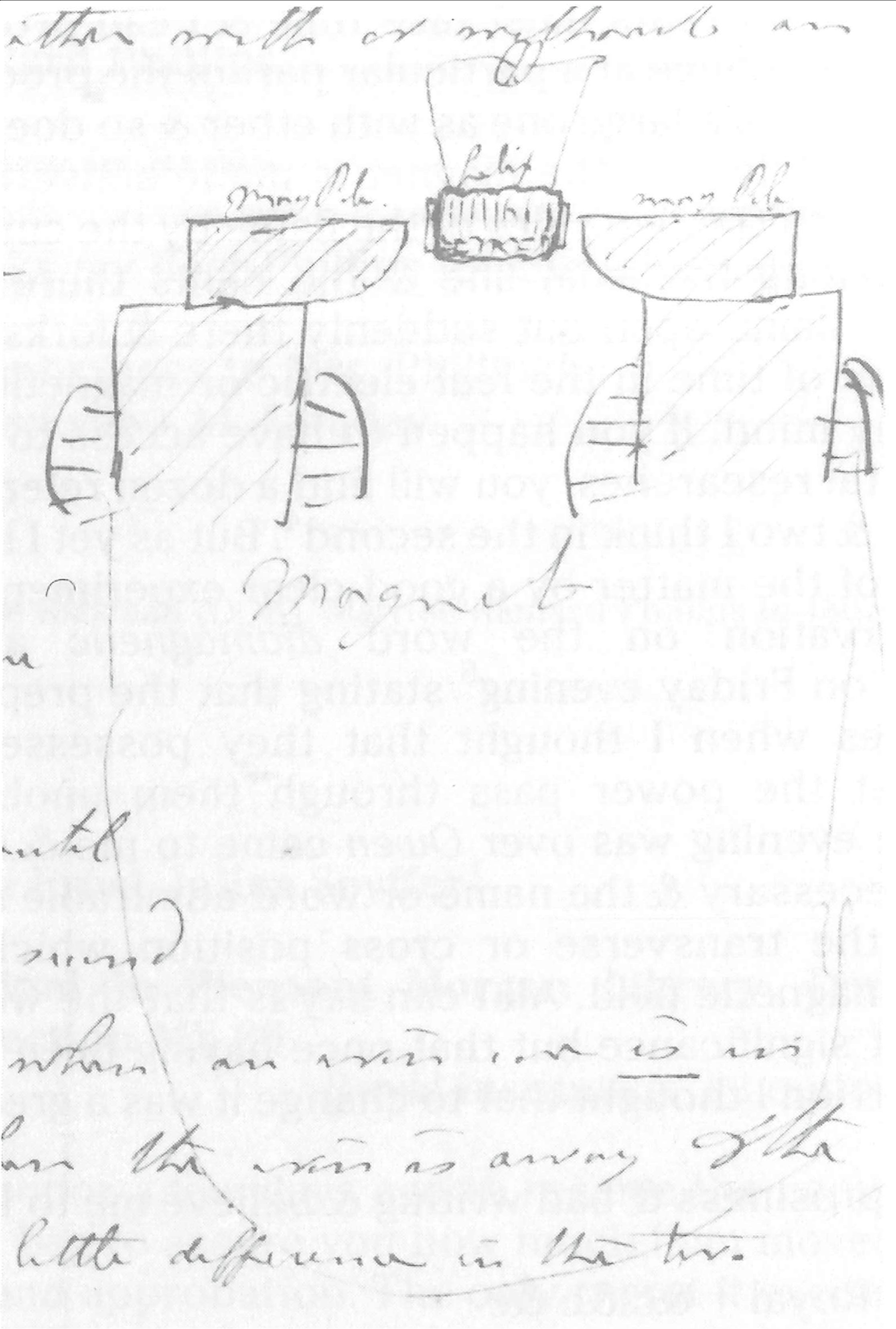
In the next place by breaking & making contact of the helix & galvanometer at one of the wires we can test the rising action of the magnet or the helix for any interval, it is easy by a wheel with pins & teeth, to divide the second during which the galvanometer shews that the current is continued into 20, 30, or any number of parts & to test for any one of these parts whether the power is then rising in the magnet. In this way I have ascertained that the power is rising in the magnet & that it is this continuous rise which makes the current at the galvanometer continuous[.]
So when on placing a piece of heavy glass between the poles of this magnet I found that its power of rotating a polarized ray rose gradually & when on placing the same piece of heavy glass between or within helices without iron cores I found that its power rose suddenly. I referred the gradual rise to the gradual development of power in the magnet rather than to the time required by the heavy glass to take up a certain state because this time is not necessary when helices alone are used. I do not say that time is not involved - but that the time which appeared necessary was necessary from another cause. You will see all this stated briefly in my letter to Taylor, Phil Mag. 1846, vol xxix p. 2572.
As therefore heavy glass does not appear to need a sensible portion of time to assume its state, so it did not appear to me likely that a gaseous medium would require more time in acquiring the same state[.]
But that the time referred in the case of flame is due to the cause I have assigned to it is to me satisfactorily shewn because it is easy to vary many of the conditions & vary the time with them & trace the currents all the while: & if you saw the experiments (which are long in description) you would see this at once. When a flame is rising between the poles there is of course a strong current of air &c up between the poles. Make the magnet active & the flame gradually shortens & when at a certain depression goes down suddenly still lower & forks out sideways & then there is a current of cold air downwards between the poles easily shewn by a little smoke properly applied[.] It is evident that this conversion of the direction of the currents must take time & I can prolong or shorten the time or stop the change at a particular part of the process at pleasure. Again when the flame is a large one as with ether & so does not shorten or sink down immediately that the magnet is made active one can see the impressions made on the two sides of the flame by the currents of air that flow in upon it along the axial line & the dents there form gradually increase until the flame open out suddenly there & forks as before[.]
The question of time in the real electric or magnetic phenomena is continually on my mind. If you happen to have access to the 8vo edition of my experimental researches, you will find a dozen references to time in the first volume3 & two I think in the second4. But as yet I have never been able to lay hold of the matter by a good clear experiment[.]
Your observation on the word diamagnetic amused me[.] I apologized for it on Friday evening5 stating that the preposition dia was applied to bodies when I thought that they possessed no magnetic condition but let the power pass through them unobstructed in its course. After the evening was over Owen came to me & said he thought the apology unnecessary & the name or word admirable since the dia so well expressed the transverse or cross position which these bodies assumed in the magnetic field. All I can say is that the word dia was not applied with that significance but that once having been used and being as a sound distinction I thought that to change it was a greater evil than to leave it[.]
Excuse my prosiness & bad writing & believe me to be truly Yours | M. Faraday
The Astronomer Royal | &c &c &c
Bibliography
FARADAY, Michael (1839b): Experimental Researches in Electricity, London.
FARADAY, Michael (1844b): Experimental Researches in Electricity, volume 2, London.
FARADAY, Michael (1846f): “On the Magnetic Affection of Light, and on the Distinction between the Ferromagnetic and Diamagnetic Conditions of Matter”, Phil. Mag., 29: 153-6, 249-58.
Please cite as “Faraday2073,” in Ɛpsilon: The Michael Faraday Collection accessed on