Faraday to William Whewell 10 October 1850
Folk[e]stone | 10, Octr. 1850
My dear Sir
I snatch a few moments to send you some account of the points I referred to in my last1[.] I will not occupy your time by leading you through the successive investigations which are described in two or three papers now sent into the R.S.2 but go at once to the chief results. Oxygen is a magnetic body in its gaseous state & rather strongly so. The kind of proof is this.
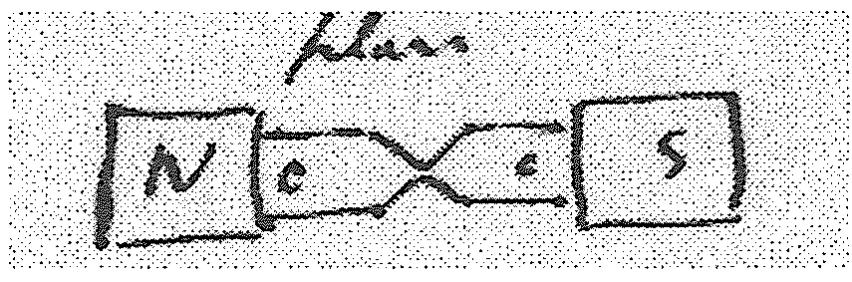 N & S are the poles of an electro magnet & cc are piece of soft iron connecting them but turned away in the middle[.] The consequence is that I have a strong field of action all round the attenuated part equal in force & condition[.] If I take two equal diamagnetic bodies
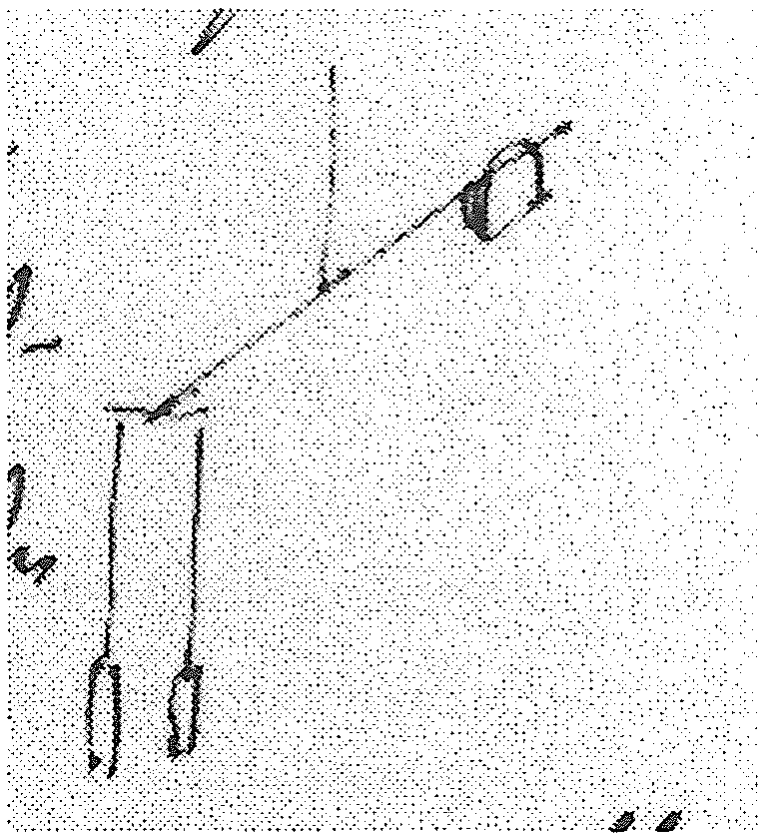 as for instance 2 glass cylinders & suspend these about 1 1/2 or 2 inches apart on a cross bar fixed to the end of a horizontal line supported by a fibre of cocoon silk & then adjust this so that the cylinders hang on opposite sides of the keeper described & then put on the magnetic power immediately the whole arrangement takes up a position in which the glass cylinders are equidistant from the core. If for one of the glass cylinders I substitute a cylinder of bismuth or phosphorous or a tube of water the two stand at different distances & by putting on a force of torsion (by a wire not a cocoon thread) I can measure the relative diamagnetic force of the bodies. I have a differential balance with the capability of measuring very accurately & yet of removing or at least balancing & estimating [the] interfering circumstance.
Now I have the power of examining gases at different pressure & different temperatures a power which I have long been searching after. First I prepare flint glass bulbs
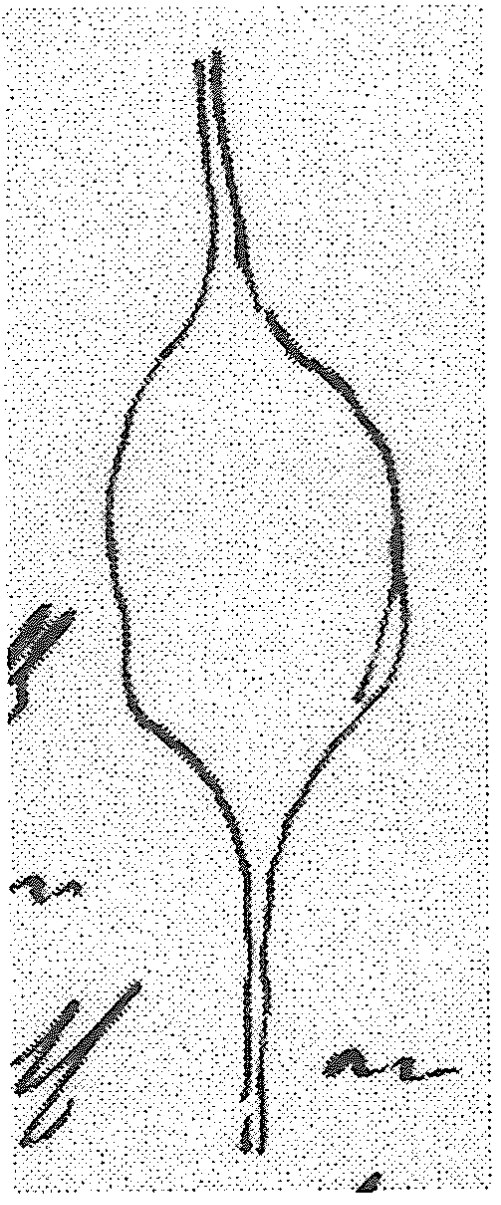 obtain them so as to be nearly equal in diamagnetic force[.] Then I fill them with gases & seal them up hermetically & I do this when the gas has been by the air pump reduced to half an atmosphere or a third or as nearly as may be to a vacuum, for I reason that if a body (gaseous) were diamagnetic it ought to become less diamagnetic by rarefaction or if magnetic less magnetic by rarefaction[.]
When two bulbs with Oxygen & Nitrogen were put up the oxygen went close up to the angle & the Nitrogen was carried out. With oxygen at 1 atmosphere & 1/2 atmosphere - the 1 atmosphere went up to the core the other out. A bulb with 1/2 atmosphere Ox against another of 1 atmosphere went out but against another of 1/3 of an atmosphere it went inwards. In fine the denser the oxygen the more magnetic it was & when I put a bubble containing 1/3 of a cubic inch of oxygen against an equal bubble containing only an oxygen vacuum, it went inwards with such power as to require force equal to 0.1 of a grain to carry it back to equidistance. With Nitrogen no such thing happens expansion causes no difference, and three bulbs being Nitrogen 1 atmosphere - Nitrogen Vacuum & Oxygen Vacuum. When compared against each other are alike. Nitrogen is neither Magnetic nor diamagnetic but stands at Zero. Oxygen is magnetic & in proportion to its quantity: Another experiment will give you a notion of the degree[.] I took crystals of proto sulphate of iron which is a pretty magnetic salt & dissolved it in water & diluted it until it was bulk for bulk equal to oxygen on the differential balance it then contained sulphate of iron equal to 17 1/2 times the weight of the oxygen which was opposed to it[.]
Now for another point in the Magnetism of Oxygen[.] Like iron it loses its magnetism or magnetic condition by heat & is at common temperatures in the condition of iron about to alter. You have a paper of mine about the diamagnetic condition of flame air & gases3 in which I shew that air heated by a platina helix is rendered more diamagnetic &c &c. Well all the effect there is due to the oxygen by very careful experiments I find that Oxygen rapidly loses its magnetic character by heat whilst Nitrogen Carbonic acid, &c are unchanged.
All these properties of oxygen it keeps in the atmosphere & I formerly shewed that by cooling the air it was made either more magnetic or less diamagnetic as the case might be. Now I know where the Zero is & that it is the oxygen of the air that was altering in its magnetic relation[.] Again I must refer you to the papers which are long but I trust not too long, for the steps of the reasoning by which I found upon this property of oxygen a branch of physics which I have called atmospheric Magnetism. I think I see the cause in the heating power of the Sun in the atmosphere for all the periodic solar variations of the needle both annual & diurnal & as far as I have gone the results of observations tally with the theory - besides these variations there are many others due to atmospheric changes & I am in hopes we shall be able to refer so many to this cause as to give us a far clearer view of the power as it exists in the Earth as its origin than we have hitherto had & so help us to discriminate that which belongs essentially to its source[.]
The postman is at the door & I must stop[.]
Ever Your Obliged | M. Faraday
Dr Whewell | &c &c &c
Bibliography
FARADAY, Michael (1847b): “On the Diamagnetic conditions of Flame and Gases”, Phil. Mag., 31: 401-21.
Please cite as “Faraday2327,” in Ɛpsilon: The Michael Faraday Collection accessed on