Nathaniel Barnaby to Faraday 26 April 18551
Department of the | Surveyor of ye Navy. | Whitehall. | April 26th 1855.
Sir,
With reference to the experiments made by you and Sir Humphry Davy in 1822-24 on the preservation of Copper Sheathing2, I wish to take the liberty of troubling you with a question.
The Iron and Zinc Protectors seem to have failed from two causes first. The conversion of the protecting metals into oxides, and the destruction of their influence, appear to have taken place before the Vessel could be docked to have the worn ones replaced, and Secondly. The rusty surfaces of the Protectors were nuclei for the deposition of earthy particles, and the formation of a bed for sea-weed, & shell-fish.
It has struck me that both these evils could be avoided, if the protectors were placed in a water-tight cistern inside the Ship, at about the height of the water line, so that a communication could be kept up between the inside of the Box, and the sea water without, by means of a tube:- one or more of the Bolts passing thro’ the bottom forming the connexion between the sheathing & the enclosed protectors - as shewn in the sketch.
If you see any objection to this, I shall esteem it a great favour if you will tell me in a few lines addressed to me here - otherwise I hope to be able to get the Admiralty to make some Experiments on it.
I have the honor to be Sir, | Very respectfully | Your obedient Servant | Nathl. Barnaby
Professor Faraday.
A. A vessel coppered inside and having its internal surface connected with the Bolt B, & <therefore> with the metal Sheathing, by means of a slip of Copper passing over the upper edge & down the outside.
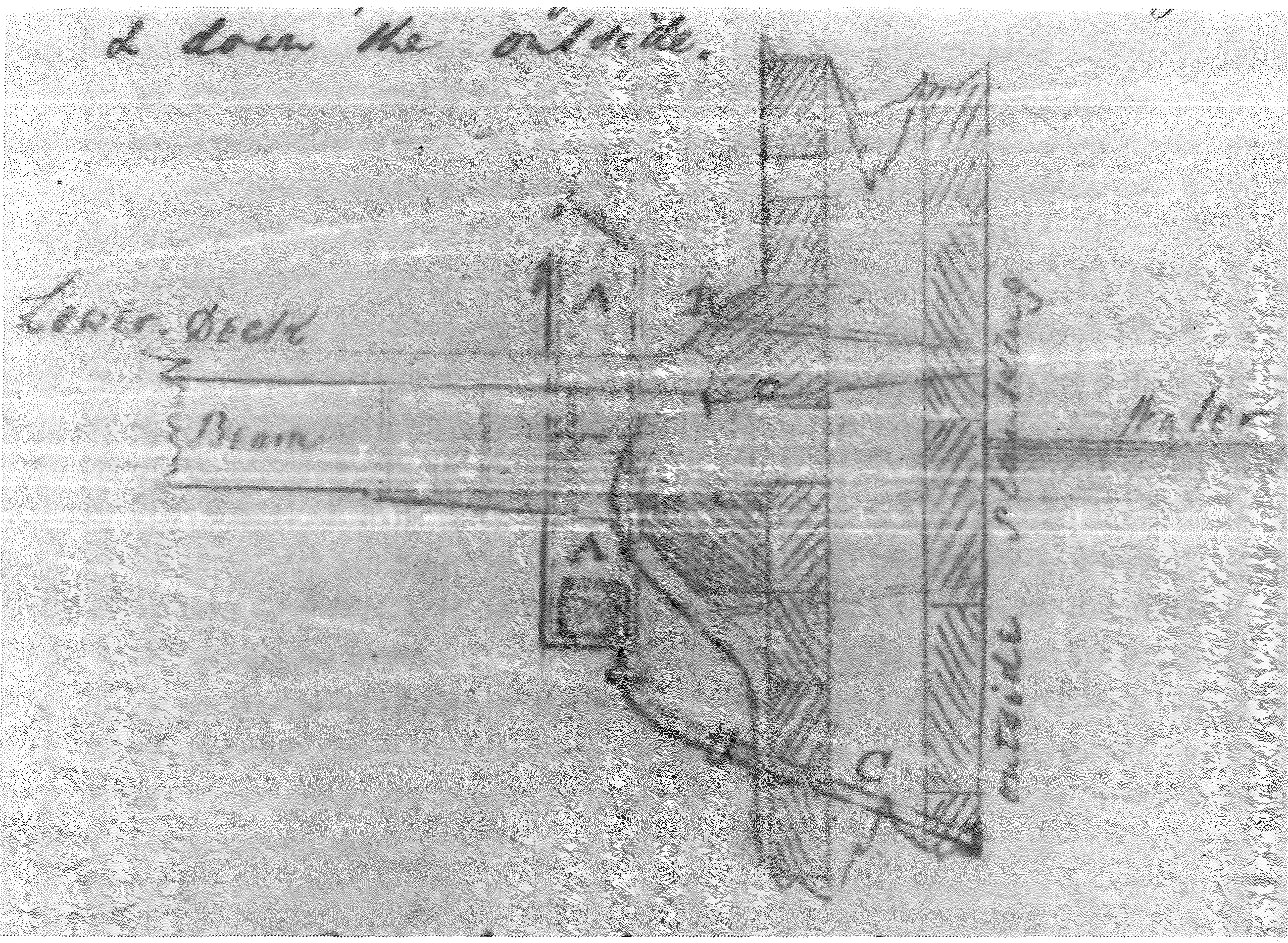
C - the tube which keeps up communication between the water in the cistern A & the sea
Address: M. Faraday Esqre F.R.S. F.G.S. &c &c | 21 Albemarle Street | London.
Bibliography
JAMES, Frank A.J.L. (1992a): “Davy in the Dockyard: Humphry Davy, the Royal Society and the Electro-chemical Protection of the Copper Sheeting of His Majesty's Ships in the mid 1820s”, Physis, 29: 205-25.
Please cite as “Faraday2978,” in Ɛpsilon: The Michael Faraday Collection accessed on