James David Forbes to Faraday 14 August 1858
Pitlochry | Perthshire | 14 Aug. 1858
M. Faraday Esq | &c &c &c
My dear Sir
I was very much obliged to you for your letter of the 23d July1 - & especially for the expressions of regard which it contains & which I can assure you that I heartily reciprocate.
I am also much obliged by your remarks on my little paper2; on which I shall not trouble you with more than a few additional words.
I hope however that you will resume consideration of a subject which you are so well able to illustrate & which is still to a certain extent obscure.
I cannot doubt that regelation takes place between Ice & Metals. The pile of shillings, though perhaps the simplest is not the only experiment I have tried; but is so easy that I hope you will repeat it. I have frozen in like manner a Bronze Letter presser of several pounds weight firmly to ice in a warm room: but this requires a long time.
I do not see any thing contradictory to the views which I have advanced, in the
other experiments you mention. The finely triturated Ice - or Mr. Harrisons3 crystalline laminae when in contact with an indefinite
mass of water
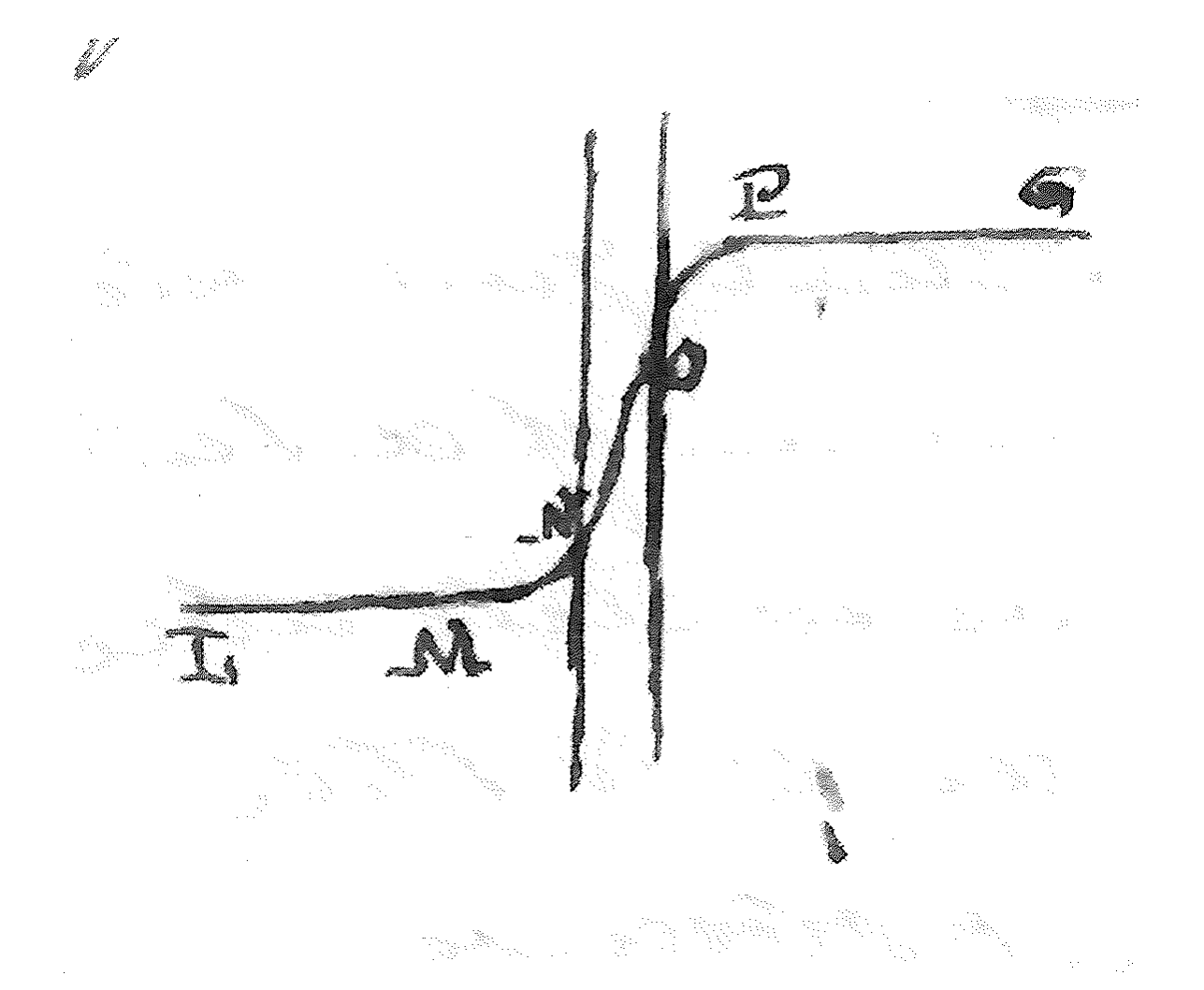 clearly belong to the portion of the curve in my figure between N and O, or to the physical
boundary between water & Ice having a temp. intermediate between 31.7 and
32.0 & possessing the plastic quality proper to that intermediate state,
just as in the case of wax, tallow, or fusible metal, when portions brought
into contact by a gentle pressure become moulded into one another’s substance
by molecular cohesion. Further in the case you mention where a quantity of
finely triturated particles of ice are taken in the hand and squeezed together,
I seem to understand perfectly why “regelation” takes place:- You have drained
or squeezed away all the perfect water from the mass,
& the molecules of plastic ice ceasing to receive heat from the perfect
water [which is operating a minute fusion at the surface of each particle without communicating the smallest quantity of heat to its
interior]4 the condition of the Ice becomes that
of more or less hard Ice not being in contact with perfect water, & this is
what is called regelation.
<->
I had last the pleasure of seeing you at Greenwich in Oct 18515. Since the end of November in that year I have been more or less of an Invalid - at times severely ill - which will account for my comparative inactivity in matters of Science. I trust that your health is good & will long continue so.
Yours sincerely | J.D. Forbes.
Bibliography
FORBES, James David (1858): “On some properties of Ice near its Melting Point”, Proc. Roy. Soc. Edinb., 4: 103-6.
Please cite as “Faraday3501,” in Ɛpsilon: The Michael Faraday Collection accessed on