George Biddell Airy to Faraday 9 March 1860
Royal Observatory, Greenwich, | London, S.E. | 1860 March 9.
My dear Sir
I wish to consult you about the location of magnetism in a steel bar - viz. a dipping needle1.
We have one needle of our dipping-needle-apparatus which without any visible reason gives us a great deal of trouble. Its results are very discordant, but the means of results (in masses) come out very fairly: but, they differ very steadily from the mean results of other needles by about ½ a degree.
The use of a dipping needle rests entirely on the assumption that, when the magnetism is reversed by the ordinary double-touch process, the new poles lie in the same line in which the old poles lay.
Now do you think it likely that there may be such perverse heterogeneity in the steel of the magnet that, when it is infected with one kind of magnetism, the magnetic axis may tend (steadily on the whole, though with some irregularity) to lie in one line: and that, when it is filled with the opposite magnetism, the magnetic axis may (steadily on the whole) be disposed to lie in a different line, inclined to the former at an angle of 1°?
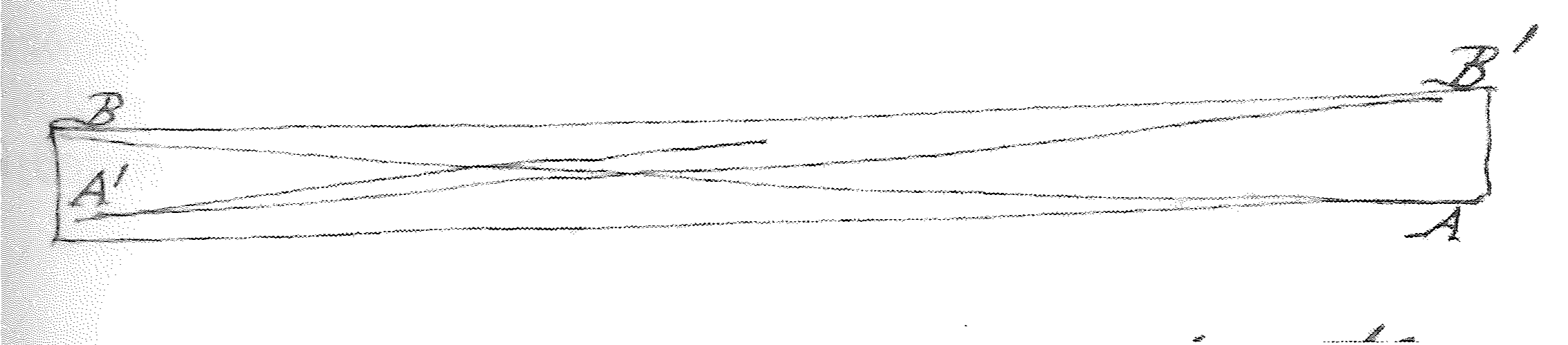
As thus:- B and A the boreal and austral poles at first, B’ and A’ the boreal and austral poles after reversion?
I am, my dear Sir, | Yours very truly | G.B. Airy
Professor Faraday | &c - &c - &c
Bibliography
AIRY, Wilfrid (1896): Autobiography of Sir George Biddell Airy, Cambridge.
Please cite as “Faraday3739,” in Ɛpsilon: The Michael Faraday Collection accessed on