Faraday report to Trinity House 19 October 1860
Report on Experiments at Whitby in relation to the focal points of lighthouse apparatus
The experiments referred to in the Report of the 14th September1 have now by the authority of the Trinity House been carried out not only in London & Birmingham but also at Whitby; and the Deputy Master2 with certain of the Brethren have there entered into an examination of the results.
The south light at Whitby was inferior on the former visit to the North light, though both lamps were of the same construction. That in the North house was left unchanged to serve as a standard, that in the South house was changed for one with four wicks & a plentiful over flow; and the light it now gives is not merely considerably more than before, but more than that of the North Light. It has burnt well from the first. The average proportion of oil consumed in a fortnight is 15 pints for the South Light and 13 pints for the North Light per 12 hours: these quantities accord with the proportion of light which they really give.
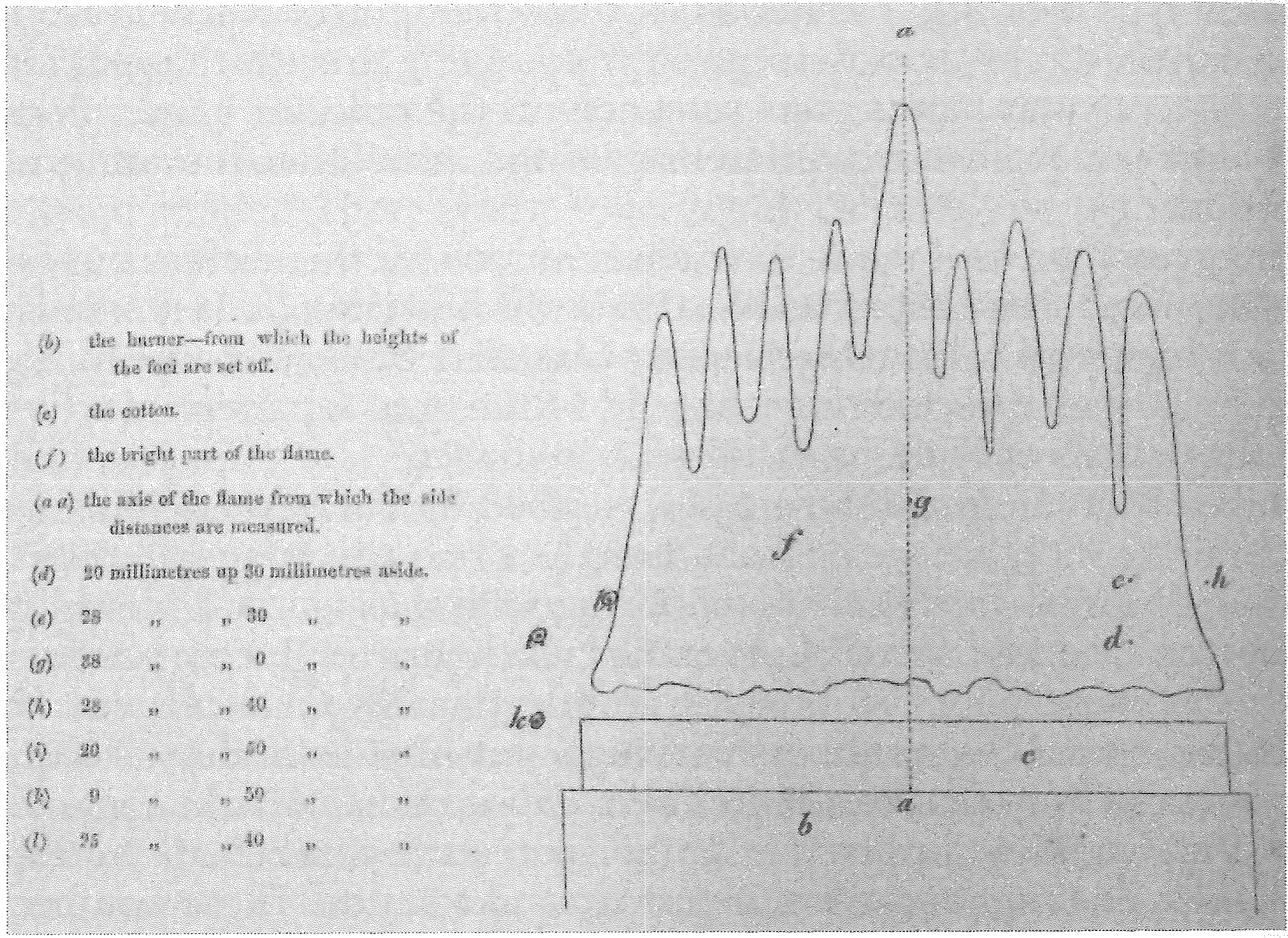
In reference to the Focal changes and adjustments the following arrangements were made. There were four equal Octants, or eights, of glass apparatus, with a central lamp to the whole. Each had its three parts: the lenticular band, the upper, and the lower reflectors. The lenticular part is the most powerful:- the upper reflectors come next; and the lower reflectors are last. The adjustment is made, first by the elevation of the lamp for the lenticular band and after that by the position of the prisms for the reflector part. The lenticular part is (in the Whitby case) adjusted for all the Octants at once. The French focus for this part has been adopted, namely, 28mm above the burner; but the French authorities send the chief ray on a horizontal level for a light of such a height as Whitby; whereas, I have sent it down to the sea horizon. No. III Octant was selected to represent the French adjustment; but it was impossible, whilst regulating the lenses of the other Octants, to separate this from them; so that it had an advantage in the comparison, as respects this lens part:- As to the reflectors, however, the focus for the upper set is 38mm above the burner in the axis of the flame; and 9mm up and 50 aside for the lower set:- these were adjusted accurately in the lighthouse to the true horizon or dead level.
The other Octants had each a pair of common foci for the reflectors
No. I focus for the upper reflectors and was 20mm up & 30 aside – for lower reflectors 20 up – 50 aside
II <-> 28- up 30 <-> 20 – 50 -
III (was the French) <-> 38- up 0 <-> 9 – 50 -
IV <-> 28- up 40 <-> 9 – 50 -
the octants I, II, and IV had their adjustments made to the Sea horizon.
The intention of all these arrangements was to discover & establish (what was expected on principle) that much light hitherto thrown up into the sky, might be disposed of on the sea between the distance & inshore, without any diminution of the light on the sea horizon;- and, that if particular regions in certain directions short of the horizon required an especial amount of light, which foci were proper for such a purpose.
The night sea voyage was so arranged that the various Octants (with all the light on) could be observed at different distances as the ship went out; the effect of the change from the one to the other being remarked; and at the same time a continual comparison with the unchanging North Light be made. On returning towards land the lens part of all the octants was blinded, so that a like comparison of the reflectors without the lenses could be made over the same series of distances[.]
When in shore i.e about a mile or 1½ miles off the Octants I, II, & IV surpassed the French Octant as was expected;- the same effect continued when further out but diminished in proportion. At 10, 12 & 14 miles out the difference between the Octants diminished; but the French Octant never surpassed No. II or No. I and was as some thought rather beneath them;- the constant N light was most important in helping to settle these differences. When the lenticular bands were screened off the reflector bands alone gave bright light but there were differences of the same kind though greater in proportion.
Every one present made their observations for themselves but I believe with a like result. I had expected No. II to be the best if not the best arrangement and I am happy to believe the Deputy Master & brethren came to that conclusion since they directed that it should be the type & pattern of adjustment for all the octants of both the Whitby Lighthouses[.]
Like observations to those just described had been made on shore and with the like result; but we had not then the same advantage of observing at very long distances, nor that of comparing with the standard North light.
On the Monday3 we wrought at the Lighthouse for the purpose of verifying or correcting the focus for the lower reflectors. Mr. Chance, in making the adjustment, found that numbers varying somewhat from those I had given, and even more from the French numbers, caused the rays to be more parallel; and as they were to supply the sea horizon such parallelism would be an advantage[.] The numbers were 25mm up and 40 aside. These numbers were used on the night of the sea observations. By trial I became satisfied of the reality of the advantage, and recommend these numbers to be adopted for the lower reflectors[.]
All the time we were at Whitby (8 or 9 days) Mr Chance & myself were occupied in learning, practising new methods of adjustment & correction, and using new instruments;- and I cannot say too much in thanking Mr. Chance for the earnest & intelligent manner in which he has considered & worked every point out. The method of adjustment is now so perfect, that the authorities can hardly require more accuracy than the manufacturer can ensure. The Trinity house may direct, at its pleasure, that the light of one part of an apparatus, shall be thrown chiefly in one direction as the sea horizon and that of another part in another relative direction, as nearer to the coast: and I have no doubt that, if the Electric light or any other of the compressed intense illuminations be hereafter adopted, the principles & methods of adjustment now devised & carried into practice will prove of very great and special advantage4.
M. Faraday
Royal Institution | 19 October 1860.
Position 5 of the experimental common foci for the upper and lower reflectors situated on the left hand side the flame represented in the figure.
The words “common focus” are intended to express that point from which the rays which lie in a plane passing through it and the axis of the flame and apparatus, and also through the middle of the pieces of glass associated in one pannel (as of the upper or lower reflectors) shall be made by adjustment to proceed to any given spot, as for instance, a point on the Sea horizon.
Please cite as “Faraday3865,” in Ɛpsilon: The Michael Faraday Collection accessed on