From Karl Hermann Knoblauch 21 July 50
Marburg, 21 July 50.
Verehrter Herr Tyndall,
Den innigsten Dank sage ich Ihnen für alle Nachrichten welche Sir mir in Ihrem Briefe v. 3.n [o.] (den ich vor 8 Tagen empfing) zukommen lassen. Wir haben vom Stauffenberg an dem Tage, an welchem ich Sie begleitet hatte, eine fabelhafte Rückfahrt gehabt. Die Postillone waren nämlich in dem Grade betrunken, dass sie nicht reiten konnten, Neumann den einen Wagen fahren musste, und die beiden andern völlig unbenutzbar wurden. Sie können nun denken, wie sich auf dem einzigen Rettungsboot die ganze Schiffbruch leidende Mannschaft zu vereinigen suchte, so dass auf dem einen für 15 Personen berechneten Leiter-Wagen schliesslich 33 – ich kann nicht sagen: Platz, aber doch eine Art von Unterstützung ihres Schwerpuncts – gefunden hatten. Obgleich nicht überzeugt, dass in einen Raum, in dem sich schon 18 Ueberzählige befinden, nicht auch noch beliebig mehr aufgenommen werden könnten, musste sich ein Theil der Gesellschaft entschliessen, bis zur Neh-Brücke zu Fuss zu gehen, wo sich endlich Gelegenheit zu fahren darbot. Die Uebrigen aber gelangten nachdem sie mehrmals gegen Stein-Haufen und in den Chaussee-Graben gefahren, einen entgegenkommenden Omnibus (bei der Unmöglichkeit auszuweichen) bedeutend beschädigt hatten, in der beständigen Gefahr umzuwerfen, bei stockfinsterer Nacht um 2h nach Marburg.
Ich habe mich sehr gefreut zu hören, dass Sie Faraday’s Bekanntschaft gemacht haben, und es ist mir sehr lieb, ein Stück seines schweren Glases zum Behuf der electrisch optischen Erscheinungen zu erhalten. Von meinem Vetter aus Bonn erfahre ich, dass Plücker unerschütterlich an seiner Theorie festhält und die Absicht hat, uns auf eine mathematische Abhandlung zu verweisen, welche nächstens in Crelle’s Journal erscheinen wird, und worin er die Kräfte so definiren will, dass sie zur Erklärung aller Erscheinungen ausreichen. Attendons! Mir kommt das Festhalten an der optischen Axe bei diesen Wirkungen so vor, als ob man mit den Newtonʼschen ‚fits of light’ gegen die Undulationstheorie ankämpfen wollte. –
Plücker hat (wie mir mein Vetter vertraulich mittheilt) u. U. 2 Experimente angestellt, welche – seiner Ansicht nach – uns widerlegen: 1) habe ein – mit der Axe vertical gehängter Kalkspath nicht 3, sondern 4 Gleichgewichts-Lagen. 2) Von 2 magnetischen Kalkspathen stellte sich der eine mit der optischen Axe axial, der andre äquatorial; von 2 diamagnetischen Kalkspath<en> der eine äquatorial, der andre axial. –
Ich habe starken Verdacht dass es sich bei dem 1n Exp. um eine lokale Wirkung, bei dem 2n um einen Einfluss der vielleicht nicht ganz reinen Oberfläche handelt. Aber gesetzt auch, es wäre dies bei dem 2n Exp. nicht der Fall, so ist es sehr leicht möglich dass bei der Beurtheilung z.B. des Magnetismus aus der Anziehung von einem Pol bei gemischten Substanzen (wie der magnet. Kalkspath ist) die magnetische Resultante überwiegen kann u. doch, beim Aufhängen zwischen den flachen Polen, die diamagnetische (Entsprechend dem sogenannten: eisenfreien Turmalin etc.) In allen diesen Fällen kann nur die chemische Analyse Aufschluss geben, indem sie die Verhältnisse angiebt, in denen die magnetischen u. diamagnetischen Bestandtheile mit einander gemischt sind.
Mitscherlich hat mir seine Abhandlung aus den Academie-Berichten geschickt. Sie enthält aber nichts wesentlich Verschiedenes von dem, was wir bereits aus Poggend. Annalen kennen. Gauss soll (wie ich von Bunsen höre) Winkel an Krystallen bis auf Bruchtheile von Secunden gemessen haben. Aber er so wenig wie Gerling (Gauss’s Schüler) konnten mir etwas über die Methode (welche nicht veröffentlicht worden ist) mittheilen.) Es wäre vortrefflich, wenn Sie auf Ihrer Rück-Reise über Göttingen gehen und sich dort über die Sache orientiren könnten. Ich wäre gern bereit die Mittel zur Anschaffung der Instrumente herzugeben, falls Sie die Ueberzeugung gewinnen, dass wir damit sicher die uns zunächst liegenden Ausdehnungsversuche (namentlich mit Schwerspath, Turmalin, Bergkrystall etc) ausführen könnten. –
Ich habe meine Dreh-bank aus Berlin kommen lassen, welche beim Bearbeiten der Krystalle eine sehr wesentliche Erleichterung darbietet. Mein Bediente<r> (den ich seit July angenommen habe) weiss bereits damit umzugehen und verfertigte mir neulich auf derselben einen Cylinder von Schwerspath innerhalb 10 Minuten. Mein Vater hat mir eine Wheatstonesche Polar-Uhr zum Geschenk gemacht. Sie kennen gewiss dieses sinnreiche Instrument: eine Sonnenuhr ohne Sonnenschein, eine Sonnenuhr auch bei Nacht.
Von Plücker ist im letzten Heft der Annales de Chimie et Physique eine lange Abhandlung erschienen; aber sie enthält für uns nichts Neues.
Die Formel, von welcher Dove seine Methode abgeleitet hat, das posit od. negat. Verhalt. der Krystalle zu erkennen ist die von Airy (Pogg. Ann. XXIII p. 228 – Jahr 1831. – Transact. of the Cambridge Philos. Society):

worin: I die Intensität des Lichts; 

 , Einfallswinkel des Lichts auf die Krystallplatte,
 , [Brechungsverhältniss] des ungewöhnl. Strahls
 , " " " " " " " gewöhnlich. " " "
T, Dicke der Platte.
 , Intensität der einfallenden Strahlen.
 , Winkel der Reflexions-Ebene des analysirenden Spiegels
mit der " " " " " polarisirenden " " .
 , das Azimuth des, zwischen dem polarisirend. Spiegel u. der Krystallplatte eingeschalteten, Fresnel’schen Parallelepiped. (
 , v. der [1n] Polarisat. Ebene an [gezählt])
 , Winkel, den der [Hauptschnitt] des Krystalls, (gelegt durch die Richtung der einfallenden Strahlen) mit der Polarisations-Ebene bildet.
 , Wellenlänge in der Luft für eine bestimmte Farbe.
Setzt man in der allgemeinen Formel  =45º, so wird:

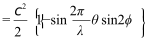
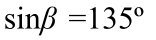 wird

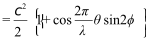 .
Diese Werthe von I stellen die Intensität des Lichtes dar wenn dasselbe (z.B. durch ein Glimmerblatt) circular polarisirt ist, durch eine Krystallplatte hindurchgeht und alsdann linear analysirt wird
Für das Experiment stellen sich im circular polarisirten Lichte, statt der einfachen Ringe, welche – auf gleiche Weise bei negativen u. posit. Krystallen im linear polarisir. Lichte sich darstellen, - discontinuirliche Kreise: wie: 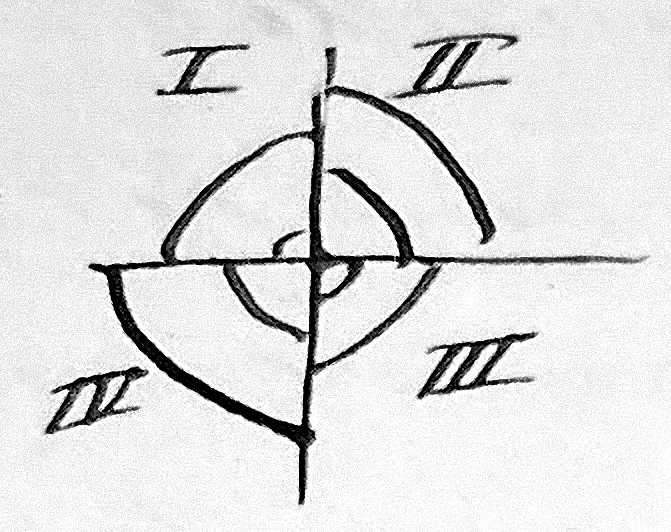 oder
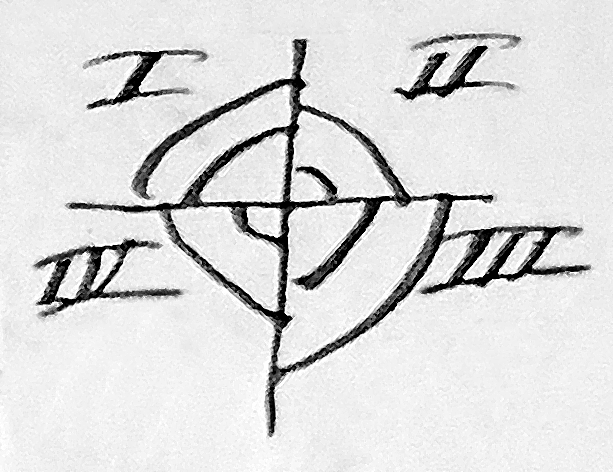 dar; je nachdem der Krystall negativ od. posit. ist.
Stellt z.B. ein zu prüfender Krystall (einaxig.), vertical [geschnitten], gegen die Axe, diejenige dieser Figuren dar, welche auch Kalkspath zeigt, so ist er negativ; stellt er die des Bergkrystall dar, positiv.
Bei optisch 2 axigen Krystallen lassen sich die Ringtypen negativer u. positiver Krystalle im linear polarisirten Lichte ebensowenig wie die der einaxigen von einander unterscheiden. – Im circular polarisirten Lichte erhält man Figuren wie: 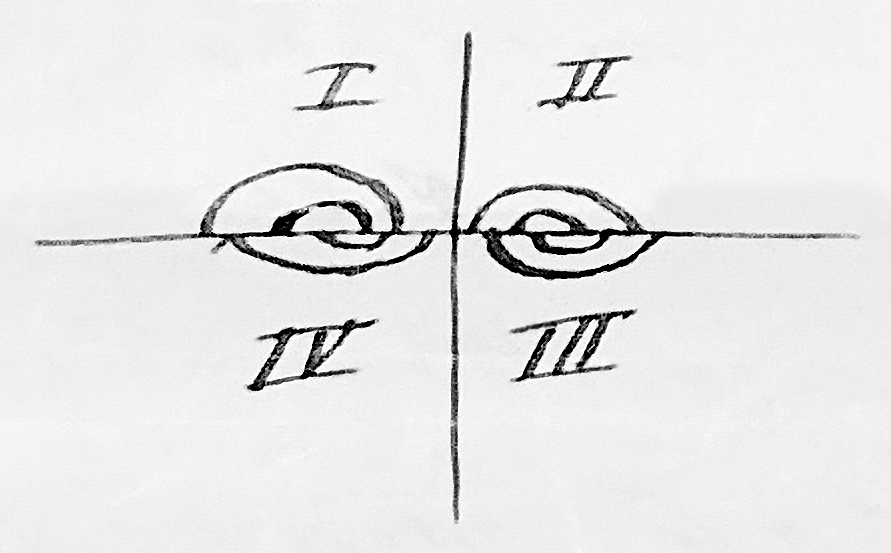 oder:
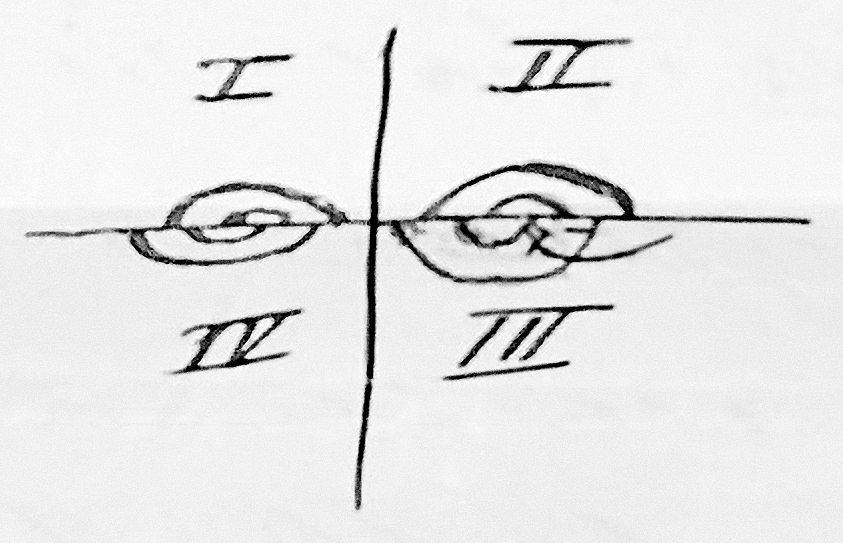
(worin immer I und III sich II <und> IV entsprechen) je nachdem d. Krystall negativ od. positiv ist. Stellt z.B. ein zu prüfender Krystall (2 axig) vertical geschnitten gegen die Mittellinie, diejenige dieser Figuren dar, welche auch Glimmer oder Arragonit zeigt, so ist er negativ, stellt er die Figur des Topases dar, positiv.
Ich habe hier die Hauptsachen mitgetheilt, das Nähere findet sich im Original: Pogg. Ann. XL., p.457 für einaxige; p.482 für 2 axige Kryst. Der Beschreibung des Experiments bei den letzteren ist keine Formel hinzugefügt worden. Die Airy’schen sind, meines Wissens, überhaupt nicht weiter als auf einaxige Krystalle ausgedehnt worden.
In diesen Tagen habe ich eine neue Beobachtung hinsichtlich der strahlenden Wärme gemacht, nämlich dass dieselbe – wie ich vermuthete – den Turmalin längs der Axe in geringerem Verhältniss als nach andern zu durchdringen vermag.
Die unter unser beider Namen erscheinende Abhandlung über die letzte Versuchs-Reihe habe ich leider noch immer nicht fertig machen können. Ich bin jetzt gar zu sehr beschäftigt; indess ist meine Zeit von der nächsten Woche an freier und ich kann alsdann ungestörter daran arbeiten. – Am Mittwoch hielt ich meinen Antritts-Vortrag in der Naturforschenden Gesellschaft. –
Fräulein Fulda hat sich mit meinem Collegen Prof. Vorländer verlobt. – Sie selbst sind Allen hier in bestem Andenken u. Alle werden sich sehr freuen, Sie hoffentlich bald wieder zu sehen.
Ganz besonders wünscht dies von Herzen
Ihr treuer Freund | Herm. Knoblauch.
Ich war ganz überrascht zu hören, dass meine Arbeiten über Wärme ins Englische übersetzt [worden] sind. Ich kann nicht zweifelhaft sein, dass dies auf Ihre Veranlassung geschehen ist und sage Ihnen meinen besten Dank dafür. Gestern machten wir eine Parthie nach d. Frauenberg. HK.
RI MS JT/1/K/14
Marburg, 21 July 50.
Dear Herr Tyndall,
I give you my deepest thanks for all the news which you send me in your letter of the 3rd [inst.]1 (which I received 8 days ago). We had a splendid trip back from Stauffenberg2 on the day I accompanied you. The coachmen were drunk to the degree that they were unable to ride; Neumann had to drive one carriage, and the other two became completely unusable. You can just imagine how the whole ship-wrecked crew sought to assemble in the single lifeboat, with the result that on a cart meant to take 15 people, 33 eventually found – I cannot say: a place – but rather a kind of support for their centre of gravity. Although not convinced that any number more could still not be accommodated in a space in which there were already 18 people in excess of the limit, part of the company went and decided to go by foot as far as Nehbrücke,3 where the opportunity of driving finally presented itself. The rest, however, after driving several times into piles of stones and into roadside ditches, seriously damaging an oncoming omnibus4 (there being no possibility of getting out of the way), and being in constant danger of overturning, eventually reached Marburg in pitch-dark night at 2 o’clock.
I was very pleased to hear that you have made Faraday’s acquaintance, and I am delighted to receive a piece of his heavy glass5 with a view to the electrical optical phenomena. I hear from my cousin in Bonn that Plücker is holding unshakably to his theory,6 and intends to refer us to a mathematical paper which will appear shortly in Crelle’s Journal,7 and in which he will define the forces in such a way that they will suffice to explain all the phenomena. Attendons! Holding fast to the optical axis with these effects seems to me as if one wanted to do battle with Newton’s “fits of light” against wave theory.8 –
Plücker has (as my cousin confidentially informs me) possibly done 2 experiments9 which – in his view – contradict us: 1) a calcite crystal with the axis suspended vertically does not have 3, but 4 equilibrium positions. 2) of 2 magnetic calcite crystals, one sets axially with the optical axis, the other equatorially; and of 2 diamagnetic calcite crystals one equatorially, the other axially. –
I have a strong suspicion that with the 1st exp. it is a question of a local effect, and with the 2nd of an influence of a perhaps not completely clean surface. But assuming also that was not the case with the 2nd exp., then it is very easily possible that with the finding, e.g., of magnetism from the attraction of one pole in mixed substances (as magn. calcite crystal is), the magnetic resultant can predominate, and yet, when suspended between flat poles, the diamagnetic (corresponding to the so-called: iron-free tourmaline etc.) does. In all these cases, only chemical analysis can give information, in that it gives the proportions in which the magnetic and diamagnetic constituents are mixed with one another.
Mitscherlich has sent me his paper from the Academie-Berichte.10 However, it does not contain anything substantially different from what we already know from Poggendorff’s Annalen. Gauss is supposed (as I hear from Bunsen) to have measured the angles on crystals to fractions of seconds. But neither he nor Gerling (Gauss’s pupil) could tell me anything about the method (which has not been published). It would be excellent if you could go via Göttingen on your trip back and while there put yourself in the picture about the matter. I would be quite happy to put up the money to purchase the instruments, in the event you become convinced that we could definitely carry out with them the expansion experiments we need to do first (particularly with baryte, tourmaline, quartz etc). –
I have had my lathe sent from Berlin, which makes things very considerably easier when machine-working crystals. My servant (whom I have employed since July)11 already knows how to use it and recently made me a cylinder of baryte on it within 10 minutes. My father has given me a Wheatstone polar-clock12 as a present. You will certainly know this ingenious instrument: a sundial without sunshine, a sundial even at night.
A long paper by Plücker has appeared in the latest issue of Annales de Chimie et Physique;13 but it contains nothing new for us.
The formula, from which Dove has derived his method of identifying the posit. or negat. behaviour of crystals is that of Airy (Pogg. Ann. XXIII p. 228 – year 183114 – Transact. of the Cambridge Philos. Society)15:

in which: I is the intensity of light; 

 , angle of incidence of light onto the crystal plate,
 , [refractive ratio] of the extraord. ray
 , " " " ordinary "
T, thickness of the plate.
 , intensity of the incident rays.
 , angle of the reflection plane of the analysing mirror
with " " " " " polarising " .
 , the azimuth of the Fresnel parallelepiped inserted between the polaris. mirror and the crystal plate. (
 being counted from the [1st] polarisat. plane onwards)
 , angle which the [plane] of the crystal (laid through the direction of the incident rays) forms with the polarisation plane.
 , wavelength in air for a specific colour.
If one inserts  =45º in the general formula, one obtains:

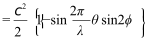
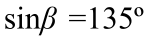 obtains

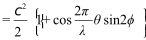 .
These values for I represent the intensity of light when it is circularly polarised (e.g., by using a sheet of mica), goes through a crystal plate, and is then analysed linearly.
For the experiment, discontinuous circles like
or
appear in circularly polarised light, depending on whether the crystal is negative or posit., instead of simple rings, which appear in the same way with negative and posit. crystals in linearly polarized light.
If, for example, a crystal to be tested (uniaxial), [cut] vertically against the axis, displays those of these figures which calcite also shows, then it is negative; if it displays those of quartz, positive.
With optically 2-axial crystals, the types of rings of negative and positive crystals can be distinguished from one another in lineally polarised light just as little as those of uniaxial ones can. – In circularly polarised light one obtains figures like: or:
(in which I and III always correspond to II <and> IV), depending on whether the crystal is negative or positive. If, for instance, a crystal to be tested (2-axial), cut vertically against the middle line, displays those of these figures which mica or aragonite also show, then it is negative, if it displays the figure of topaz, positive.
I have communicated the main points here; further details can be found in the original: Pogg. Ann. XL., p. 457 for uniaxial cryst<als>; p. 482 for 2-axial ones.16 No formula has been appended to the description of the experiment with the latter. Airy’s ones have, to my knowledge, not been taken any further at all than uniaxial crystals.
The other day I made a new observation with regard to radiant heat, namely that it – as I suspected – is able to penetrate tourmaline along the axis at a lower rate than in other directions.
I have unfortunately still not been able to finish the paper about the last series of experiments which is appearing under both our names17. I am much too busy now; however, my time will be freer from next week onwards and I can then work on it with less interruption. – On Wednesday I gave my inaugural lecture in the Naturforschende Gesellschaft. –
Fräulein Fulda18 has got engaged to my colleague Prof. Vorländer.19 – Everyone here has the fondest memories of you and everyone will be happy to see you again, hopefully soon.
With the most heartfelt wishes for this
Your loyal friend | Herm. Knoblauch.
I was quite surprised to hear that my works on heat have [been] translated into English.20 I can be in no doubt that this has happened at your instigation and give you my best thanks for this. Yesterday we went on a trip to the Frauenberg.21 HK.
letter of the 3rd [inst.]: letter missing.
Stauffenberg: misspelling of Staufenberg, a town in the district of Gießen, Hesse, Germany along the Lahn River.
Nehbrücke: situated about 6 miles south of Marburg along the Lahn River.
omnibus: a large public vehicle carrying passengers by road, running on a fixed route and typically requiring the payment of a fare (OED).
heavy glass: this refers to the glass Faraday used to discover the Faraday effect. It contained traces of lead also known as boro-silicate of lead.
his theory: see letter 0395, especially n. 20.
mathematical paper … Crelle’s Journal: this paper never appeared. Plücker may have been referring, not to his own paper, but to W. Thomson and G. Green, ‘An Essay on the Application of mathematical Analysis to the theories of Electricity and magnetism’, Journal für die reine und angewandte Mathematik 39 (1850), pp. 73–89.
Newton’s “fits of light” against wave theory: Newton believed in the particle nature of light. Yet, his ‘theory of fits’ seemed compatible with (indeed, supportive of) a wave theory as well.
Plücker has (as my cousin confidently informs me) possibly done 2 experiments: not identified.
Mischerlich … Academie-Berichte: Eilhardt Mischerlich’s work, but the paper is not identified.
My servant (whom I have employed since July): not identified.
Wheatstone polar-clock: Wheatstone presented his instrument to the BAAS meeting in 1848 in a paper entitled, ‘On a means of determining the apparent Solar Time by the Diurnal Changes of the Plane of Polarization at the North Pole of the Sky’. It was published in Brit. Assoc. Rep., 1848 (pt. 2), pp. 10–12.
Long paper by Plücker… Annales de Chimie et Physique: J. Plücker, ‘Sur le Magnétisme et le Diamagnétisme’, Annales de Chimie et de Physique, Ser 3, T29 (1850), pp. 129–60.
Pogg. Ann. XXIII p. 228 – year 1831: G. B. Airy, ‘Ueber die Natur des Lichts in den beiden durch die Doppel brechung des Bergkrystalls hervorgebrachten Strahlen’, Poggend. Annal., 23:10 (1831), pp. 204–81.
Transact. … Philos. Society: G. B. Airy, ‘On the Nature of the Light in the two Rays produced by the Double Refraction of Quartz,’ Cambridge Phil. Soc. Trans., 4 (1831), pp. 79–123, 199–208.
Pogg. … crystals: H. W. Dove, ‘Ueber den Unterschied positive und negative einaxiger Krystalle bei circularer und bei elliptischer Polarization,’ and ‘Erscheinungen an zweiaxigen Krystallen in circular polarisirtem Licht,’ Poggend. Annal., 40:3 (1837), pp. 457–62, 482–4.
finish the paper … under both our names: the paper, as written up by Tyndall, had appeared in the July number of the Phil. Mag. (cited letter 0403, n. 2); Knoblauch was referring to the German version, which was not published until December (see letter 0458). Knoblauch’s wording indicates that they each wrote an account of their joint results, one in English and one in German, but that neither version was a direct translation of the other.
Fräulein Fulda: a close friend of Sophie Fick, whom Frankland married in 1851 (see Russell, Edward Frankland, p. 84).
Prof. Vorländer: Franz Vorländer (1806–67) was professor of philosophy at the University of Marburg.
my works … English: this might refer to the translation of two papers by Knoblauch entitled ‘Investigations on Radiant Heat,’ first published in Poggend. Annal. in 1847, that were eventually published as part of volume 5 of the Scientific Memoirs in 1852 (pp. 188–237 and 383–434). Both papers were translated by J. W. Griffith.
Frauenberg: a high hill 4 to 5 miles south of Marburg. Its panoramic views and 13th-century castle made it a popular scenic site.
Please cite as “Tyndall0417,” in Ɛpsilon: The John Tyndall Collection accessed on