From Thomas Archer Hirst Novr 20th/53
Queenwood College | Novr 20th/53
My dear John.
If I cannot always write you long letters I can pass others through your hands and thus let you see for yourself what I am doing when such doings are likely to interest you. Enclosed is Henry Hill’s last letter1 and my answer post the latter to him and the former to me when read. My health has been much better during the week and as I have worked pretty well I am allowing myself a little relaxation to day in the way of letter writing. Edmondson arrived home last night with news from you which was welcome. I have devoted the principal part of the week to my lecture at Abbotts Ann on heat2 and have already written what will take 2 ½ hours to deliver, as I do not wish to cut it shorter I shall split it into two lectures one this season and the other next. I am inclined to think the two lectures will interest the good folks they are simple and illustrated by continual reference to the daily experiments on Heat which they make for themselves3 The experiments on the lecture table will be few in number and are all simple & well known ones. I wish I could hit upon a few more neat ones that would not require too much trouble and expense
1st I shall first shew the dilation of solids, liquids, and gases.4 That of solids by an iron bar fitting exactly into a form when cold –
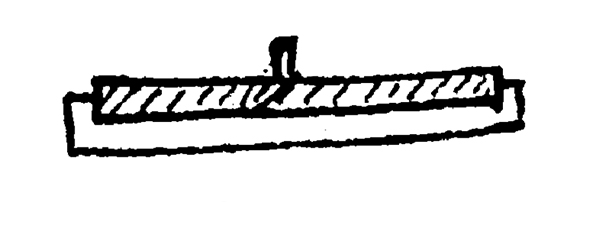
That of liquids and gases by a simple glass tube and bulb
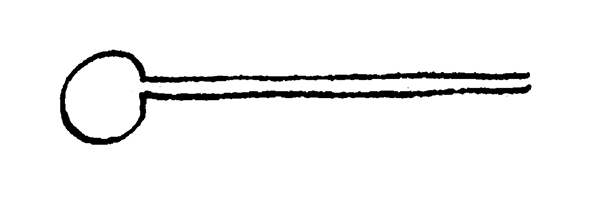
I want you to send me a couple of suitable tubes
2nd I shall shew the currents in boiling water
3rd The fire syringe5
4th Latent heat6 of water by melting ice and observing the thermometer to be stationary (I do not like this class of experiments, however, for such a lecture it does not appeal to their sense of sight sufficiently) or better by mixing on the one hand a pound of ice at 32˚ and on the other a pound of water at 32˚ with a pound of water at 174˚
5th Latent heat of steam by shewing the heat disengaged by condensing steam from the vessel A in the cold water of vessel B
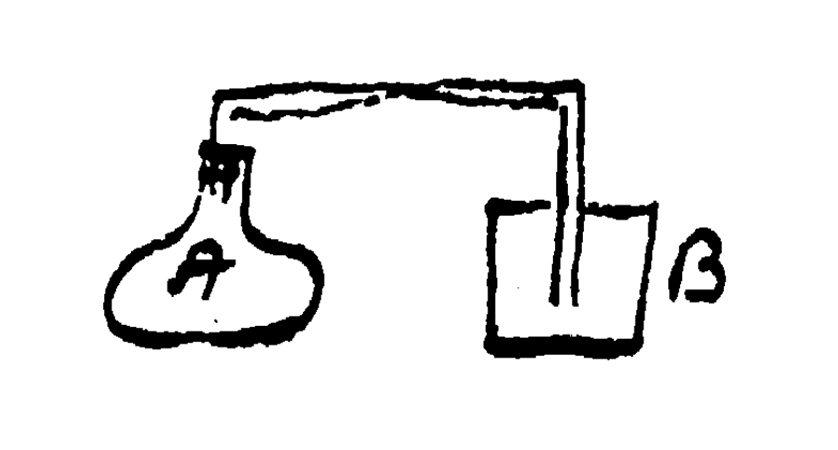
6th Dependence of boiling point on pressure By means of a closed flask containing only water and steam at 212˚ which when immersed in cold water boils and in warm water ceases.
7th The three cases of conductibility in wood illustrated by shewing part of the trunk of a tree so made that bars in the three directions can be lifted from other places and put back again.
8. On Radiant Heat I should here like to shew the experiment of igniting tinder with parabolic reflectors.7 For this reason I want to know if you can get me a pair of parabolic reflectors If you will suggest any alteration in these experiments I shall be glad at the same time I should like you to procure me the above apparatus and to have it sent down to me before the end of the month, If you suggest anything further, or can meet with other apparatus that will be serviceable buy the latter and send all together. I have not yet mentioned it to Edmondson but if he objects the apparatus will be my own. You see, if I lecture on physics and make experiments I must have apparatus furnished, for my other work which I consider more suited and important to me, will not allow me the time to construct much apparatus for myself. After all has been provided there will be much which will require my time and constructive powers. At Queenwood all goes on well and smoothly, I never knew 76 better boys. As to the Edmondson family8 I keep on the same constant terms with them which maybe termed a relation of respectful non-interference. In Edmondson I have seen nothing to blame or praise lately as far as I have been permitted to see he has done his duty and nothing more. As regards Mrs and Miss E.9 who are almost strangers to one another, I rarely see them more than once a week at supper on Sunday Evenings With Mummery I have had some slight difference; I offended him sorely about a week ago, but now he sees that my conduct was merely firm and not offensive. He told me one day with that annoying giggle of his that he was about to purchase a German Doctorship10 for £25 at first I did not think he was in earnest, but when I saw he was, I did not spare his feelings in expressing my opinion about the matter. He scarcely spoke to me for two or three days after and was evidently in low spirits. I was about to go to him and tell him why I had spoken so harshly when he came to me again, telling me he had almost given up the notion but that he had written to two or three friends11 about the subject, he still supported the step with his former sophistries but it was evident that his feeling of justice and honour had been touched and had rather shaken his decision. Well, answers came to his letters, and it appears they encouraged him in the matter and hoodwinked him as to its positive dishonesty. Edmondson himself did so and gave him a testimonial to help him to attain it. With more courage than before he came to me again, attacking me stronger than ever with his sophistries which apart from a sense of honour are staggering enough. It was evident that he wanted nothing more now than to win me over to conviction. This he found more difficult than he anticipated and pushed his arguments until they became obtrusive and tedious. We were talking a while together and I had appealed to him and combatted his arguments in vain for a whole hour, at the end of which I cut it short by requesting him to change the subject telling him that he must see from what I had said and repeated that I could never recognize a title so obtained either by him or any other man, and that on his obtaining his Doctorship I should only be acting conscientiously if I wrote to the Times and under my own signature exposed its invalidity. He laughed at my threat and has not spoken about the matter again, but as I hear he is taking steps towards procuring the degree. Of course this affair has lowered him considerably in my estimation though we continue as friendly as before. There is no depth of character in the man at all and not much talent either, he is in general sensible in his conversation but when pushed superficial. He is good natured and honest so far as this is recognized in the world. Beyond this his honesty has little root. It is not the flower of his character as it should be, it is but grafted on the tree of worldly providence and prosperity whose roots sink far deeper into his nature. Once in his day he has worked hard at study but it was less from a humble desire to learn than in order to attain a certain worldly position; this is rendered the more evident because now having reached this position he intends from his own confession to rest and work only so much as is necessary to maintain it. So that, good fellow though he is, sympathy with him does not go far Goodbye, John
As ever | T. A. Hirst
I have spoken to Edmondson he says he has ordered some reflectors so never mind. I will see that the Electro Magnet is sent soon.
RI MS JT/1/H/185
RI MS JT/1/HTYP/287–288a
Henry Hill’s last letter: presumably a letter Hill sent to Hirst regarding his financial difficulties. Hirst eventually helped Hill gain employment with Bevington (see letters 0836; 0848; 0849; 0853; 0855; 0868; and 0898).
my lecture at Abbotts Ann on heat: see letter 0836, n. 10.
the daily experiments … for themselves: not identified. Hirst was likely suggesting that the experiments he planned for the lecture were related to everyday household tasks involving the use of heat.
dilation of solids, liquids, and gases: thermal dilation, or expansion, refers to the tendency of matter to change in shape, size, or volume when exposed to heat.
The fire syringe: ‘an instrument by which dry tinder or spunk may be ignited by the heat produced by the sudden compression of a portion of atmospheric air. It consists of a hollow cylinder, closed at one end, and a solid piston fitting it accurately, and having in its under side a cavity to receive the substance to be ignited’ (J. Johnston, A Manual of Chemistry on the Basis of Turner’s Elements of Chemistry; Containing, in a Condensed Form, All the Most Important Facts and Principles of the Science, 6th edn [Philadelphia: Charles Desilver, 1856], p. 60).
Latent heat: see letter 0836, n. 5.
parabolic reflectors: ‘a reflector for light, sound, radio waves, etc., made in the form of a paraboloid of circular cross-section so as to reflect parallel rays to a focus, or produce a parallel beam from a source at the focus’ (OED).
the Edmondson family: see n. 9. The Edmondsons also had a son, George, who attended Queenwood College.
Mrs and Miss E.: George Edmondson’s wife, Anne Edmondson (see letter 0818, n. 2) and their daughter, Jane Edmondson.
purchase a German Doctorship: see letter 0817, n. 4.
two or three friends: not identified.
Please cite as “Tyndall0833,” in Ɛpsilon: The John Tyndall Collection accessed on