From A Normandy March 20, 18541
To Dr. Tyndall, F.R.S. &c. | 67 Judd Street, Brunswick Square, | March 20, 1854.
DEAR SIR,
CONVINCED as I am that water frequently assumes the spheroidal state in boilers, in consequence of which these most important vessels, on which the very existence of the steam engine, that is, of most of the comforts of civilized life, depend, are too often converted by mismanagement or ignorance into frightful engines of death and destruction, I venture now to trouble you with a few observations in addition to those which you were kind enough to listen to the other day,2 in the hope that, should the facts which I am about to relate appear to you as conclusive as they do to me, you may be induced, in your lectures on heat, to call once more the attention of the audience, should you deem fit to do so, to this, I believe, fruitful but almost unsuspected, or at any rate scarcely credited source of explosion.
I have already had the honour to relate to you that I had seen the plates of a Cornish boiler,3 a quarter of an inch thick, become red-hot in the flue, although at the time the boiler contained its due quantity of water. It was a new boiler, about 18 feet long; and that the water had assumed therein the spheroidal state is proved by the fact, that a lead rivet, 1 inch in diameter, put in for safety was actually melted. It is, in fact, this rivet which led to the detection of the cause of the occurrence, and an investigation of the subject brought out the following details. The fireman or stoker was an ignorant mulatto, who having noticed the lead rivet in the boiler, had given it as his opinion that it would soon be melted by the fire; the possibility of such an accident having been denied by one of his fellow-workmen, a bet had taken place between them. The wager having thus been laid, the fireman set to keeping up a brisk, bright fire; in consequence of which, steam being generated exceedingly fast, priming, that is, a production of steam under the superincumbent water,4 took place, and, as a matter of course, the water, or a portion thereof, not being any longer in contact with the surface of the iron plate, the latter in a very short time became red-hot, and the rivet melted; for some time afterwards, however, the water being in the spheroidal state, the boiler remained apparently sound, that is, it did not leak, although it had an opening of an inch diameter left in consequence of the melting of the rivet; it is only shortly afterwards I was told, that the heat having diminished, torrents of water poured through the hole with almost explosive violence, emitting volumes of scalding steam as it came in contact with the fire on the grate.
This took place at the Wenlock Timber Saw-mills;5 and I can bear testimony to the above fact, and likewise to this circumstance, that when filled as usual with its normal quantity of water, the bottom of the boiler over the fire could, in the course of five or six minutes, be made red-hot at pleasure by brisk firing. In fact, having called at the above works, according to appointment, to meet the engineer there, my inquiry as to the then state of the boiler was answered by the foreman, in presence of his master, in these words:–‘The boiler is not red-hot now, but if you will step this way it will be made so immediately;’ and in spite of all remonstrance as to the danger of such an experiment, he came shortly afterwards to announce that the boiler was red-hot, and I saw it in that state in presence of the engineer, the master, his nephew, the foreman, and the fireman or stoker. The production of steam had been thereby spontaneously reduced, the bolt or lead rivet eventually melted, but not in my presence; for seeing the state of things, I speedily retreated with the engineer and the master, but almost reluctantly followed by the foreman, in whose somewhat jeering looks I could plainly read that he entertained but a poor idea of our pluck.
In addition to this, I may say that in ‘waggon boilers,’6 a shape than which none can be more unsafe, but which is now fortunately much less in use than in former years, bulging bumps are very often observed, which are certainly due to the pressure of the steam in the boiler upon the iron plates of the bottom, when by extravagant or incautious firing they have been made red-hot. Frequently, however, instead of bulgings or bumps being thus produced, a disruption of the boiler takes place, attended with more or less fatal consequences. Many such accidents have thus happened at Manchester, and particularly on Monday mornings.
The following occurrence, related to me by my friend Mr. A. M. Perkins7 as having taken place in his presence in a boiler of a peculiar construction in which steam was generated by means of his hot-water pipes, is also well worth mentioning, as I think we may gather from it a correct explanation of the facts under consideration; and the rough sketch below, which represents a cross section of the boiler, will perhaps explain the matter better than I could do by writing.
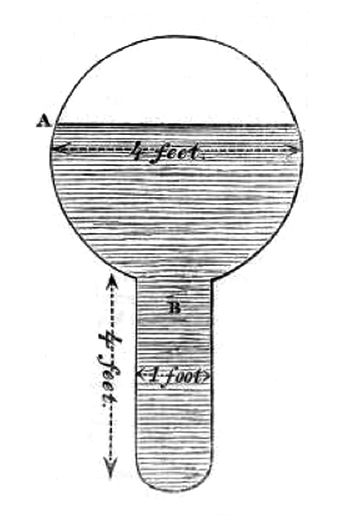
The boiler had the dimensions indicated, and was 8 feet in length; it was filled with water to about A as usual, the safety-valve had an area of 4 inches. From such a boiler the whole of the water was completely driven off through the valve by violent priming; that is to say, steam was generated so fast by a hot water pipe in the limb B, that it completely lifted up the water and violently squirted it out of the boiler, as just related. In such a case, the water being heated by pipes, and not by contact with the heated surfaces of the boiler, no other mischief could result than that of priming: but suppose, on the contrary, such a boiler to have been heated in the usual manner; there is no doubt that the steam generated in the limb B would, by lifting the superincumbent water, have soon permitted that part of the boiler to become red-hot, and thus have produced the curious phaenomenon revived and studied by Boutigny8 d’Evreux,9 and named by him a fourth or spheroidal condition of matter, but to which, so far as refers to water, the late Jacob Perkins10 had, to my certain knowledge, called the attention of engineers and of savants more than twenty-five years ago (in fact, as far back as 1824).
Allow me to relate also the curious experiment11 of a distinguished civil engineer, Mr. Alexander Gordon,12 made several years ago, as related to me by Mr. A. M. Perkins.13
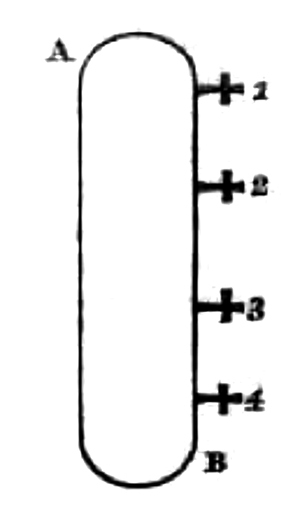
AB is a cylinder provided with four try-cocks, 1, 2, 3, 4; water being introduced into the cylinder and heated therein, the cocks on being successively turned gave the following results; namely, steam issuing from 1, 2, 3, and water from 4; but after urging the fire, the above order was found to be completely reversed; that is to say, cock No. 1 emitted water, and cocks Nos. 2, 3, 4 steam.
These facts, in my humble judgement, appear to me to prove in a decided manner,–
-
That the heating of surfaces previous to the introduction of water is not necessary to produce the spheroidal state.
-
That many boiler explosions may be referable to that condition.
-
That all boilers which offer an extensive surface to the heat, that is to say, all boilers with internal flues, are pre-eminently liable to explosions from this cause.
Earthy deposits in all kinds of boilers are favourable to the production of this dangerous phaenomenon.
I cannot terminate this informal letter without apologising for having so long trespassed on your valuable time and patience; but if a collection of facts be essential to the progress of science, I hope that you will indulgently receive this communication, and believe me,
Yours very faithfully, | A. NORMANDY.
A. Normandy, ‘On the Spheroidal State of Water in Steam-boilers’, Phil. Mag. 7:45 (1854), pp. 283–6.
A. Normandy: Alphonse René le Mire de Normandy (1809–64), a French-born chemist who lived and worked in England where he wrote a number of textbooks on analytical chemistry and invented an apparatus used to distil seawater into drinking water (ODNB). He was admitted as a member of the RI on 6 April 1857 (‘General Monthly Meeting’, Roy. Inst. Proc., vol 2, pp. 413–4). This letter was published in the Phil. Mag.
I venture now to trouble you … the other day: not identified. However, Normandy may have attended the weekly meeting at the RI held on Friday, 17 March 1854.
Cornish boiler: a cylindrical flued boiler, also called a flue-boiler (OED).
superincumbent: overhanging (OED).
Wenlock Timber Saw-mills: Wenlock, Shropshire, England, a town now comprised of Much Wenlock and Little Wenlock, located close to the Wales border. While the mills are unidentified, the region is known historically to have housed a number of mills (A. P. Baggs, G. C. Baugh, D. C. Cox, J. McFall, and P. A. Stamper, ‘Much Wenlock’, in C. J. R. Currie [ed.], A History of the County of Shropshire, Vol. 10: Munslow Hundred (Part), the Liberty and Borough of Wenlock [London: Victoria County History, 1998], pp. 399–447, at British History Online http://www.british-history.ac.uk/vch/salop/vol10/pp399–447 [accessed 28 October 2016].
waggon boilers: a steam boiler shaped with a semi-cylindrical top resembling a waggon. Used to power land engines, by 1875 they had all but disappeared from use due to their inefficiency (W. T. Brande, and G. W. Coxe, ‘Steam Boiler’, in Brande and Coxe [eds.], A Dictionary of Science, Literature, & Art [London: Longmans, Green, & Co., 1875], vol. 3 pp. 571–5, on p. 571.).
Mr. A. M. Perkins: Angier March Perkins (1799–1881), an American heating and steam engineer who became successful as an inventor and designer of heating systems, tools, and methods used in manufacturing and industry (ODNB).
Boutigny: see letter 0903, n. 6.
d’Evreux: the commune in northern France, Evreux, where Boutigny worked (see n. 8)
Jacob Perkins: Jacob Perkins (1766–1849), an American engineer and physicist, who worked on inventions used in printing coins and banknotes before he turned his attention to steam power and its advantages for use in locomotives (ODNB).
the curious experiment: Gordon’s experiment is described in J. Perkins, ‘Observations on the Circumstances Attending the Explosion and Bursting of Steam Boilers; With Animadversions on the Experiments of the Franklin Institute on that Subject’, Mechanics’ Magazine, Museum, Register, Journal and Gazette 727 (15 June 1839), pp. 185–8, on p. 188.
Mr. Alexander Gordon: Alexander Gordon (1802–68), an American–born civil engineer who worked in England and published an important treatise on locomotion (A. Gordon, An Historical and Practical Treatise upon Elemental Locomotion by means of Steam Carriages on Common Roads [London: B. Steuart, 1832]; he was also one of the founders of the Polytechnic Institution (‘Obituary, Alexander Gordon 1802–68’, Minutes of the Proceedings of the Institution of Civil Engineers 30:1870 [1870], pp. 435–6).
Mr. A. M. Perkins: see n. 7.
Please cite as “Tyndall0905,” in Ɛpsilon: The John Tyndall Collection accessed on