From Heinrich Gustav Magnus 26 April 54
Berlin d. 26 April 54.
Theurer Freund.
Zwei von Ihren Briefen liegen unbeantwortet vor mir, der letzte vom 15 d. M.; der frühere vom 29 März. Zunächst will ich Ihnen berichten daß alle Aufträge ausgeführt sind. Die Instrumente für Colonel Yorke sind fertig. Ich lasse sie verpacken, und bitte mich wissen zu lassen: 1. Was für eine Adresse auf die Kiste gesetzt werden soll? 2. Wie ich die Kiste schicken soll? Ob ich sie dem Buchhändler Asher wieder übergeben soll? – Die Auslagen betragen
für 2 Windfahnen 3 [Rthl.] 20 [Sgr.]
" ein Cylinder im Ring 7.
" ein dito auf die Rotationsmaschinen zu setzen 4
_____
14.20
Emballage 1
____
15.20
Das Polytrop für Mr. Gassiot ist bestellt, es werden aber mehrere Wochen vergehn bis es fertig wird. Ich werde es so schnell als möglich zu schaffen suchen.
Colonel Yorke wird sich müssen zu dem Cylinder im Ringe noch eine Art von Drehwage machen lassen, wie in Fig 2 meiner Abhandlung abgebildet ist. – Die Schwierigkeiten welche Sie erwähnen wegen der Erklärung der Abweichung der Kugeln sind nicht schwer zu beseitigen: Wenn eine Kugel durch die Gase, welche sich aus dem Pulver entwickeln, in dem Geschütz vorwärts getrieben wird, so ist der Druck den sie erfährt überall derselbe, d.h wenn man einen grössten Kreis der Kugel senkrecht gegen die Axe des Geschützes sich vorstellt, so erfährt dieser in jedem Punkte denselben Druck. Liegt nun der Schwerpunkt der Kugel in diesem Kreise, aber nicht im Mittelpunkt desselben sondern z.B. mehr nach rechts in Bezug auf einen hinter dem Geschütz stehenden Beobachter 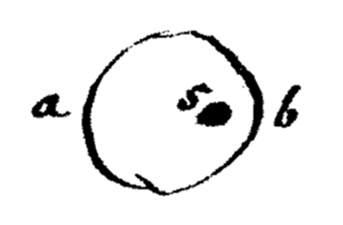 ; so ist links von dem Schwerpunkte zwischen as eine größere Fläche des Kreises als rechts zwischen sb; die Kugel wird also auf der rechten Seite stärker gedrückt als auf der linken, und folglich rotirt sie von links nach rechts
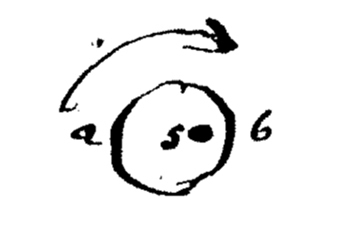 sowohl im Geschütz als wenn sie dasselbe verlassen hat. Wiewohl auf beiden Seiten des Schwerpunkts gleichviel Materie ist, so ist doch die Quantität der Bewegung verschieden weil dieselbe sich nach der Fläche richtet.
Wirft man einen Körper mit der Hand, so erhält jeder Punkt der Masse gleichviel Bewegung, unter der Voraussetzung daß man nicht mittelst der Hand den einen Theil stärker gestossen hat als den andern. Wenn bei einem mit der Hand geworfenen Körper der schwerere Theil voran eilt, so rührt das davon her daß derselbe im Verhältniß zu seiner Bewegung einen geringeren Widerstand erfährt als der andere, weil er im Verhältniß zur Masse eine geringere Fläche darbietet. – Mr. Baden Powell's Vortrag, oder richtiger der Auszug desselben in dem Phil Mag., ist nicht sehr klar. Er wirft mir Unklarheit der Darstellung vor, aber ich kann nicht finden daß er überhaupt etwas Neues in der Sache vorgebracht hat. Sehr neugierig wäre ich etwas von Wheatstone's Apparat zu erfahren, namentlich ob er im Princip etwas Neues enthält. Ich hoffe Sie werden sich an dem Polytrop erfreuen, und ich fühle mich sehr dankbar gegen Mr. Gassiot daß er eins bestellt hat.
Von Herzen bedaure ich daß Sie unwohl gewesen sind, hoffentlich ist alles vorüber, und Sie sind wieder ganz wohl und frisch. Prof. Faraday bitte bestens zu grüßen, ich sende ihm nächstens etwas rothen und schwarzen Schwefel, über die ich neulich in der Academie gelesen. Viele Empfehlungen an Dr. B. Jones, Mr. Gassiot, und Alle die sich meiner erinnern. Warrington bitte zu sagen daß ich dies Jahr schwerlich nach England komme. Wir wissen ohnehin nicht ob wir nicht in Krieg gerathen, und das ist für uns ernster als für die Engländer, die keinen Feind im Lande sehn werden, denen also der Krieg nur Geld kostet, während uns die Russen leicht mit ihrer Knute beglücken könnten. Leben Sie wohl und schreiben Sie bald
Ihrem | treuen | GMagnus.
Meine Frau und die Kinder, so wie mein Bruder der jetzt aus Paris zurück gekehrt ist, grüßen vielmals.
P.S. Die Reclamation von P. Rieß haben Sie wohl erhalten?!
Berlin, 26 April 54.
Dear friend.
Two of your letters1 lie before me unanswered; the last one from the 15th of this month, the earlier from 29 March. I want to tell you, first of all, that all the jobs have been completed. The instruments for Colonel Yorke are finished. I am having them packed, and ask you to let me know: 1. What kind of address should be put on the case? 2. How should I send the case? Whether I should hand it over to the bookseller Asher again? – The expenses amount to
for 2 wind vanes are 3 [Rthl.] 20 [Sgr.]
" one cylinder in the ring 7.
" one ditto to be put on the rotation machines 4_____
14.20
Packaging 1
____
15.20
The polytrope2 for Mr. Gassiot has been ordered, but it will take several weeks until it is finished. I will try to do it as quickly as possible.
Colonel Yorke will still need to have a kind of torsion scale3 made for him for the cylinder in the ring, as it is illustrated in Fig. 2 of my paper.4 – The difficulties which you mention about the explanation the deviation of bullets are not difficult to eliminate: If a bullet is driven forwards in the gun by the gases which are produced from the gunpowder, then the pressure that it experiences is the same everywhere, i.e., if one imagines a greatest circle of the bullet perpendicular to the axis of the gun, then this will experience the same pressure at every point. If, now, the centre of gravity of the bullet lies within this circle, though not at its centre but rather e.g. more to the right relative to an observer standing behind the gun , then, on the left of the centre of gravity between as, there will be a larger area of the circle than on the right between sb; the bullet will therefore be pushed more powerfully on the right side than on the left and consequently it will rotate from left to right, both within the gun as well as when it has exited it. Although there is the same amount of matter on both sides of the centre of gravity, the quantity of motion will nevertheless be different because it depends on the area.
If one throws a body by hand, then every point of the mass receives the same motion, assuming that one has not pushed the one part more powerfully by means of one’s hand than the another. If, with a body thrown by hand, the heavier part rushes forwards, then that is due to the fact that it experiences less resistance in proportion to its motion than the other part, because it presents less area in proportion to the mass. – Mr. Baden Powell’s lecture, or more correctly, the excerpt of it in the Phil Mag.,5 is not very clear. He accuses me of a lack of clarity in my presentation, but I cannot find that he has put forward anything new at all in the matter. I should be very curious to learn anything about Wheatstone’s apparatus,6 in particular if it contains anything new in principle. I hope that you will take pleasure in the polytrope and I feel very grateful to Mr. Gassiot for ordering one.
I sincerely regret that you have been unwell, hopefully everything has passed, and you are quite well and bright again. I ask you to give my best regards to Prof. Faraday, I shall shortly send him some red and black sulphur, about which I recently read at the Academy.7 Many compliments to Dr. B. Jones,8 Mr. Gassiot and everyone who remembers me. I ask you to tell Warrington9 that I shall hardly make it to England this year. We do not know anyway if we shall not get into a war,10 and that is more serious for us than for the English, who will not see an enemy in their country and for whom war will therefore only cost money, while the Russians could easily favour us with their lash. Farewell and write soon to
Your | loyal | GMagnus.
My wife11 and the children,12 as well as my brother,13 who has now returned from Paris, give you their best regards.
P.S. You have no doubt received the complaint from P. Riess?!14
RI MS JT/1/M/10
Two of your letters: letters missing.
polytrope: see letter 0870, n. 7.
torsion scale: a scale used for weighing in which the levers function through torsion, a twisting motion.
my paper: see letter 0870, n. 3.
the excerpt of it in the Phil Mag: see B. Powell, ‘On Certain Phenomena of Rotary Motion’, Phil. Mag. 7:45 (April 1854), pp. 291–6.
Wheatstone’s apparatus: see letter 0907, n. 5.
the Academy: see letter 0852, n. 13.
Dr. B. Jones: Henry Bence Jones.
Warrington: likely Sir Warington Wilkinson Smyth (1817–90), a British geologist and lecturer at the Government School of Mines.
a war: the Crimean War (see letter 0873, n. 30). Although Prussia initially resisted joining the war, they eventually followed Austria in trying to limit Russia’s expansion of power (G. Arnold, Historical Dictionary of the Crimean War [Lanham: The Scarecrow Press, 2002], pp. xviii, 113).
wife: Bertha Magnus (née Humblot) (1820–1910), whose family were French Huguenots.
the children: Heinrich and Bertha Magnus had three children: Anna Magnus (1841–75), Christine Magnus (1842–1936), and Paul Gustave Magnus (1845–1930).
my brother: in 1854, Magnus had five living brothers: Friedrich Martin Magnus (1796–1869), Eduard Leopold Samuel Magnus (1799–1972), Ludwig Immanuel Magnus (1790–1861), Ferdinand Ludwig Magnus (1804–65), and Albert Magnus (1809–59).
the complaint from P. Riess?!: see letter 0920. Tyndall had already responded to Riess’s letter (see letter 0922).
Please cite as “Tyndall0925,” in Ɛpsilon: The John Tyndall Collection accessed on