From Heinrich Gustav Magnus 26 Decemb 54.
Berlin 26 Decemb 54.
Verehrter Freund,
Entschuldigen Sie daß ich Ihren werthen Brief vom 3tn. d. M. erst heut beantworte. Ich war bis zum Schluß meiner Vorlesung sehr beschäftigt, besonders weil ich auch meine Abhdl. über die Flüßigkeiten zu vollenden wünschte. Den von mir angegebenen kleinen Apparat, den Sie aus Riess Electricitäts Lehre ausgewählt, habe ich für Sie bestellt. Barreaud hat mir versprochen ihn in den ersten Tagen des Jahres zu liefern und werde ich ihn Ihnen dann sogleich durch Asher zusenden.
Poggendorffs Vorschlag die Magnetnadel zu beobachten ist in so fern verschieden von Gauß & Weber’s Methode, als er den Spiegel parallel mit der Axe der Nadel anbrachte, während diese ihn bekanntlich senkrecht gegen die Axe befestigen. Dieser Vorschlag von P. ist früher als der von G & W. Poggendorff’s findet sich im 7. Bd seiner Annalen [pr.] 1826. Gauß Methode ist im 28 Bd. p. 247. Anmerk. mitgetheilt und ist aus dem Jahre 1833.
Wenn Sie den Peltierschen Versuch mit dem Luftthermometer machen wollen, dürfen Sie nur einen ganz schwachen Strom anwenden. Ich pflege ein Grove’sches Element nur so weit einzutauchen, daß nur 2–3 Quadratzoll wirksam sind.
Die Vorstellung welche Sie mir mitgetheilt haben über die seitliche Bewegung einer Masse in Folge der ungleichen Reibung auf beiden Seiten, scheint mir nicht ganz begründet. Wenn der Punkt d festgehalten würde, etwa durch einen Faden, dann würde der Erfolg ganz so statt finden wie Sie meinen, aber so wirkt die Reibung nicht! Die Reibung ist nur eine tangentiale Kraft. Ich will versuchen die Schwierigkeiten die Sie veranlaßt haben eine Bewegung des Schwerpunkts anzunehmen, so weit es in meinen Kräften ist, fortzuräumen, aber ich weiß nicht ob ich werde hinreichend klar mich ausdrücken können.
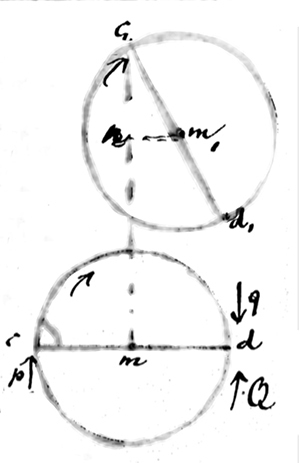
Denkt man sich die Scheibe cd zuerst in Ruhe, und es wirkt bei m, d.i auf den Schwerpunkt, eine Kraft ein, welche diesen nach n bewegt, so werden gleichzeitig auch alle andern Punkte der Scheibe sich parallel mit mn bewegen. Wenn ausserdem noch eine Kraft p bei c in Richtung der Tangente wirkt, so wird c mehr voraneilen als alle übrigen Punkte, die Scheibe wird rotiren, aber dabei wird doch die ganze Scheibe so fortrücken daß ihr Schwerpunkt sich in der Richtung mn bewegt. Ist bei d noch eine Kraft q=p vorhanden, welche die Rotation im gleichen Sinne hervorbringt, so wird die Scheibe mit doppelter Geschwindigkeit rotiren. Schafft man q fort, so wird sich nur die Geschwindigkeit der Rotation wieder ändern, eine seitliche Bewegung des Schwerpunkts kann durch solche (parallel mit mn wirkende Kräfte nicht erfolgen. Die Schwierigkeit die Sie haben rührt, wie ich vermuthe, aus folgender Vorstellung. Sie sagen wenn bei d eine Reibung vorhanden ist, wenn z.B. eine Kraft Q dort wirkt die q gerade entgegen und genau so groß wie dieses ist; so geht der Punkt d in Ruhe über! Dies ist richtig aber nur in Betreff der Rotation um m. An der fortschreitenden Bewegung nimmt d noch immer unverändert Theil. Würde d durch die Einwirkung von Q fest im Raume, so daß es gleichsam als Hypomochlion für den Hebel cd dienen könnte, dann würde m durch die fernere Rotation von c nach m1 gedrückt. Aber d kann niemals als [Stützpunkt] dienen, da er selbst frei im Raume ist. Es wird fortfahren zu rotiren, auch nach Aufhebung der Wirkung von q durch Q, gerade so wie es rotirte, bevor q hinzutrat, als nur p die Rotation hervorbrachte. Durch die Reibung kann niemals eine Veränderung in der Richtung der Bewegung des Schwerpunkts herbeigeführt werden. Auch wenn die Reibung senkrecht gegen die Richtung der Fortschreitung verschieden ist. Gesetzt die Scheibe rotirte wie es die folgende Figur andeutet, und bei a [und] b brächten die gleichen Kräfte p [und] q die Rotation hervor; so wird wenn P=p, die Rotation bei a gehemmt wird, der Schwerpunkt m doch nach n fortschreiten. Die Scheibe wird nur langsamer rotiren da sie jetzt nur durch die Kraft q rotirt.
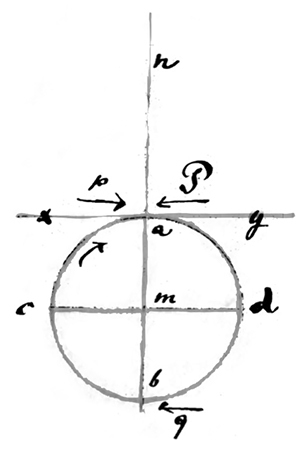
Die Reibung könnte eine seitlich Bewegung hervorbringen wenn sie gegen eine feste Fläche statt fände. Wenn xy eine feste Ebene wäre gegen welche die Scheibe drückte, während sie rotirt, dann könnte eine seitliche Bewegung eintreten. Vorausgesetzt daß der Druck groß genug ist. Aber solcher Druck ist gegen die bewegliche Luft nicht denkbar!
Viel mehr wüßte ich über diese Reibung nicht zu sagen. Übrigens hat Poisson dieselbe auch in seiner Abhandlung berücksichtigt, aber er wie alle andern Mathematiker, kommt zu dem Resultat daß die Reibung keine seitliche Abweichung hervorbringen kann.
Sie würden mir einen großen Gefallen thun wenn Sie mir einige Auskunft über die Lancaster Canonen geben könnten, vielleicht theilt Ihnen Col. Yorke etwas darüber mit. Alles was unsere Zeitungen darüber sagen ist mir unverständlich.
Grüßen Sie Dr. Faraday recht herzlich von mir. Ebenso Mrs F. wenn dieselbe sich meiner noch erinnern sollte.
Mss Francis ist hier wohl und munter, ich habe sie vorgestern gesehn. Freitag ist Poggendorffs Geburtstag, da hoffe ich sie wieder zu sehn.
Gott schenke Ihnen ein glückliches Jahr! Ihr pupil Anna [und] meine Frau grüßen bestens.
Von Herzen | Ihr | GMagnus.
Berlin 26 Decemb 54.
Honoured friend,
Excuse me for the fact that I am answering to your kind letter of the 3rd of this month1 only today. I was very busy up to the end of my lecture, particularly because I was also wishing to complete my paper on liquids.2 I have ordered for you the small apparatus3 indicated by me that you selected from Riess’s study on electricity.4 Barreaud has promised me that he will deliver it in the first few days of the year and I shall then forward it to you at once through Asher.
Poggendorff’s suggestion to observe the magnetic needle differs from Gauss5 & Weber’s method, insofar as he inserted the mirror parallel to the axis of the needle, while the latter two are known to have fastened it perpendicular to the axis. The suggestion of P. is earlier than that of G & W. Poggendorff’s can be found in the 7th vol. of his Annals [for] 1826.6 Gauss’s method is communicated in the 28th vol., p. 247,7 footnote, and is from 1833.
If you want to do Peltier’s experiment8 with the air thermometer, you may use only a quite weak current. I am in the habit of inserting a Grove cell9 only as far only 2–3 square inches are active.
The idea which you have communicated to me10 about the lateral motion of a mass as a consequence of unequal friction on both sides does not seem entirely substantiated to me. If point d were to be fixed in place, for example by a thread, then the outcome would occur entirely as you think, but friction does not work like this! Friction is only a tangential force. I shall try, as far as it is in my power to do so, to clear away the difficulties that have caused you to assume motion of the centre of gravity, but I do not know whether I shall be able to express myself sufficiently clearly.
If one imagines the disc cd at rest to begin with, and a force acts at m, i.e. on the centre of gravity, which moves the latter towards n, then all other points on the disc will move simultaneously, parallel to mn. If, in addition, another force p acts at c in the direction of the tangent, then c will rush forward more than all the other points, the disc will rotate, but in the process the whole disc will move away in such a way that its centre of gravity moves in the direction mn. If, at d, another force q = p is present which produces rotation in the same sense, then the disc will rotate with double the speed. If one removes q, then only the speed of rotation will change again, a lateral motion of the centre of gravity cannot occur through such forces (acting in parallel to mn). The difficulty that you have stems, as I suspect, from the following idea. You say that if friction is present at d, when e.g. a force Q acts there that is directly contrary to q and precisely as large as this; then the point d will come to rest! This is correct, but only with respect to rotation around m. d continues to take part in the ongoing motion without any changes. Were d to become fixed in space through the action of Q, so that it could serve, as it were, as a hypomochlion11 for the lever cd, then m would be pushed by the more distant rotation of c towards m1. But d can never serve as a [fulcrum], as it itself is free in space. It will continue to rotate, even after the neutralisation of the effect of q by Q, exactly as it was rotating before q came along, when only p produced the rotation. A change in the direction of the motion of the centre of gravity can never be brought about by friction. Even if the friction perpendicular to the direction of the progression is different. Assuming that the disc was rotating as the following figure suggests, and the identical forces p [and] q were to produce rotation at a [and] b; then if rotation is inhibited at a when P = p, the centre of gravity m will still progress towards n. The disc will only rotate more slowly, as it is rotating now only due to the force q.
Friction could produce a lateral motion if it were to occur against a solid surface. If xy were a solid plane against which the disc pressed while it rotates, then a lateral motion could occur. Provided that the pressure is large enough. But such pressure is not conceivable against movable air!
There is not much more that I could say about this friction. Incidentally, Poisson12 has considered it also in his paper,13 but he like all the other mathematicians comes to the result that friction cannot produce a lateral deviation.
You would do me a great favour if you were able to inform me about the canons in Lancaster cannons;14 perhaps Col. Yorke will tell you something about them. Everything that our newspapers say about them is incomprehensible to me.
Give Dr. Faraday my very warm regards, and also to Mrs F,15 if she should still remember me.
Miss Francis is well and cheerful here, I saw her the day before yesterday. Friday is Poggendorff’s birthday and I hope to see her there again.
May God give you a happy year! Your pupil Anna16 [and] my wife17 send you their best regards.
Sincerely | Your | GMagnus.
RI MS JT/1/M/15
your kind letter … this month: letter missing.
my article on liquids: not identified.
small apparatus: Tyndall mentioned an apparatus used in Riess’s experiments on auxiliary currents that he wanted Riess to order for him (see letter 0996).
Riess’s study on electricity: see letter 0996, n. 6.
Gauss: Johann Carl Friedrich Gauss (1777–1855), a German mathematician who together with Weber built one of the first electromagnetic telegraphs.
Poggendorff’s … 1826: see J. C. Poggendorff, ‘Ein Vorschlag zum Messen der magnetischen Abwichung’, Poggend. Annalen. 7: 1 (1826), pp. 121–30.
Gauss’s method … vol. 28, p. 247: see C. F. Gauss, ‘Die Intensität der erdmagnetischen Kraft, zurückgesührt auf absolutes Maass’, Poggend. Annalen. 28:6 (1833), pp. 241–72.
Peltier’s experiment: Jean Charles Athanase Peltier (1875–45), a French physicist who researched thermoelectricity and discovered the so-called Peltier effect – ‘an effect whereby heat is given out or absorbed when an electric current passes across a junction between two materials’ (OED).
Grove cell: an early fuel cell, invented by William Robert Grove.
The idea which you communicated to me: not identified.
hypomochlion: fulcrum, or ‘the point against which a lever is placed to get a purchase or on which it turns or is supported’ (OED).
Poisson: Siméon Denis Poisson (1781–1840), a French mathematician and physicist known for the eponymous Poisson’s ratio, equation, bracket, and distribution (OED).
in his paper: not identified. For papers by Poisson see ‘Poisson, Simon Denis’, RS Catalogue, vol. 4, pp. 964–69.
Lancaster cannons: the Lancastor cannon, or 68-Pounder Lancaster gun, a rifled, muzzle-loaded cannon with a slightly oval bore invented by Charles Lancaster (1820–78), which was used in the Crimean War (see letter 0873, n. 30) (ODNB).
Mrs. F.: Sarah Barnard, Faraday’s wife.
Your pupil Anna: Anna Magnus, daughter to Heinrich Gustav and Bertha Magnus (see letter 0852, n. 17).
my wife: see n. 16.
Please cite as “Tyndall1024,” in Ɛpsilon: The John Tyndall Collection accessed on