From George Gabriel Stokes 27th Decr 1861
Lensfield Cottage Cambridge | 27th Decr 1861
My dear Prof Tyndall,
On the 24th I began a letter to you in continuation of my last,1 and then Xmas intervened, and yesterday I was attending to another matter. The consideration of all the circumstances which have to be attended to in your war with air, in successive experiments, of different pressures is a complicated matter and demands further consideration. I find I must look out your letter and consider the thing more maturely.
But you have proposed one simple question which I may as well answer at once. If a gas discharges itself from a vessel at one given pressure (or the atmosphere) into another at another given pressure through a hole in a thin plate (in order to get rid as far as may be of the effects of internal friction) then the velocity of discharge varies inversely as the square root of the density under a standard pressure, the effects of internal friction being assumed to be insignificant compared with those of inertia. In comparing gases of different nature we should find this law of efflux on the supposition that the internal friction may be neglected.
Yours very truly | G. G. Stokes
P.S. For fear I should have misunderstood the object of your question which may be to compare the rates of discharge of the same gas under given circumstances I may mention that the usual formula for the vel[ocit]y, of discharge (v) is
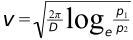
where
π is a standard pressure
D the density under pressure π
 the pressure in the vessel from which the gas comes
 -----into which it goes
and the density of the gas moving with the vel[ocit]y v is deemed to be that statically belonging to the pressure  .
In this formula the effect of internal friction and of the cold produced by expansion are not taken into account nor those of the “contraction of the vein” unless in so far as may be done by taking instead of the actual area of the orifice an area reduced in a ratio to be determined by experiment.
The formula gives results differing widely from exper[imen]t when  is small. See a memoir by Barré de St. Venant & Wantzel Journal Polytechnique Cah.2 XXVII p. 853 referred to in my report on Hydrodynamics. Rep. Br. Assn for 1846 p. 13.4
Yours very truly | G. G. Stokes
RI MS JT/1/S/227
Please cite as “Tyndall1846,” in Ɛpsilon: The John Tyndall Collection accessed on