From George Gabriel Stokes 1 Jany 1862
Lensfield Cottage Cambridge | 1 Jany 1862
Dear Prof[esso]r Tyndall,
I delayed answering your last letter1 because I wanted first to look into Graham’s papers.2
His results as to effusion convince me that in that case the velocity of discharge is regulated almost entirely by inertia to be overcome, and not by internal friction. If the gas were perfectly smooth to itself, I don’t believe the vel[ocit]y of effusion would be much increased. Graham finds that the experiments follow these laws.
(1) The vel[ocit]y of effusion into a vacuum (estimated with reference to the density the gas has in the reservoir) of a given gas is independent of the pressure or very nearly so.
(2) With different gases the velocity varies inversely as the square root of the density under a given pressure.
Now these are precisely the laws which would have to be obeyed by perfectly frictionless gases, in which the velocity of efflux would be regulated solely by inertia, whereas we have reason to believe that the 2nd law (whatever might become of the first) would not be obeyed if the vel[ocit]y of effusion were regulated by internal friction mainly; for we have reason to believe that in different gases the coefficient of friction depends on the nature of the gas, and not simply on its specific gravity.
I have attended much to internal friction, and have succeeded in solving the problem (and an uncommonly tough one it was) of determining the motion of a sphere or cylindrical rod oscillating as a pendulum in a liquid or gas, taking into account the internal friction in the fluid. I send you a copy of my paper;3 I have no spare copy of my first paper on internal friction,4 in which I have obtained in a particular way the general equations; but this does not signify, for I take for granted you don’t want to go into the mathematics, and I send it that you may cast your eye over some of the tables giving the comparison of theory and experiment, especially those at pp. 59 and 62 which are the most important. The quantity [η] in a frictionless fluid would be 2 for a long cylinder, and 1½ for a sphere, irrespective of the diameters. All the rest is unaccounted for on the Common theory (that in which a fluid in its motion is supposed perfectly smooth) and the theory which I have applied shows that they (the differences) ought to be accounted for if the value of one disposable constant ([r’], the index of friction) be properly assumed; and when the great difference in size and shape of the pendulums is taken into account, and it is remembered that the formula applied contains no second disposable constant whereby a seeming agreement between theory and observation might be brought about, the agreement will I think be deemed highly satisfactory.
Now one supposition made in deducing the formula is that there is no finite slipping of the fluid over the surface of the solid—in other words that the in receding from the surface of the solid the velocity of the fluid changes in a continuous manner from that of the solid to that of the fluid at some distance from the solid. This supposition, which seemed extremely probable a priori, is in accordance with an experiment of Sir James South’s5 mentioned in the introduction to my paper, and is confirmed by the remarkable agreement between the result of calculation and observation exhibited in my tables.
Now if we may extend the same supposition to transpiration tubes, i.e. that there is no abrupt sliding of the fluid over the side of the tube, the velocity of transpiration will be determined by internal friction. The fluid will in fact move in cylindrical shells (the tube being supposed of circular bore) with a velocity increasing from o at the surface to a maximum in the middle. A slice of any shell will be urged onwards by the difference of pressure at its two ends, and by the friction of its neighbor inside, and retarded by the friction of its neighbor outside. The velocity in comparing different points of a cross section of the tube will vary as 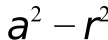 (Camb. Phil. Trans. VIII, 305) where r is the distance from the axis, and a the radius of the bore. The successive positions of a cross line of particles will be like and it is evident that on this supposition of the absence of abrupt sliding over the side of the tube the rate of transpiration must depend on internal friction only, since we may imagine a solid cylinder of fluid comprising all but the whole to move within a pipe composed of the same fluid.
If there be any finite slipping of the fluid, its effect would doubtless be far more sensible in transpiration experiments than in pendulum experiments. Its existence would be best exhibited by the law of the discharge as regards the diameter of the bore. The laws as to difference of pressure and length of tube would be equally obeyed in both cases, i.e. whether the friction be mainly internal or external. The discharge per second ought to vary on the former supposition as the 4th power on the latter as the cube of the diameter. M. Poiseuille6 (Savants Etrangers IX 433)7 found the law of the 4th power to be obeyed in the transpiration of water and alcohol through capillary tubes. Helmholtz and Piotrowski8 (Sitzungsberichte of Vienna Acad. XL, 607)9 found that in order to reconcile theory and observation with reference to the motion of a hollow sphere filled with liquid & also to account more exactly for Poiseuille it was necessary to admit a small finite slipping. An experiment of Coulomb’s10 which I have mentioned (p. 74 of paper sent) in discussing his results would seem to indicate that in that case the slipping was insensible. A direct exper[imen]t of Helmholtz and Piotrowski’s showed however that a small but sensible difference was produced according as water was in contact with glass or silver.
Now a consideration, on the one hand of certain capillary phenomena relating to solids not wetted by the liquid, and on the other of the ignition of a mixture of H and O by sponge platinum, and allied phenomena, make it highly probable that of the two forms of fluid, the liquid and the gaseous, the former is that in which, if in either, slipping is more likely to occur. But we have seen reason to think that even in the transpiration of liquids the effect of slipping is slight, so that in the transpiration of gases it is probably insensible. If so the rate of transpiration is regulated by internal friction, which is also confirmed by what Graham found that the nature of the tube (e.g. whether it was glass or copper) was a matter of indifference.
As far as may be gathered from a single experiment of Gen[era]l Sabine’s (see p. 2) we may say that in a given gas at a given temperature the internal friction varies as the density, or  , or
 the “index of friction” is constant.
In your convection exper[imen]t the hot face is found to lose a given amount of heat in a given time whether the air be at whole or half pressure. In the latter case the same amount of heat entering the air would produce a double expansion in a given volume or (what I take it comes nearer the actual circumstances) the same expansion in a double volume. In either case the total ascensional force due to gravity would be the same as in air of whole pressure, and on the supposition of a double vel[ocit]y, we should have, to make equilibrium with this, the same total force as for full pressure, the force being halved for a given velocity in consequence of the reduced density, and doubled for a given density in consequence of the augmented velocity *
Yours very truly | G.G. Stokes
The memoir by book post.
P.S. I was forgetting to write about your paper.11 I don’t think the paper need be read on the 16th but to prevent any objection being raised I think the paper ought to be in our hands complete by the 16th. The title could then be read for form’s sake if thought desirable.
* My notion is that the heat enters the air by way of radiation and absorption. The transparency to heat w[hic]h you found for air does not disprove this because your heat was necessarily sifted by rock salt, and in examining rock salt Melloni’s12 heat was sifted by air. Any heat with respect to which rock salt and air are both black would not show itself in either Melloni’s exper[imen]ts or yours.
RI MS JT/1/TYP/4/1377–80
Your last letter: letter 1847.
Graham’s papers: T. Graham, ‘On the motion of gases: part I’, Phil. Trans., 136 (1846), pp. 573–632. T. Graham, ‘On the motion of gases: part II,’ Phil. Trans., 139 (1849), pp. 349–92.
a copy of my paper: G. G. Stokes, ‘On the effect of the internal friction of fluids on the motion of pendulums’, Transactions of the Cambridge Philosophical Society, 9 (1851), pp. 8–106.
my first paper on internal friction: G. G. Stokes, ‘On the theories of the internal friction of fluids in motion, and of the equilibrium and motion of elastic solids’, Transactions of the Cambridge Philosophical Society, 8 (1845), pp. 287–319.
Sir James South: Sir James South (1785–1867), astronomer (ODNB)
Poiseuille: Jean Léonard Marie Poiseuille (1797-69), French physicist.
(Savants … 433): Mémoirs des Savants Estrangers (9) (1846).
Piotrowski: Gustav von Piotrowski (1833–1884), Polish-Austrian physicist.
(Sitzungsberichte … 607): ‘Uber Reibung von tropfbarer Flüssigkeiten’, Sitzungsberichte der Kaiserlich Akademie der Wissenschaften, 40 (1860), pp. 607–58.
Coulomb’s: Charles-Augustin de Coulomb (1736–1806), French natural philosopher.
write about your paper: Tyndall (1862). See letter 1847, n. 1.
Melloni’s: Macedonio Melloni, (1798–1854), Italian physicist.
Please cite as “Tyndall1848,” in Ɛpsilon: The John Tyndall Collection accessed on