From George Gabriel Stokes 4 Jany 1862
Lensfield Cottage Cambridge | 4 Jany 1862
Dear Prof. Tyndall,
I have been further considering1 Graham’s results, and have arrived at a rather striking conclusion.
Theory and experiment cannot be compared accurately as to absolute results, on account of the irregularities as to form and area of a section of the bore of a capillary tube. I have however taken one of Graham’s experiments (Phil. Trans. 1846 p.603 Table XVII)2 where the diam[ete]r, of the tube, in a part measured, is found to be .0222 in. For want of better data I have assumed the bore uniform and circular throughout, though as the tube was made up of different parts joined together by fusion, and as it was several times bent, and as Graham remarks the bore was probably narrowed at the bends, the resistance is doubtless much underrated by the supposition of a uniform and circular bore of .0222 in. diameter.
Assuming the resistance to be due to internal friction, and the index of friction  to have the numerical value ν deduced from Baily’s3 pendulum experiments viz.
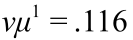 inch,
I have deduced the times of transpiration from theory on two suppositions as to the relation of µ to the density.
-
That
 or
 is constant
-
That μ is independent of ρ
It will be seen (see table next page) that the law of discharge is given almost exactly on the second supposition; and the absolute value is not so very different from the observed when it is considered that the resistance was doubtless much under-rated in assuming the base uniform, and that the numerical constant on which the whole depends was got from such a totally different class of experiments, namely exper[imen]ts on the effect of air on the time of vibration of a pendulum.
| Range of wire gauge | Time by Expt |
Time
|
by theory µ const. |
Time by theory Time by expt
|
µ const. |
| 28 to 24 | 213 | 72 | 127 | .338 | .596 |
| 24 to 20 | 227 | 85 | 135 | .375 | .592 |
| 20 to 12 | 549 | 239 | 325 | .435 | .592 |
| 12 to 8 | 388.5 | 189 | 228 | .488 | .587 |


Seeing that the effects of contractions of the bore, or even changing it without contraction to an elliptical form, and those of effusion so far as they may have been operative in a sensible manner, would both be to augment the observed times, it is hard to say how much, if any, of the observed deficiency (about 2/5ths of the whole) would remain to be explained (by a small finite slipping or otherwise) if the two named causes of retardation were got rid of.
The same conclusion, that µ is independent of ρ, I deduce independently from Graham’s two laws that the velocity of transpiration through a very long capillary of uniform bore into a vacuum, estimated at the density at the high pressure side, varies directly as the pressure and inversely as the length of the tube.
It is remarkable that Maxwell arrived at the same conclusion4—that µ is independent of ρ—in the speculations in which he assimilates gases to collections of enormous numbers of perfectly elastic balls moving about and impinging in all possible ways. It seemed to him however almost too paradoxical to admit.
As to the absorption of heat by air my notion was that possibly air changed very rapidly with a change of quality (refrangibility) of the radiant heat from highly opaque to highly diathermanous, so that it was only a proportionately small fraction of the whole initial radiation with respect to which air was moderately diathermanous, and which alone could be rendered sensible in such an experiment as that you mention. Likely or unlikely, such a view is I think conceivable.
Your conclusion about the transmission of heat (radiant heat) by a smoked plate of rock salt is so strange that one wishes for rather fuller details, to obviate a possible objection that the heat passed instantly through the salt, warmed the soot, and that radiated in all directions. If the plate were placed either very near the source or very near the pile such an effect might be produced to a sensible degree, but hardly if the plate were placed midway, a tolerable space intervening between the source & the pile. If it be true transmission, the galvanometer ought to tell the same tale wherever the plate were placed, supposing it large enough (or the source sufficiently limited) to intercept all the rays which fall on the pile. Or the amount of heat which is either scattered or absorbed and re-emitted by the soot might be measured separately by interposing a screen which should allow the pile to see the plate but not the source, and correcting for the angle of obliquity (multiply by the secant for the emitted part)
Yours very truly | G.G. Stokes
turn over
P.S. If the observed heat be scattered that would still imply diathermancy of soot but the effect could not be observed in the same way. To prove that it was not absorption and re-emission it would I think be satisfactory to show that a piece of silver foil blackened by soot on both sides and interposed as a screen in place of the blackened salt produced no, or only a trifling deflection of the galvanometer.
RI MS JT/1/S/229
RI MS JT/1/TYP/4/1381–3
I have been further considering: see letter 1848.
(Phil. Trans. 1846 p.603 Table XVII): T. Graham, ‘On the motion of gases,’ Phil. Trans., 136 (1846), pp. 573–631.
Baily’s: Francis Baily (1774–1844), British astronomer and stockbroker (ODNB)
Maxwell arrived at the same conclusion: J. Maxwell, ‘Illustrations of the dynamical theory of gases, part I’, Phil. Mag., 19 (1860), pp. 19–32.
Please cite as “Tyndall1852,” in Ɛpsilon: The John Tyndall Collection accessed on